Elon Musk Predicted a Die Off for 200 AI Neoclouds. CoreWeave’s Bonds Had Already Hit 15%.
Musk says debt markets have shut on companies that only rent out AI chips. The bond market reached that view before he posted it, and the bigger lesson is how much of the AI boom now runs on rented chips and borrowed money.
Last verified Also on Medium
On this page
- What Musk said, and when
- How a neocloud makes money
- How long a GPU really lasts
- CoreWeave is the biggest test case
- The secured loans and the bonds tell different stories
- Not every neocloud is in the same spot
- Lenders, Nvidia and the AI labs are all tied in
- Money is only half of the problem
- Musk has a stake in this fight
- The market was already moving
- The case against the doom
- What to watch next
- The lesson for anyone exposed to AI infrastructure
On October 25, 2026, Elon Musk posted that more than 200 AI cloud rental companies, the so called neoclouds, are headed for “guppy-level death and consolidation,” and that only a few will make it through. By Monday morning CoreWeave, Nebius and IREN were trading lower before the opening bell. CoreWeave, the biggest of the group, owed $35.6 billion at the end of June against $5.5 billion in unrestricted cash, and its unsecured bonds were already yielding around 15% to 16%. I want to walk through what Musk actually said, how the neocloud business works, why its problems reach lenders, Nvidia and the biggest AI labs, and why Musk is far from a neutral observer, because the numbers behind his warning were in plain sight 2 weeks before he posted it.
What Musk said, and when
Musk circled this corner of the AI trade for about 2 weeks, and each post was sharper than the last.
On October 12, Broadcom CEO Hock Tan told a conference in Singapore that many AI investors have no clue what they are buying and behave almost like casino gamblers. Musk replied to a post summarizing Tan’s remarks with 5 words, “No crying in the casino,” according to Benzinga. His point was that anyone who piled into the AI trade should not complain when the table turns.
On October 13, as yields on CoreWeave’s unsecured bonds approached 15%, venture capitalist Chamath Palihapitiya posted a warning about them. Musk replied with 1 word, “Yikes,” as The Wealth Advisor reported. The next day CoreWeave shares closed at $65.78, down 15.46%, while Nebius fell about 11% and Oracle about 9%, per ROIC.ai’s market report.
On October 25 came the full argument. Palihapitiya had posted a thread calling neoclouds disorganized and poorly capitalized, while adding that some are better than others. Replying to it, Musk wrote that over the past few weeks debt markets had almost entirely cut off money to any company without substantial revenue from outside AI data centers. He predicted the 200 plus neoclouds would see a wave of failures and mergers, and warned of “stranded compute in partially complete data centers,” as ITPro reported. Palihapitiya, in the thread Musk was answering, added that 2027 will be a turbulent year.
In the same thread he brought up SpaceX. He said SpaceX had closed about $40 billion of mostly callable debt to pay for GPUs arriving in the first half of 2027, and credited that to SpaceX being investment grade with Starlink and launch revenue behind it, according to InvestingLive. When traders asked whether he was talking prices down to buy cheap, he answered, “SpaceX is not buying any neoclouds. Pointless.”
How a neocloud makes money
A neocloud is a company that owns AI computing power and rents it out. The name separates firms like CoreWeave, Nebius, Lambda, Nscale and IREN from the established cloud giants, Amazon, Microsoft and Google, which the industry calls hyperscalers.
The model runs in 3 steps. First, the neocloud borrows money and spends it on Nvidia GPUs. That borrowing ranges from term loans to high yield bonds, which pay more interest because the lender takes more risk. Second, it rents those chips out on contracts that run for years, usually to the biggest names in tech. Third, it hands the chips and the contracts to its lenders as collateral, so if the neocloud cannot pay, the lenders take the hardware and the rental income attached to it.
The structure has a clear lineage. In August 2023, Magnetar Capital and Blackstone Tactical Opportunities jointly led a $2.3 billion loan to CoreWeave secured by its Nvidia chips and its contracts with Microsoft, with Coatue, DigitalBridge, BlackRock, PIMCO and Carlyle also taking part, as Wing VC’s history of GPU lending sets out. A $7.5 billion facility led by Blackstone followed in May 2024. In March 2026, CoreWeave closed an $8.5 billion loan backed by a Meta contract, the first chip backed loan to carry a full investment grade rating, anchored by Blackstone Credit & Insurance.
That Meta deal shows how lenders actually think. The loan priced at SOFR plus 225 basis points, with a fixed tranche at 5.9%, against roughly 870 basis points over SOFR on the 2023 deal. Lenders were pricing Meta’s credit far more than CoreWeave’s. Wing VC’s analysis puts it directly, the market is mostly pricing the customer and the contract length, with very little weight on what a used GPU is worth.
The weak spot is timing. Bloomberg reported that lenders structure these loans to be repaid over 5 or 6 years, roughly the period they expect the chips to hold their value, as summarized by Benzinga. Nvidia ships a new generation far faster than that, and each new generation cuts the rental price older chips can command. A neocloud can end up years into a loan, still making full payments on chips that earn much less than when it bought them.
How long a GPU really lasts
The accounting decides how big that problem looks. CoreWeave depreciates its GPUs and related equipment over 6 years, a schedule it lengthened from 5 years starting in 2023, according to its filings. Nebius moved from 4 years to 5 in 2026, and Amazon went the other way in 2025, cutting part of its server fleet from 6 years to 5 because AI hardware is changing faster, as IO Fund summarized.
Investor Michael Burry made the bear case in late 2025. He argued that GPUs have an economic life closer to 2 or 3 years, and that big AI spenders would understate depreciation by about $176 billion between 2026 and 2028 by assuming 5 to 6 years, according to Beancount’s explainer. The neoclouds have a real answer. CoreWeave said on its second quarter call that it had signed a contract running into 2029 for A100 chips that Nvidia launched in 2020, so a 6 year old GPU is still earning.
Both things can be true. Old chips can keep earning and still lose pricing power every time Nvidia ships something faster. The lender’s risk is about timing. One analysis of CoreWeave’s 2026 borrowing found that every instrument it raised in the first half matures by October 2032, with an average term of about 5.9 years against its 6 year equipment life, per Cape Fear Advisors. The debt and the chips are scheduled to wear out at about the same time, which leaves little room if rental prices fall faster than planned.
CoreWeave is the biggest test case
CoreWeave’s latest 10-Q shows the scale. Total debt principal was $35.6 billion at June 30, 2026, up from $21.6 billion 6 months earlier, and unrestricted cash was $5.5 billion, according to sec-api.io’s filing analysis. Cash covered about 15% of the debt. Reuters, using LSEG data with a broader definition, put CoreWeave’s debt closer to $50 billion by mid October.
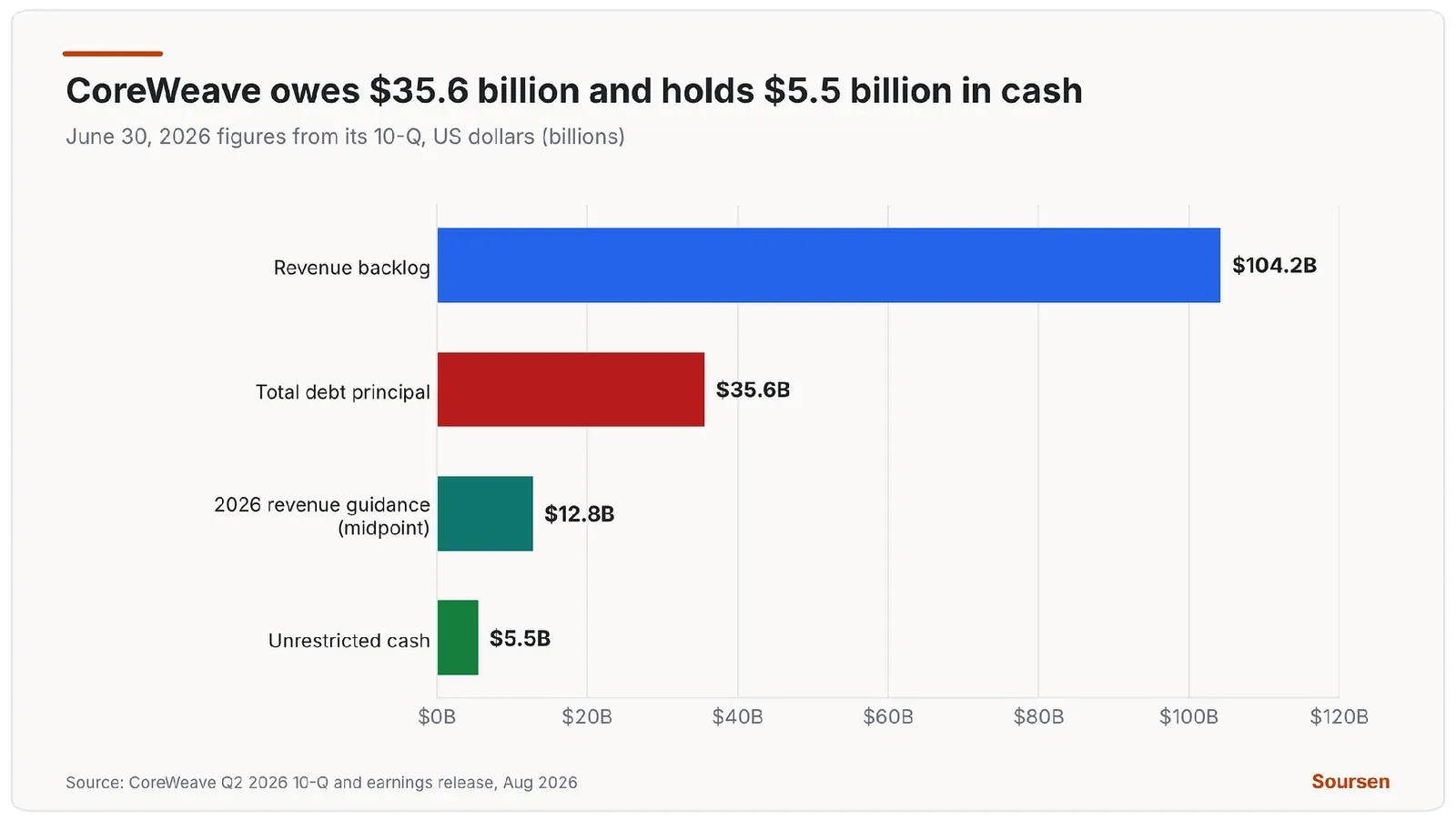
CoreWeave’s contracted backlog is large, and so is the gap between its debt and its cash. Source: CoreWeave Q2 2026 10-Q, Aug 2026
The company is growing fast and still losing money. Second quarter revenue was $2.58 billion, up 112% from a year earlier, but the net loss widened to $626 million, mainly because of about $640 million in quarterly interest expense, per StorageNewsletter’s results summary. CoreWeave guided 2026 capital spending at $35 billion to $39 billion, close to 3 times its expected revenue of $12.4 billion to $13.2 billion.
The bond market noticed. CNBC reported a 14.8% yield on CoreWeave’s 9.625% notes due July 2032 on October 14, and a 15.78% yield on its 9.75% notes due October 2031 the next day. By November 2, FINRA trade data showed every one of its 4 dollar bonds yielding between 14.93% and 15.83%, as FourWeekMBA tracked. The October 2031 notes last traded at 79.75 cents on the dollar, under the 80 cent line bond investors usually read as distress, and the 2032 notes sat just above it at 80.03. Together the 4 notes, with $7.75 billion of face value, were worth about $6.3 billion, roughly 81 cents on the dollar. Its convertible notes traded lower still, between about 64 and 73 cents.
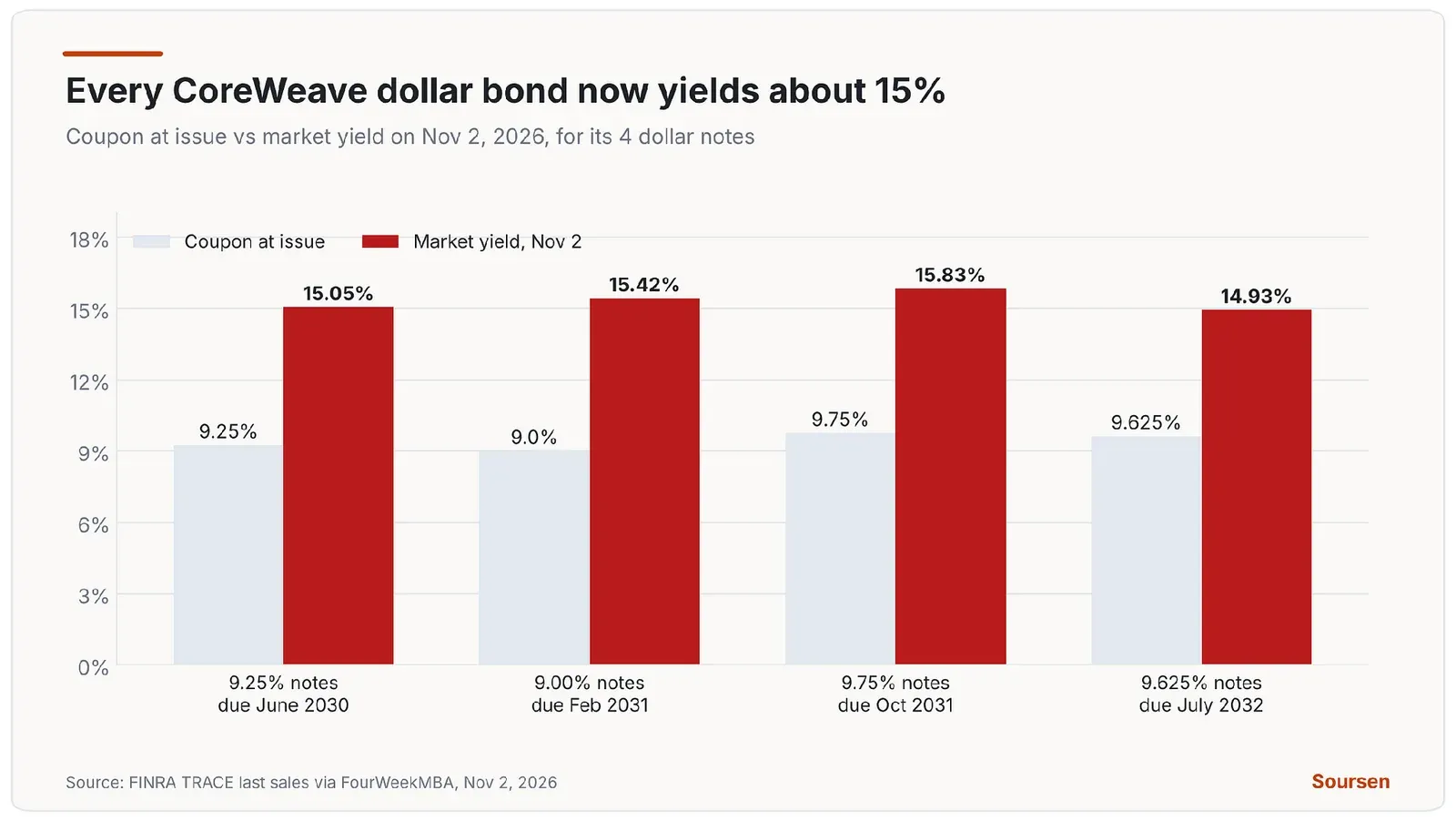
All 4 CoreWeave dollar bonds now trade at yields 5 to 6 points above the coupons they were sold at. Source: FINRA TRACE via FourWeekMBA, Nov 2026
Credit insurance told the same story. Reuters reported that credit default swaps on CoreWeave near 1,000 basis points implied roughly a 63% chance of default within 5 years, up from about 30% a year earlier. I would treat that as a market price for fear, since swap markets on a single company can be thin, but the direction is hard to argue with.
A 15% yield hurts a company that has to keep borrowing. If CoreWeave raised another $1 billion of unsecured debt at anything near today’s market yield, it would pay about $150 million a year in interest. At the original 9.625% coupon, the same $1 billion cost about $96 million. That extra $54 million a year, on every new billion, comes straight out of the cash that is supposed to pay for the next data center.
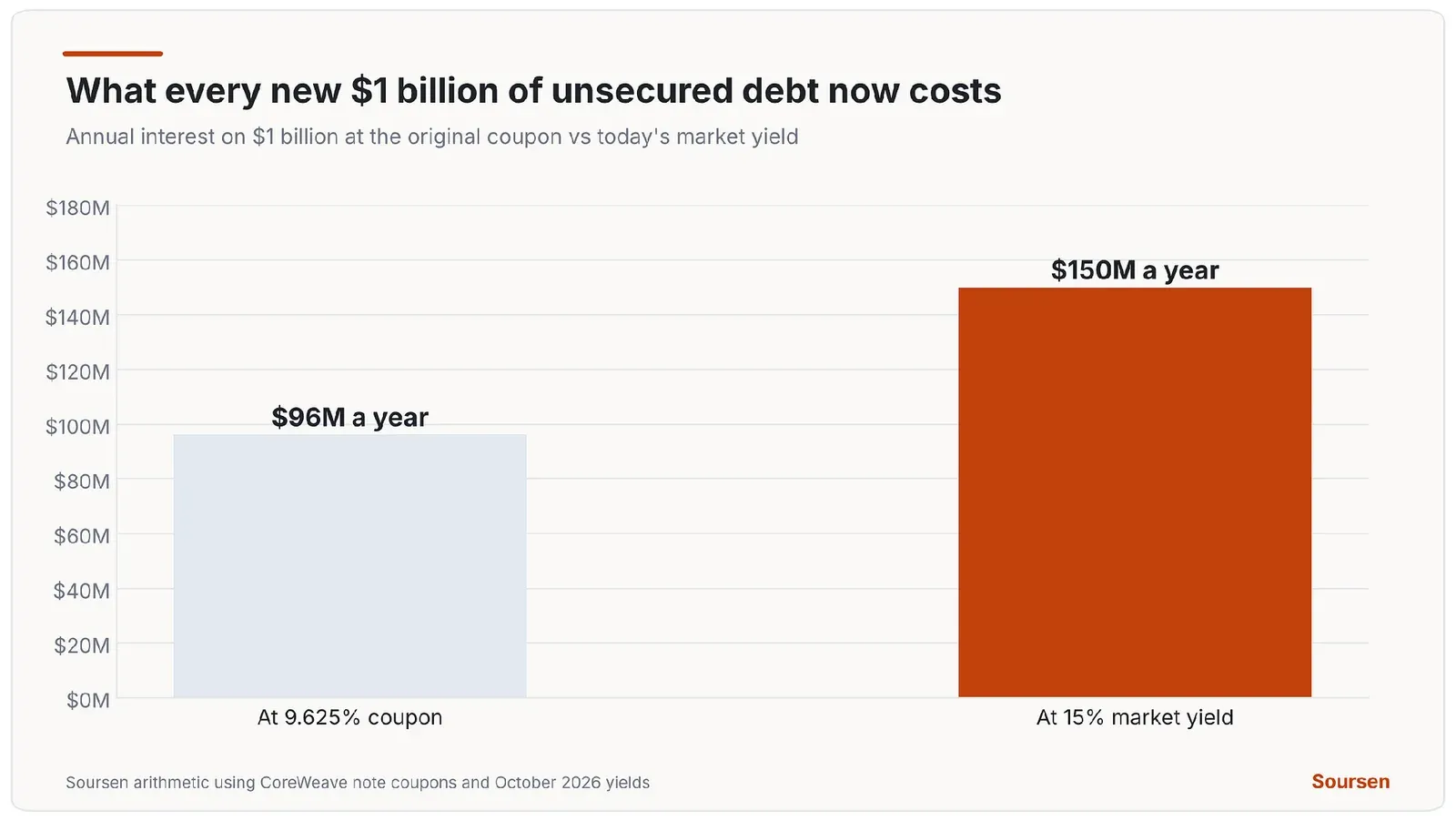
Annual interest on each new $1 billion of unsecured debt at the original coupon and at October’s market yield. Source: Soursen arithmetic, Nov 2026
CoreWeave’s defence is its order book. Revenue backlog was $104.2 billion at June 30, up from $99.4 billion in March, and the company said it signed more than $25 billion of new commitments in the first weeks of the third quarter, according to Reuters via The Star. Meta added $21 billion during the second quarter, Anthropic signed a multiyear deal in April and OpenAI has contracted up to about $22.4 billion in total.
A backlog is a promise of future revenue, and CoreWeave still has to build, power and equip the data centers before most of it turns into cash. It also had $35.5 billion of payments on leases signed but not yet started at June 30. Near term revenue is concentrated too. CoreWeave’s 2025 annual filing shows its largest customer, Microsoft, generated 67% of revenue, up from 62% in 2024.
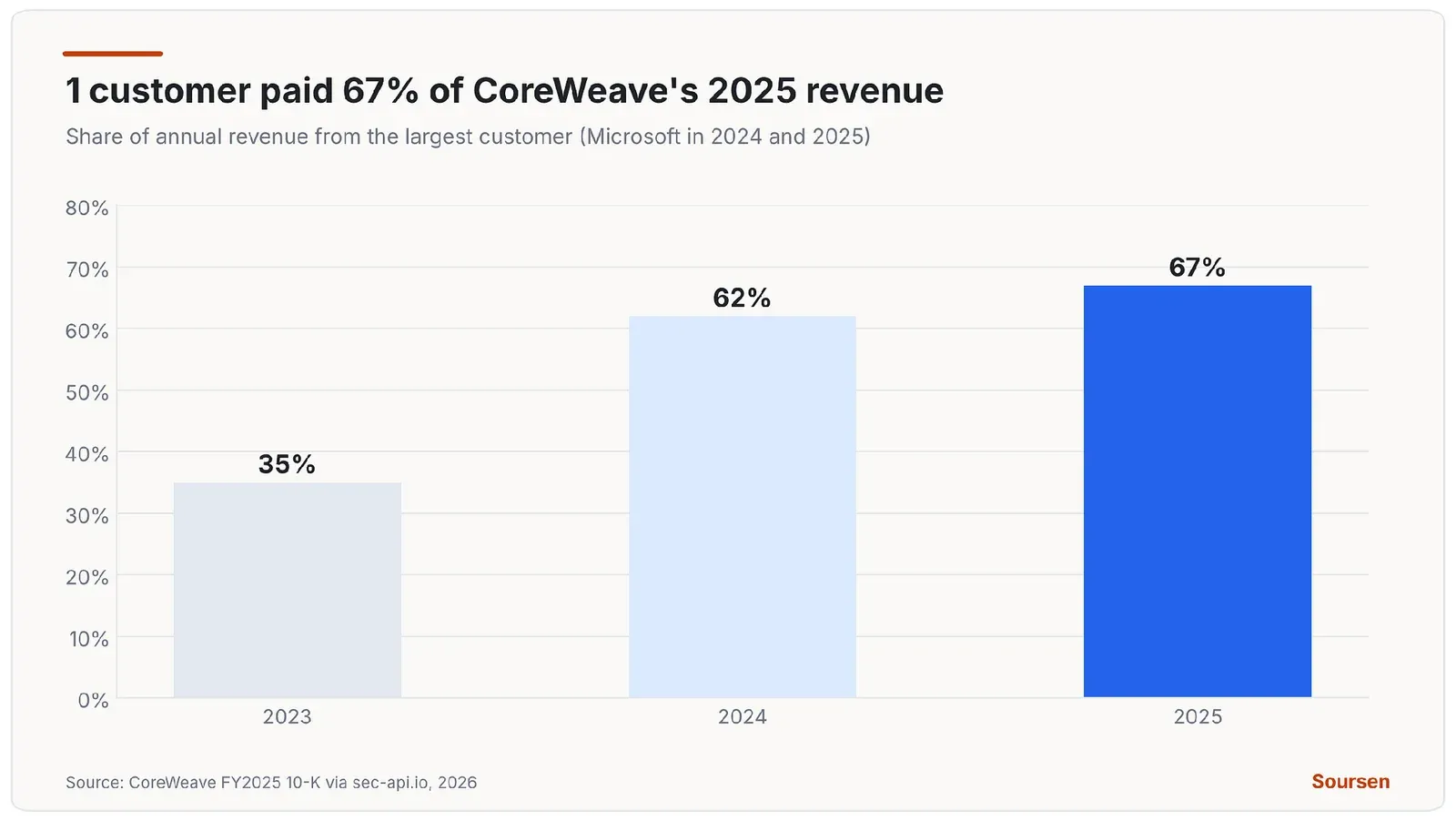
CoreWeave’s dependence on its largest customer has grown each year since 2023. Source: CoreWeave FY2025 10-K via sec-api.io, 2026
CoreWeave is looking for cheaper money. Brannin McBee, one of its founders, told the Financial Times on October 14 that the company wants investment grade ratings on more of its chip backed debt, and eventually on CoreWeave itself, so it can tap insurance company capital, a pool he described as “unlimited,” per Dealroom’s summary. He also said contracts with AI labs, which lack investment grade ratings, are not yet ready for that market.
The secured loans and the bonds tell different stories
CoreWeave’s 2 kinds of debt are behaving very differently. Its chip backed loans, secured on GPUs and tied to customers like Meta and Microsoft, have stayed close to face value. Its unsecured bonds, which rank behind those loans and depend on CoreWeave as a company, are the ones trading near 15%, as Benzinga reported citing Bloomberg.
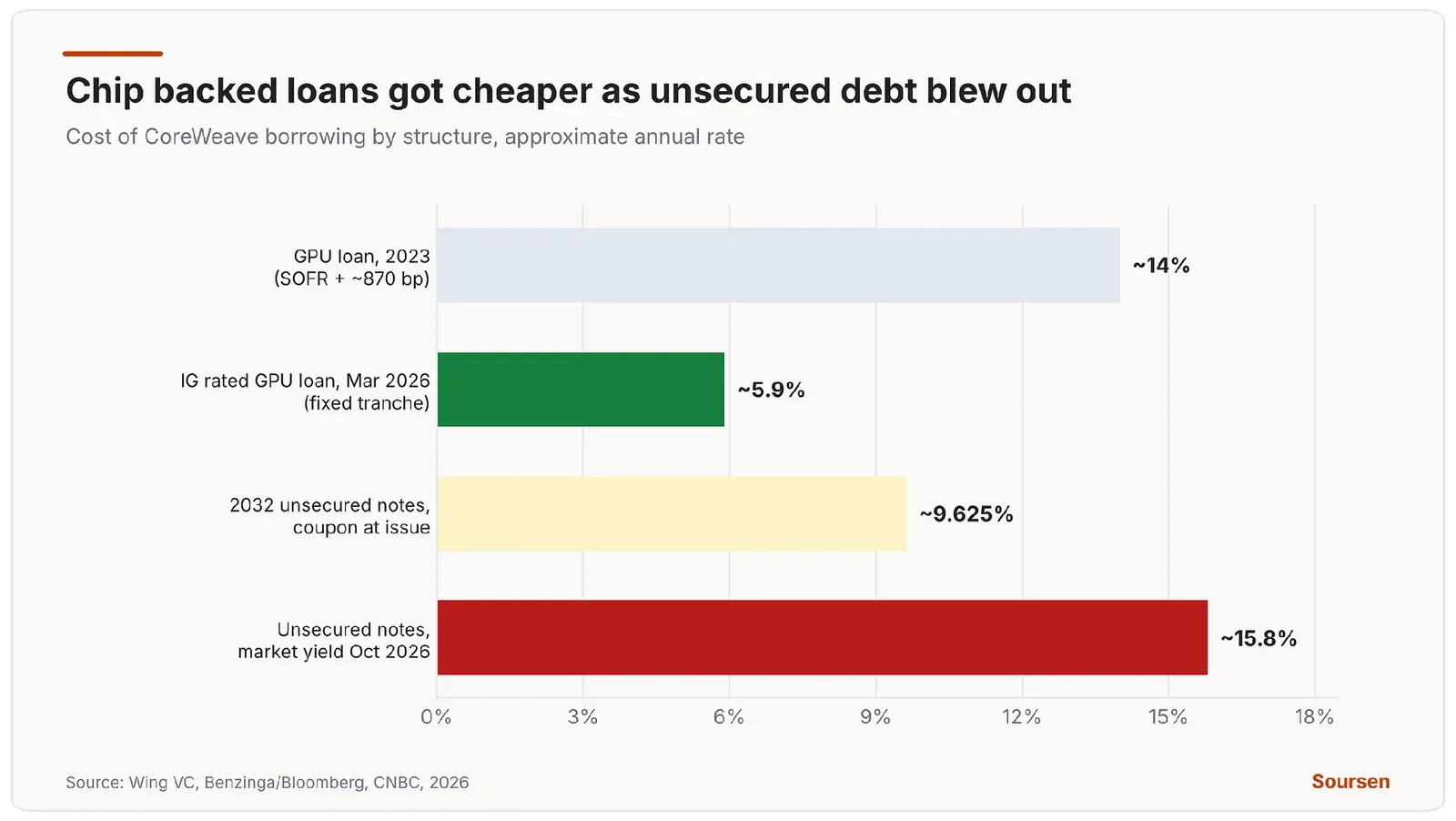
What CoreWeave pays depends on whose credit backs the debt. Rates are approximate. Source: Wing VC, Benzinga/Bloomberg, CNBC, 2026
That split matters for Musk’s argument. Lenders still fund GPUs that sit behind a contract with an investment grade customer. The money that has dried up is the money that bets on the neocloud itself, which is exactly the kind of money that the smaller players depend on.
Not every neocloud is in the same spot
Musk himself said some will make it, and the balance sheets back that up. Nebius, the Amsterdam based neocloud, ended June with $8 billion in cash and generated $2.3 billion of operating cash in the second quarter, largely because about 70% of the deals it closed included an upfront customer prepayment. It expects more than $9 billion of prepayments in 2026, which it says will cover 50% to 60% of the related capital spending, according to Rivkin’s results summary.
On October 22, 3 days before Musk said the debt markets were shut, Nebius announced a $3.5 billion senior secured facility from Citi. It carries an initial rate of SOFR plus 2.75%, rising to as much as 3.50%, and matures on October 16, 2027, per FourWeekMBA. That is a 364 day loan funding assets that will run for years, so Nebius will have to refinance it within 12 months. The door is still open for some borrowers, on shorter and tighter terms.
Even Nebius felt the squeeze. Its CEO acknowledged on October 26 that some capital sources were temporarily closed, Benzinga reported.
Below CoreWeave and Nebius sits a long tail of smaller operators, many of them former bitcoin miners such as IREN, Cipher Mining, Hut 8 and TeraWulf that pivoted to renting AI chips, plus private players like Lambda, Nscale and Fluidstack. Many have thin backlogs and little cash. Those are the guppies Musk meant.
Lenders, Nvidia and the AI labs are all tied in
The neocloud problem reaches well past the neoclouds, through 3 links.
The first is the lenders. Private credit funds, which lend directly to companies outside the banking system, financed much of the build. Blackstone, Magnetar, BlackRock, PIMCO, Carlyle and Apollo all appear in GPU financing deals, and Apollo and Blackstone announced a $35 billion package to finance chips for Anthropic in June. Carlyle has estimated private credit may need to fund about $1 trillion of the AI computing build out, according to Private Equity Wire. The collateral behind much of it is GPUs, the same chips that lose value with every new Nvidia release.
The second is Nvidia. It sells chips to the neoclouds, it owns equity in several of them and it has promised to buy back unused capacity. Nvidia invested $2 billion of equity in CoreWeave in January 2026, IFR reported, and it has agreed to buy any of CoreWeave’s unsold capacity, up to $6.3 billion, through April 13, 2032. In August it signed agreements with Apollo, BlackRock, Blackstone, Brookfield, Goldman Sachs and KKR for financing platforms targeting $500 billion, keeping the option to backstop up to $125 billion itself, per Capacity Global. Nvidia sells the chips, owns part of the buyer and promises to rent the chips back if nobody else will.
The third is the customers. Microsoft, Meta, OpenAI and Anthropic all rent capacity from CoreWeave alone, and Google has backed lease deals between AI developers and former bitcoin miners turned neoclouds, as Wing VC notes. Part of the computing power behind the companies that define the AI trade sits on someone else’s borrowed money.
Put the loop together and the word bubble starts to fit. Lenders fund the neoclouds, the neoclouds buy from Nvidia, the AI labs rent from the neoclouds and the labs’ growth is what convinced lenders to fund the neoclouds in the first place. A large share of the AI build out is rented, and the rent is underwritten by debt that got more expensive this month.
Money is only half of the problem
Musk made a second point that got less attention. He argued that raising money for data centers is the easier part, and that delivering power, cooling and networking is harder. In a separate post he said even SpaceX, with what he called a “super cracked team,” finds it very difficult, according to Benzinga via Longbridge.
The scale is enormous. Close to $700 billion is projected to go into data centers in 2026, and roughly 40% of it pays for buildings, power and other physical infrastructure, according to Channelchek. A modern AI data center needs a grid connection, liquid cooling to keep the chips from overheating and networking to tie thousands of them together. Each runs on its own timeline. A neocloud can have the chips, the loan and the customer contract and still lack a building that can switch them on. Interest keeps running and the chips keep depreciating while the revenue waits for a power line. That is the “stranded compute” Musk was warning about.
Musk has a stake in this fight
Musk is far from a bystander. SpaceX acquired xAI in an all stock deal in February 2026 that valued the combined company at about $1.25 trillion, as Sacra documented, and its AI unit now rents out computing capacity to outside customers, including compute deals with Anthropic and Google, as INDmoney reported. That puts SpaceX in direct competition with the neoclouds for chips, for electricity, for customers and for lenders willing to finance GPUs. Borrowing billions against GPUs is exactly what the neoclouds do, and Musk’s argument rests on persuading lenders that SpaceX is a different kind of borrower.
The $40 billion itself is less settled than Musk’s post suggested. SpaceX’s own SEC filing describes a proposed equipment finance lease, in which an entity managed by Apollo Global Management would buy the GPUs and lease them to SpaceX over about 5 years, according to IBTimes. SpaceX signed a binding commitment letter on October 24, the day before Musk’s post, but the filing says the master lease has yet to close and pricing has not been set. Deliveries are expected to start in the first half of 2027. Structurally, that is a GPU backed financing with a lender holding the chips, which is the same basic tool the neoclouds use, with SpaceX’s credit standing behind it.
There is a second possible motive. Musk has been in a legal fight with OpenAI since 2024, and OpenAI relies heavily on outside computing, including up to about $22.4 billion of commitments with CoreWeave. Pressure on the neoclouds is pressure on a rival’s supply line. When traders accused him of talking his own book, his answer was about acquisitions, which sidestepped the question about competition.
A motive does not decide whether a claim is true, though. The yields, the debt loads and the contracts stand or fall on their own.
The market was already moving
Most of the stress Musk described showed up before his October 25 post. CoreWeave’s bonds crossed 15% on October 13. On October 14, Gartner forecast that more than 80% of neocloud providers will stop operating independently by 2030, through failure, acquisition or merger, and that over $3.5 trillion of AI infrastructure spending could be exposed to impairment by the end of that year, as Network World reported. Gartner also ranked CoreWeave as the most exposed to debt among roughly 100 neoclouds it tracks, per Capacity Global. Rate hike fears were hitting AI debt at the same time, 24/7 Wall St. reported.
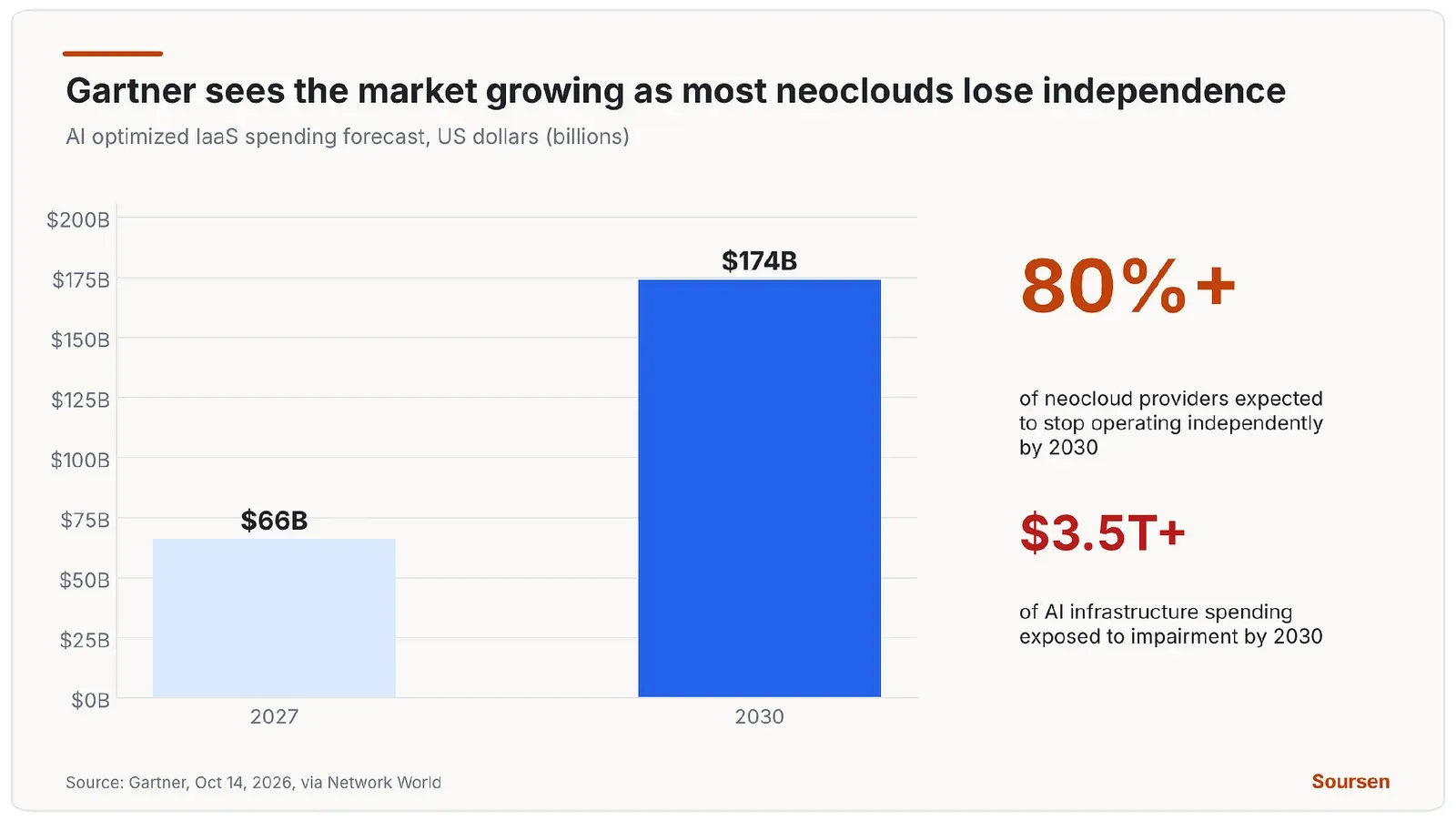
Gartner expects spending to keep rising even as most neocloud providers lose their independence. Source: Gartner via Network World, Oct 2026
Gartner’s forecast is a consolidation call. It also expects spending on AI optimized cloud infrastructure, the market neoclouds sell into, to rise from $66 billion in 2027 to $174 billion in 2030. The market keeps growing. Fewer independent companies share it.
By the time Musk posted, CoreWeave, Nebius and IREN had each lost between 33% and 39% of their value in October, according to CoinCentral. On Monday, October 26, Reuters reported CoreWeave down 4.5% in early trading, Nebius down 3.4% and IREN down 3.3%, and short sellers betting against the group had made at least $6 billion in paper profits, via BusinessDay. By that afternoon the shares had recovered above Friday’s close, even as CoreWeave’s 2033 bonds and Nebius’ 2034 bonds hit record lows, FourWeekMBA noted. Musk’s post moved prices for a morning. The bonds had been falling for 2 weeks. CoreWeave stock closed at $89.62 on October 2 and was trading near $50 on November 2, a fall of about 44% in a month.
The case against the doom
Plenty of serious people disagree with Musk. Nvidia CEO Jensen Huang told Bloomberg in Stockholm on October 15 that “CoreWeave’s strength is improving every day,” that its cost of capital is falling and that he sees no need for Nvidia to backstop it, per Bloomberg Government. Huang has also said demand is off the charts and that the shortage is capital, which is close to Musk’s diagnosis with the opposite conclusion.
Goldman Sachs analyst Gabriela Borges upgraded CoreWeave from Neutral to Buy on October 19, cutting her price target from $139 to $106. Goldman argued that most of CoreWeave’s financing comes through GPU backed loans and that any rise in its cost of capital should be limited to 100 to 200 basis points, according to Crypto Briefing.
Musk softened his own tone at one point. About a week after “Yikes,” he called the computing shortage “ridiculous” and pointed to customers demanding more capacity, The Wealth Advisor reported. Demand and financing are separate questions, and both sides of this argument agree demand is strong.
What to watch next
CoreWeave reports third quarter results on Tuesday, November 10, 2026, after the market closes, the company said. Management has guided third quarter interest expense to $860 million to $940 million, up from $640 million in the second quarter, and is targeting annualized revenue of $18.5 billion to $19.5 billion by the end of 2026, according to Earnings Whispers. The interest line is the one I would read first, since it shows what the October repricing does to a company that has to keep borrowing.
The other things to watch are whether CoreWeave lands an investment grade rating on more of its chip backed debt, whether Nebius refinances its Citi loan before October 2027, and whether SpaceX’s $40 billion lease closes and on what terms.
The lesson for anyone exposed to AI infrastructure
2 things from this generalize past the neoclouds. The first is that the bond market priced this risk before the loudest voice in tech did. CoreWeave’s unsecured notes were at 15% on October 13, and anyone watching yields, credit default swaps and the gap between secured and unsecured debt had 2 weeks of warning. If you hold AI infrastructure stocks, track the bonds of the companies you own alongside the share price.
The second is that a backlog only protects a lender or shareholder once it turns into cash, and that depends on power, buildings and a customer list wider than 1 company. Before you buy or lend to any neocloud, check 4 numbers in its latest filing, which are cash against total debt, the share of revenue from its largest customer, how much of its debt matures within 12 months and how much of its backlog is tied to customers rated investment grade.
Sources
- Elon Musk Fires Back at Broadcom CEO Hock Tan’s AI Investment Warningbenzinga.com. Accessed 8 November 2026.
- Neocloud market set for brutal consolidation, Elon Musk warnsitpro.com. Accessed 8 November 2026.
- Musk says SpaceX closed $40 billion GPU debt deal, predicts neocloud shakeoutinvestinglive.com. Accessed 8 November 2026.
- Elon Musk predicts guppy level death for cloud rivals as SpaceX secures $40B debtibtimes.co.uk. Accessed 8 November 2026.
- CoreWeave 2026 revenue analysis and customer concentrationsec-api.io. Accessed 8 November 2026.
- CoreWeave’s $7.75B of Dollar Bonds Now Trade Near $6.3Bfourweekmba.com. Accessed 8 November 2026.
- Nvidia’s Huang says no backstop needed for CoreWeaveroic.ai. Accessed 8 November 2026.
- CoreWeave boosts 2026 spending plan, beats quarterly estimatesthestar.com.my. Accessed 8 November 2026.
- Nebius Fiscal 2Q26 Financial Resultsstoragenewsletter.com. Accessed 8 November 2026.
- CoreWeave wants investment grade ratings to tap insurance moneydealroom.co. Accessed 8 November 2026.
- How the GPU Became Collateralwing.vc. Accessed 8 November 2026.
- Blackstone’s $2.3 Billion CoreWeave Bet Sparked a Trillion Dollar AI Lending Boomwebull.com. Accessed 8 November 2026.
- CoreWeave debt selloff raises concerns over private credit’s AI exposureprivateequitywire.co.uk. Accessed 8 November 2026.
- Nebius gets $3.5B from Citi in a 364 day secured facilityfourweekmba.com. Accessed 8 November 2026.
- Nebius Group Q2 2026 resultsrivkin.com.au. Accessed 8 November 2026.
- Nvidia throws US$2bn lifeline to under fire CoreWeaveifre.com. Accessed 8 November 2026.
- Nvidia now agrees to rent back unused GPU capacity from neocloud operatorscapacityglobal.com. Accessed 8 November 2026.
- Why SpaceX acquired xAIsacra.com. Accessed 8 November 2026.
- Gartner warns $3.5T in AI infrastructure spending could be at risk by 2030networkworld.com. Accessed 8 November 2026.
- Neocloud consolidation explainedcapacityglobal.com. Accessed 8 November 2026.
- CoreWeave leads tech selloff after Musk’s consolidation warningbusinessday.co.za. Accessed 8 November 2026.
- Neocloud Stocks Recover From Musk Warning as Bonds Hit Lowsfourweekmba.com. Accessed 8 November 2026.
- Nvidia CEO Downplays CoreWeave Concernsnews.bgov.com. Accessed 8 November 2026.
- Nebius Vs CoreWeave, Which AI Stock Has the Upper Handio-fund.com. Accessed 8 November 2026.
- GPU cloud unit economics and depreciation schedulesbeancount.io. Accessed 8 November 2026.
- CoreWeave, Twenty Seven Yearscapefearadvisors.substack.com. Accessed 8 November 2026.
- CoreWeave Q2 2026 earnings and backlogdashboard.channelchek.com. Accessed 8 November 2026.
- How SpaceX’s AI problem became a $26B Google and Anthropic dealindmoney.com. Accessed 8 November 2026.
- Gartner, 80% of neocloud firms face extinction by 2030247wallst.com. Accessed 8 November 2026.
- CoreWeave Q3 2026 conference call datebenzinga.com. Accessed 8 November 2026.
- CoreWeave’s margin inflection faces its first testearningswhispers.com. Accessed 8 November 2026.
- Goldman Sachs upgrades CoreWeave to buycryptobriefing.com. Accessed 8 November 2026.
- Elon Musk Said Yikes and AI Stocks Crashed. Now He Says the Shortage Is Ridiculousthewealthadvisor.com. Accessed 8 November 2026.
Related stories
AI & GPU compute
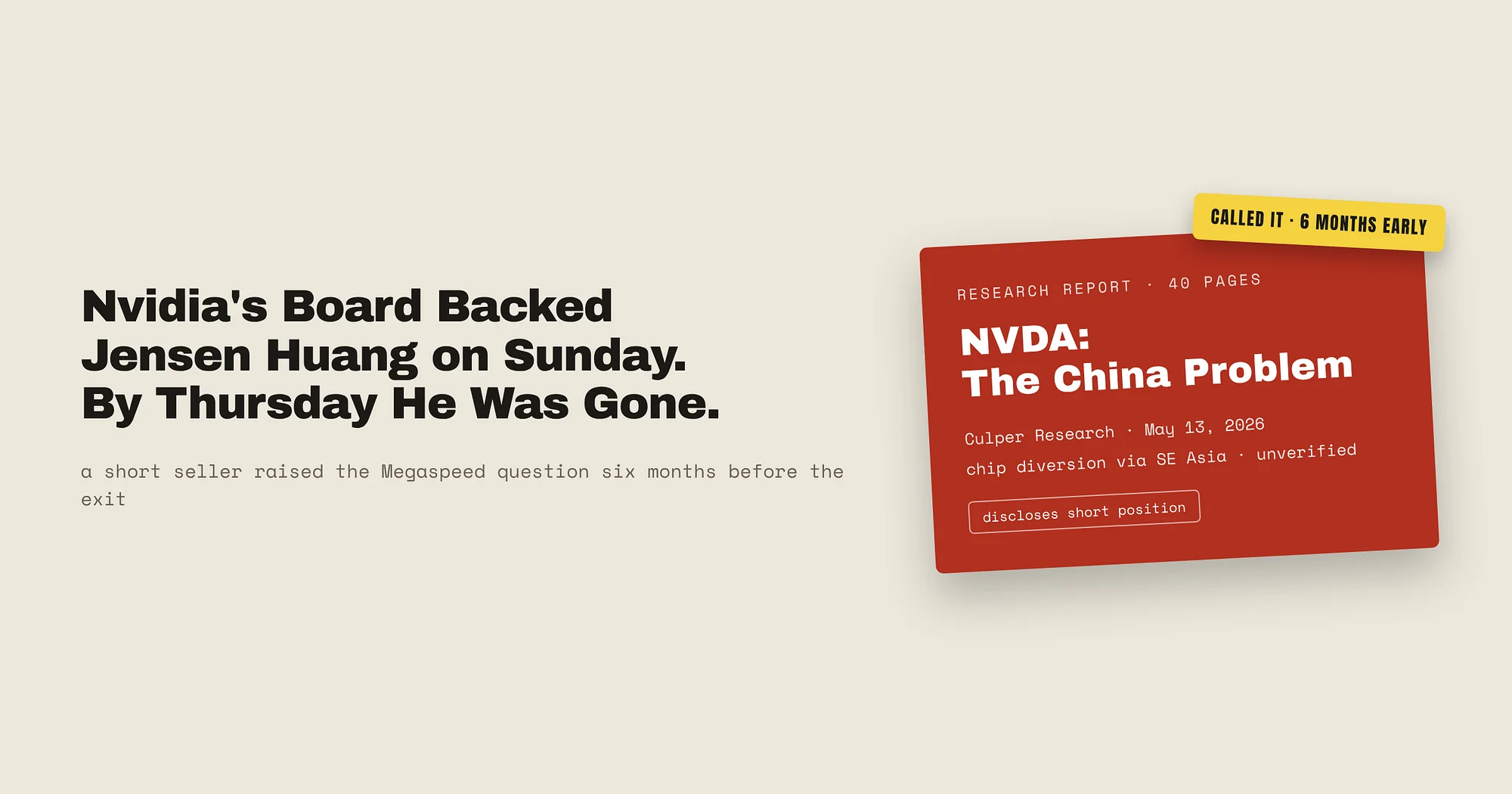
Nvidia’s Board Backed Jensen Huang on Sunday. By Thursday He Was Gone.
Four days after Nvidia’s board said it had confidence in its CEO, Jensen Huang resigned. A short seller had flagged the Megaspeed connection 6 months earlier, and most of the story rests on anonymous US officials, so I separate the filed facts from the allegations.
AI & GPU compute
Microsoft Filed a Patent to Rewrite What You Say Live and Redraw Your Lips
Application US 2026/0341309 A1 describes swapping words in live video within 1 to 10 seconds, tailored to each viewer’s profile. The main claim says nothing about telling viewers, no patent has been granted, and nearly every piece of the idea already ships somewhere.
AI & GPU compute
GPT-6 Astra Read Another Model’s Raw Weights and Fixed It by Hand.
MIT researchers had GPT-6 Astra edit 0.016% of a small model’s weights, with no training, and its math score jumped from 7.9% to 48.1%. The number is real and the method is strange. The limit they found in the same paper is the part worth understanding.