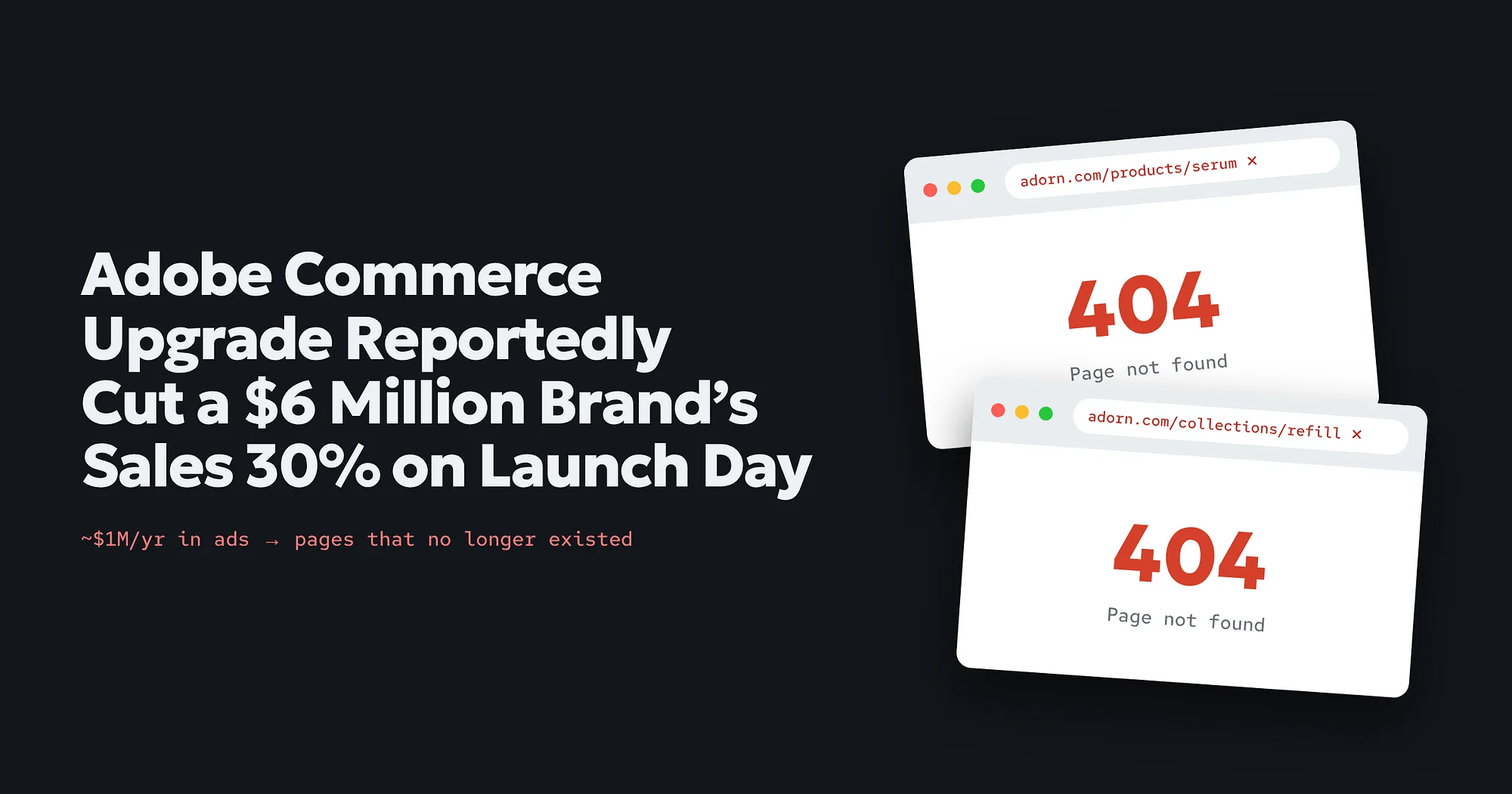
Adobe Commerce Upgrade Reportedly Cut a $6 Million Brand’s Sales 30% on Launch Day
Founder Briony Kennedy says a website migration cut sales by about 30% and broke roughly $1 million a year in ads. Adobe will not comment. The $150 million Adobe settlement in the headlines concerns consumer subscriptions and has no stated link to her contract.
Last verified Also on Medium
On this page
- What Briony Kennedy says happened
- Adobe and the agency have said almost nothing
- The platform she started on was already free
- The 34% to 94% promise has no public source I can find
- How a launch can break $1 million of ads
- The $150 million settlement is a different case
- Responsibility is still an open question
- 2 things from this generalize
On November 8, 2026, 7NEWS Australia reported that Adorn Cosmetics, a Melbourne skincare company that once turned over about $6 million a year, was about to close. Founder Briony Kennedy told the network her troubles began when she moved her online store to Adobe’s ecommerce platform. She laid off staff, sold her family home, rebuilt the store on Shopify, and says it came too late. I want to walk through what she claims, what the public record backs up, and what remains unknown, because this story is being passed around as a lesson about Adobe when the evidence supports a narrower and more useful lesson about launching a store.
What Briony Kennedy says happened
Adorn sells refillable, recyclable and biodegradable skincare, mostly to mature aged women, and Kennedy started it in 2009 as a new mother of twins, according to Adobe’s own case study of the company. Her account to 7NEWS has 5 parts. Adobe convinced her to leave a basic free website for a paid ecommerce platform. Adobe quoted revenue increases between 34% and 94%. A Melbourne agency named Convert Digital did the implementation. When the new site launched, sales fell by about 30%, and roughly $1 million a year of Instagram and Facebook advertising stopped sending shoppers to the website.
She says she was not allowed out of the contract. She says she wanted the move for security and expected it to lift sales. After the family home was sold and the staff were let go, she abandoned the Adobe site, started again on Shopify, and was left with debt and a looming bankruptcy. Her closing advice to other owners was short, and I think it is the most quotable line in the report. She told viewers “Don’t chase the new shiny thing.” The 7NEWS Melbourne post summarizes the story in 2 sentences, and every figure in it comes from Kennedy herself.
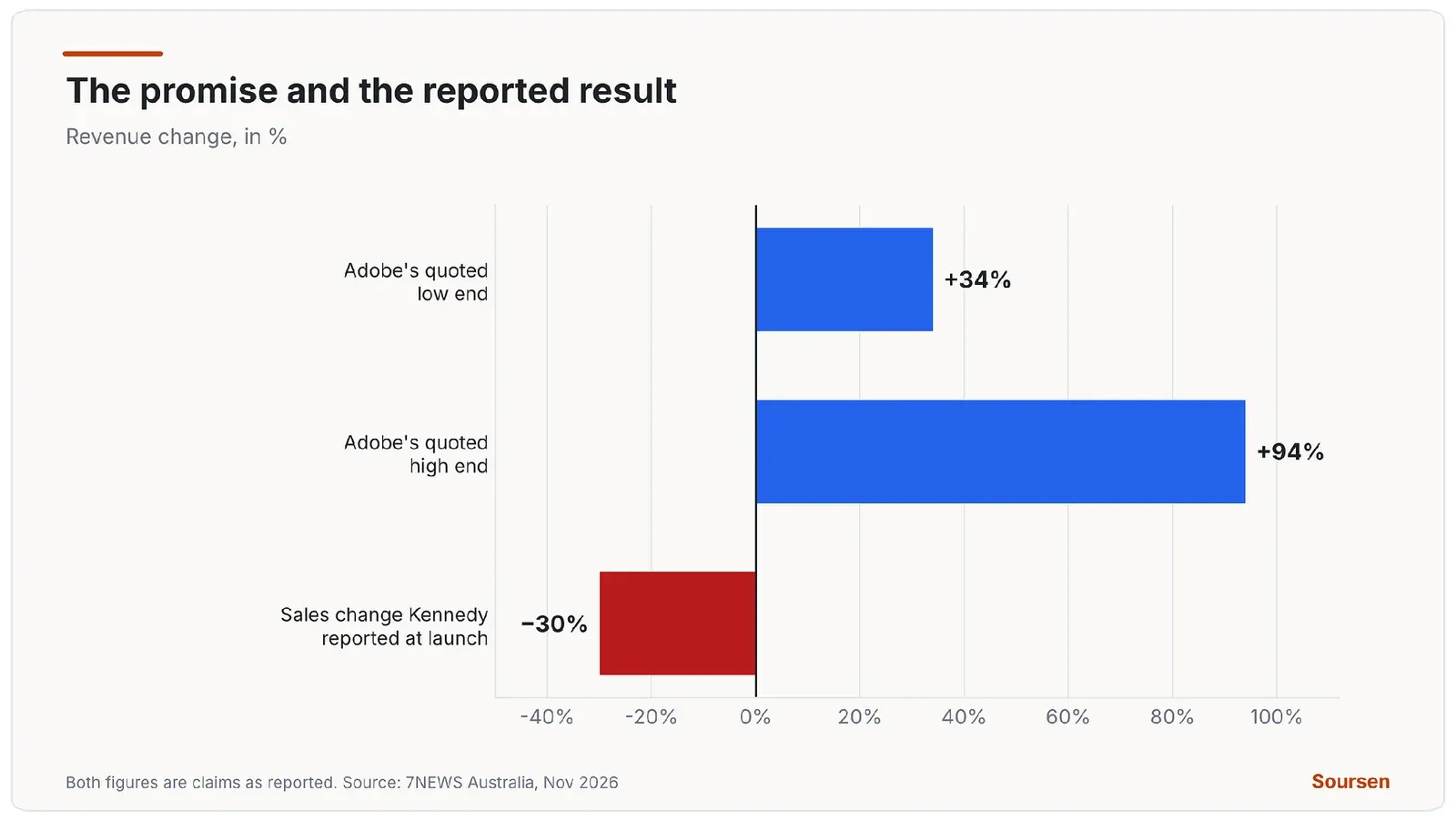
The projected revenue gain Adobe is said to have quoted, next to the sales change Kennedy reports at launch. Source: 7NEWS Australia, Nov 2026
Adobe and the agency have said almost nothing
An Adobe spokesperson told 7NEWS the company would not comment on the case for legal reasons, and the report says a mediation attempt between the parties failed. Convert Digital is named in the report as the implementation partner, and I found no public statement from the agency in any coverage I read. That leaves a one sided record. The report gives no dates for the contract, the launch or the move to Shopify. It gives no baseline or time window for the 30% drop. It does not say whether a formal insolvency process has started, and PPC Land’s analysis of the report lists the sales decline, the $6 million turnover and the $1 million ad spend among the figures with no supporting data in public.
None of that makes Kennedy wrong. A founder describing her own losses is a primary source for her own experience. It does mean every number in this story is a claim, and I have treated each one that way.
The platform she started on was already free
The detail that changed how I read the story is the starting point. B&T reported in September 2021 that Adorn had used an open source version of Magento since launch, and was upgrading to Adobe Commerce. Adobe bought Magento in 2018 for a reported $1.68 billion, and the free edition is now called Magento Open Source. Dotdigital’s case study says Adorn moved to Magento 2, now branded Adobe Commerce, in 2021, and built a stack around it with Dotdigital for email and Yotpo for reviews.
Adobe’s case study listed what the upgrade was meant to deliver. Search across ingredients and accreditations, a loyalty program beyond a simple spend and reward plugin, stock levels that sync with inventory, and PCI compliance with security scanning. It cited about 75,000 Facebook followers and 20,000 Instagram followers, and B&T put the social following near 100,000. Those are real assets for a brand selling direct to shoppers.
Adobe does not publish Adobe Commerce prices. MGT Commerce’s 2026 breakdown estimates licenses starting around $22,000 a year for the on premise edition and around $40,000 a year on Adobe’s cloud, rising with sales volume. Open Source costs nothing in license fees, and free software still needs hosting, development and security patching. scandiweb’s cost guide offers planning anchors and says they are not quotes. It puts a straightforward Open Source build at $20,000 to $60,000, an Adobe Commerce initial build at $60,000 to $500,000 or more, and annual maintenance at roughly $4,000 to $25,000 for Open Source and $15,000 to $50,000 for Adobe Commerce.
Those are ranges from public guides, and nobody has published Adorn’s actual bill. They do show that moving up an edition adds a license fee and a project budget to a business that was already running.
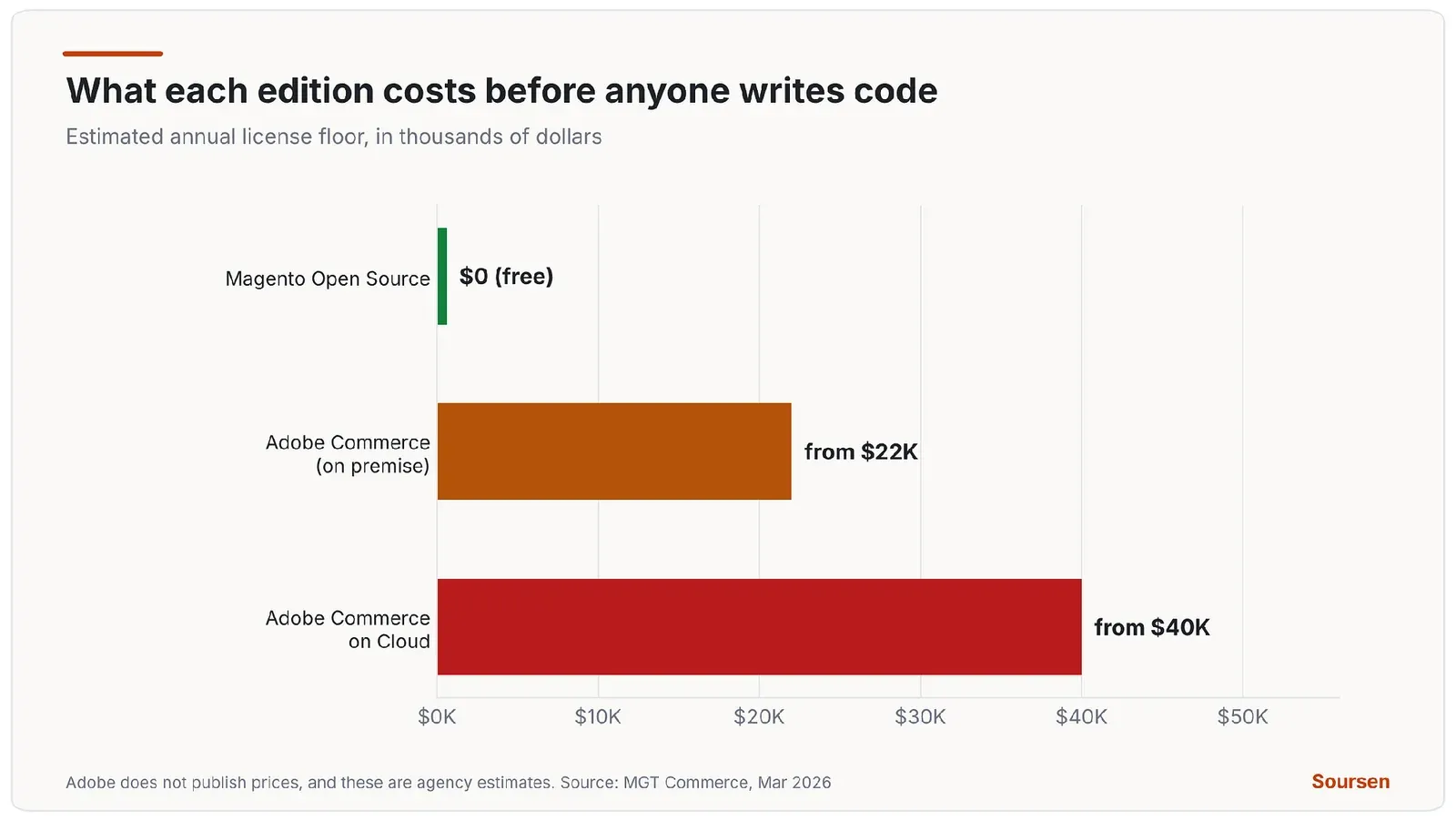
Estimated annual license floor for 3 Magento editions. Adobe does not publish its prices. Source: MGT Commerce, Mar 2026
The 34% to 94% promise has no public source I can find
The revenue range is the claim I most wanted to verify. I could not find 34% to 94% in Adobe’s case study or in the B&T report, and PPC Land reached the same result. It notes that an Adobe sponsored IDC study listed in December 2021 reported 29% higher platform revenue for Adobe Commerce users, which is a different number from a different kind of document. Kennedy may have received the range in a sales pitch or a proposal, and a private document would not show up in public searches. Until someone publishes it, the range stays an attributed claim.
Sales projections like this deserve scrutiny in any platform deal. Ranges like this typically summarize past customers, and they say nothing about what happens to a particular store in its first month after launch. A store that loses 30% at launch and a store that gains 94% a year later can both appear in the same average.
How a launch can break $1 million of ads
Kennedy’s most specific claim is that her ads stopped linking to the website. The report does not say why, and PPC Land lists the usual suspects without confirming any of them. Product URLs may have changed. Product feed links may have gone out of date. Tracking may have broken. I can tell you how that failure usually works, as long as you read it as a general mechanism and not a finding about Adorn.
Every ad is a link to a specific address on your site. A platform move often changes those addresses, because the new system builds product and category paths its own way. If the old addresses are not mapped to the new ones, each ad click lands on an error page, and what happens next depends on the ad platform. Google Ads’ Destination not working policy disapproves ads whose landing page returns an error such as a 404, which stops the spend and the sales together. I could not confirm how Meta’s systems handle the same failure, and Kennedy’s ads ran on Instagram and Facebook. She puts her ad spend at about $1 million a year, which works out to roughly $2,740 a day and about 17% of her reported $6 million peak turnover. If a platform kept charging for clicks that hit error pages, a week of that would cost about $19,000, before counting the sales that never happened.
The same mapping problem hits search traffic. Google’s guidance for site moves says to set up a permanent 301 redirect from every individual page on the old site to its equivalent on the new one, and to keep those redirects in place for at least a year. Google’s site move guide also says permanent redirects do not cause a loss in PageRank. Search Engine Journal’s Ask an SEO column calls missing or incorrect redirects one of the top causes of traffic loss after a migration.
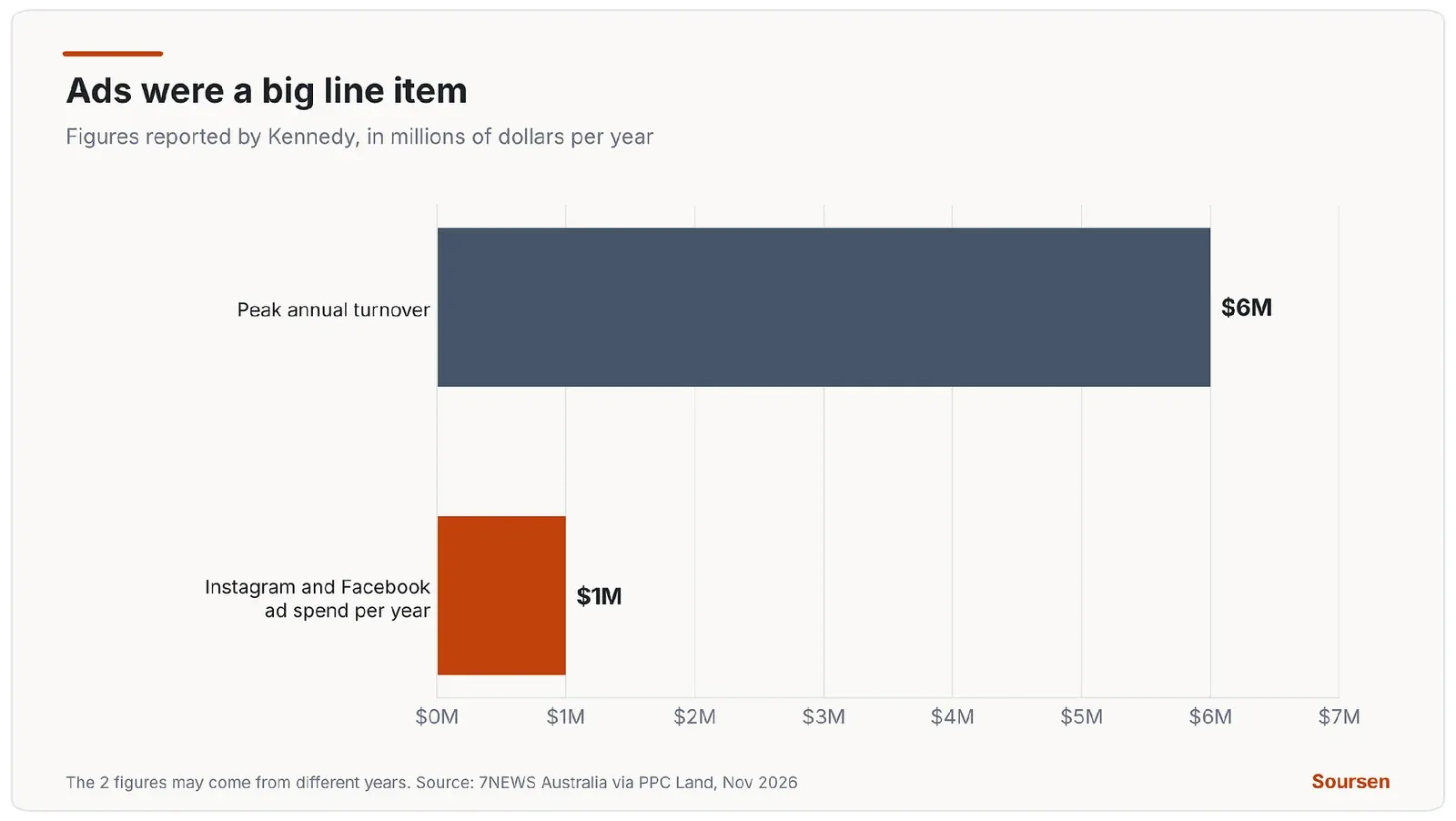
Kennedy’s reported peak turnover and annual social ad spend. The 2 figures may come from different years. Source: 7NEWS Australia via PPC Land, Nov 2026
Practical Ecommerce’s Jill Kocher Brown documented 2 cases that show the range. One consumer goods site changed every URL in a redesign, used a 301 redirect strategy, lost 25% of its traffic for about 6 weeks, and later ran 19% above its pre launch level. Another manufacturer changed URLs without redirects and watched organic search traffic fall 42% after 12 days. Adorn’s reported 30% sales drop sits between those 2 outcomes, which fits a launch that went wrong without proving that redirects were the cause.
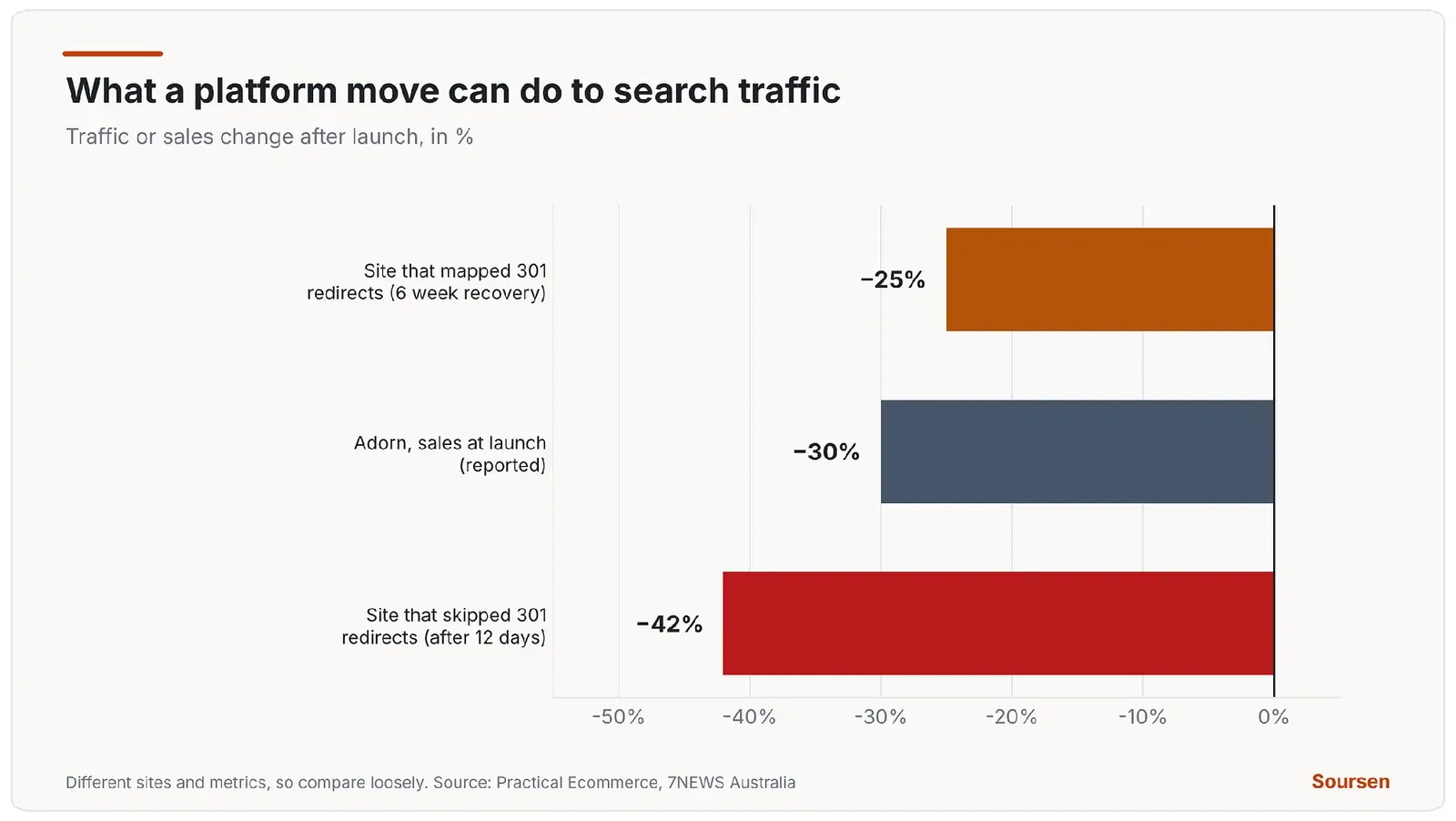
Reported changes after a platform move. The Adorn figure is sales, and the other 2 are organic search traffic. Source: Practical Ecommerce, 7NEWS Australia
If the 30% applied to a $6 million business, that is about $1.8 million a year in lost sales. A business can absorb a month of that, and a year of it is far harder, and the report says the damage ended with Kennedy selling her family home.
The $150 million settlement is a different case
The 7NEWS report mentions that the US government sued Adobe in June 2024 and that this year Adobe reached a $150 million settlement without admitting wrongdoing. Viewers could easily read that as the legal consequence of what happened to Adorn. It is not described that way anywhere I can find.
The US Department of Justice announced the proposed order on March 13, 2026. It requires Adobe to pay $75 million in civil penalties and provide $75 million in free services to qualifying customers, and it resolves claims against Adobe and 2 employees under the Restore Online Shoppers’ Confidence Act. The case was about consumer subscriptions, specifically an early termination fee on the “annual paid monthly” plan, which the FTC alleged in 2024 equals 50% of the remaining monthly payments when someone cancels in the first year. The order requires Adobe to disclose that fee before enrollment and to offer simple ways to cancel. Adobe disagrees with the government’s claims and denies wrongdoing, per the settlement reporting. The Justice Department page was last updated October 20, 2026, and I found no confirmation that the court has entered the order, so I describe it as proposed.
Nothing in that case concerns Adobe Commerce, merchant contracts or Adorn. The overlap is the word Adobe and a shared theme of exit terms, and I would keep the 2 stories apart until someone shows a connection.
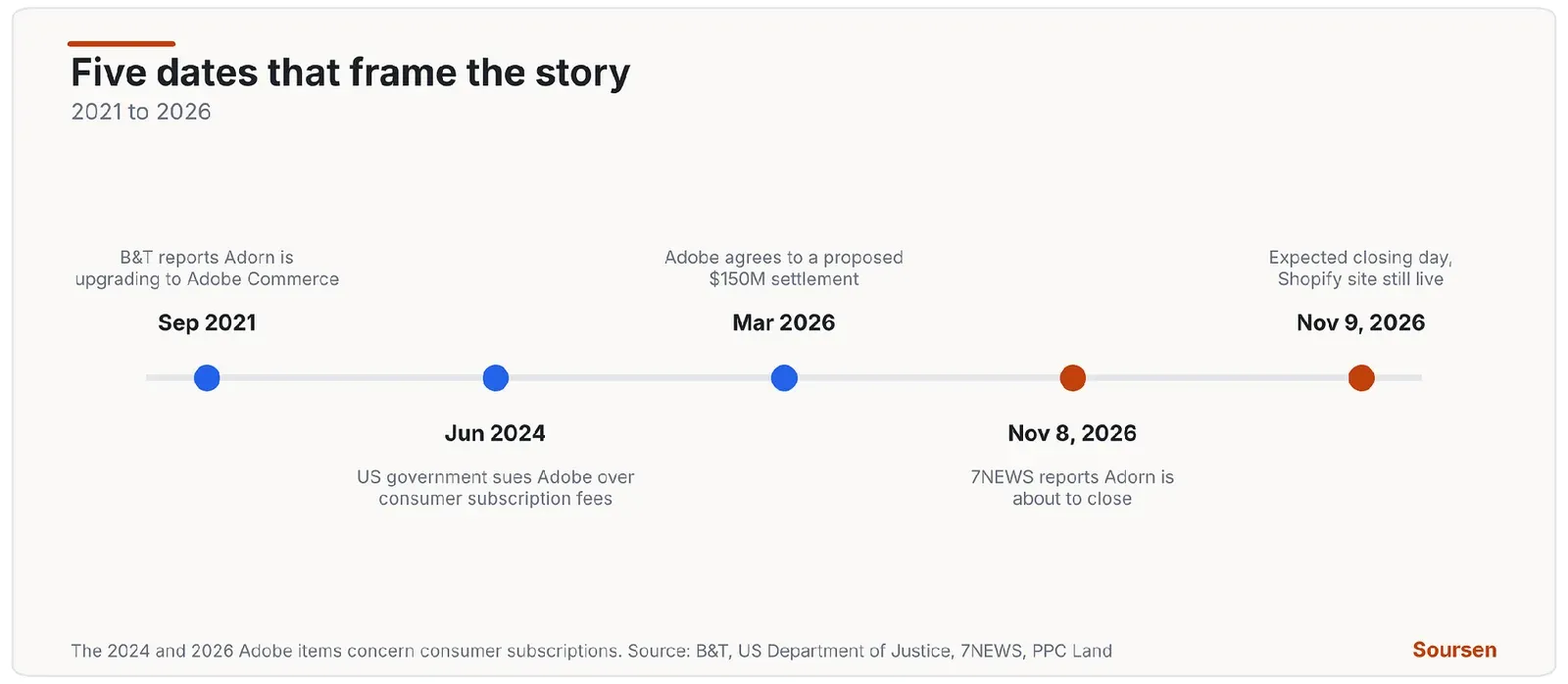
The dates in the Adorn story, with the 2 Adobe settlement items concerning consumer subscriptions. Source: B&T, US Department of Justice, 7NEWS, PPC Land
Responsibility is still an open question
The reaction online split in useful ways. SEO specialist Lily Ray wrote on X that the story is a reminder to hire SEO teams with substantial migration experience before moving a company website, especially an ecommerce one. Nick LeRoy replied that he felt for Kennedy but noted the report points to a migration partner that failed at launch, which raises the question of why Adobe is cast as the villain. Hung Lee wrote that technical people will ask why she chose Adobe, while a non technical owner may not know enough to run the due diligence. These are posts from observers, and none of them has seen the contract.
Gymshark is another brand that has described leaving Adobe Commerce, and its account comes with a caveat. Founder Ben Francis told Shopify, in a case study on Shopify’s own site, that building his Adobe Commerce store took 6 to 8 months, that it went down for 8 hours on Black Friday at an estimated cost of £100,000, and that he replatformed to Shopify Plus 10 months into the relationship. Shopify has every reason to tell that story, and the cost is Francis’s own estimate. His remark about customers stuck with me, because he says shoppers blamed the Gymshark brand whichever vendor was at fault.
I find the timeline the hardest part to explain. The upgrade was announced in September 2021, and the closure is reported in November 2026. The report does not say when the new site launched, how long it ran, or how many months of damage preceded the move to Shopify. Without those dates nobody outside the dispute can say how much of the collapse traces to the launch and how much to other pressures on the business.
That is also why I think the useful reading is narrow. A platform choice is a decision with a license fee, an implementation partner and a contract. The part that failed, on Kennedy’s account, was the launch itself, and a launch has checks that anyone can demand in writing.
2 things from this generalize
First, treat the URL list as a contract deliverable. Before launch, export every address that earns you money, meaning the landing pages of your paid ads, the links in your email templates, your product feed and your top 200 organic pages. Have the agency prove on a staging site that each one either loads or redirects with a single 301 to the right new page, and write “0 broken money URLs at launch” into the acceptance criteria. Then keep the old redirects live for at least a year, as Google advises. Google’s site move guide also says to make changes one after another, and eSEOspace quotes its example of moving to a new domain first and changing the layout afterward. A new platform, a new design and new URLs on the same day multiply the ways a launch can fail.
Second, read the exit clause and set a rollback rule before you sign. Kennedy says she could not leave the contract after the launch went wrong. Ask what it costs to cancel in month 1, month 6 and month 12, and keep the old store able to take orders until the new one has matched its sales for a full 30 days. If the new platform cannot clear that bar, you need the contract to let you go back.
If you run a store, take 30 minutes this week to export your top 200 landing URLs from your ad accounts and analytics, then check what each one returns today. Any that end in an error page are costing you money before you ever replatform.
Sources
- Adorn Cosmetics gives its e-commerce experience a makeover with Adobe Commerce, Adobebusiness.adobe.com. Accessed 9 November 2026.
- Adorn Cosmetics gets a digital makeover using Adobe Commerce, B&Tbandt.com.au. Accessed 9 November 2026.
- 7NEWS Melbourne post on the Adorn Cosmetics report, Xx.com. Accessed 9 November 2026.
- Adorn Cosmetics faces closure, blaming 30% sales drop on Adobe site, PPC Landppc.land. Accessed 9 November 2026.
- Adorn Cosmetics case study, Dotdigitaldotdigital.com. Accessed 9 November 2026.
- Magento License Cost, Adobe Commerce pricing breakdown for 2026, MGT Commercemgt-commerce.com. Accessed 9 November 2026.
- Magento Pricing, the true cost of running an Adobe Commerce store, scandiwebscandiweb.com. Accessed 9 November 2026.
- Google, keep 301 redirects in place for a year, Search Engine Journalsearchenginejournal.com. Accessed 9 November 2026.
- Ask an SEO, how can we recover a 30% drop in organic traffic from a site migration, Search Engine Journalsearchenginejournal.com. Accessed 9 November 2026.
- Technical SEO, Practical Ecommercepracticalecommerce.com. Accessed 9 November 2026.
- Adobe Agrees to $150 Million Settlement, US Department of Justicejustice.gov. Accessed 9 November 2026.
- Destination not working, Google Ads policy helpsupport.google.com. Accessed 9 November 2026.
- Google’s site move guide now covers www and non www domain variants, PPC Landppc.land. Accessed 9 November 2026.
- How to protect AI visibility during a redesign or migration, eSEOspaceeseospace.com. Accessed 9 November 2026.
- How Gymshark outgrew Adobe Commerce and replatformed to scale internationally, Shopifyshopify.com. Accessed 9 November 2026.
- Adobe Ends Federal Subscription Lawsuit With $150 Million Settlement Package, PYMNTSpymnts.com. Accessed 9 November 2026.
Related stories
Linux & open source
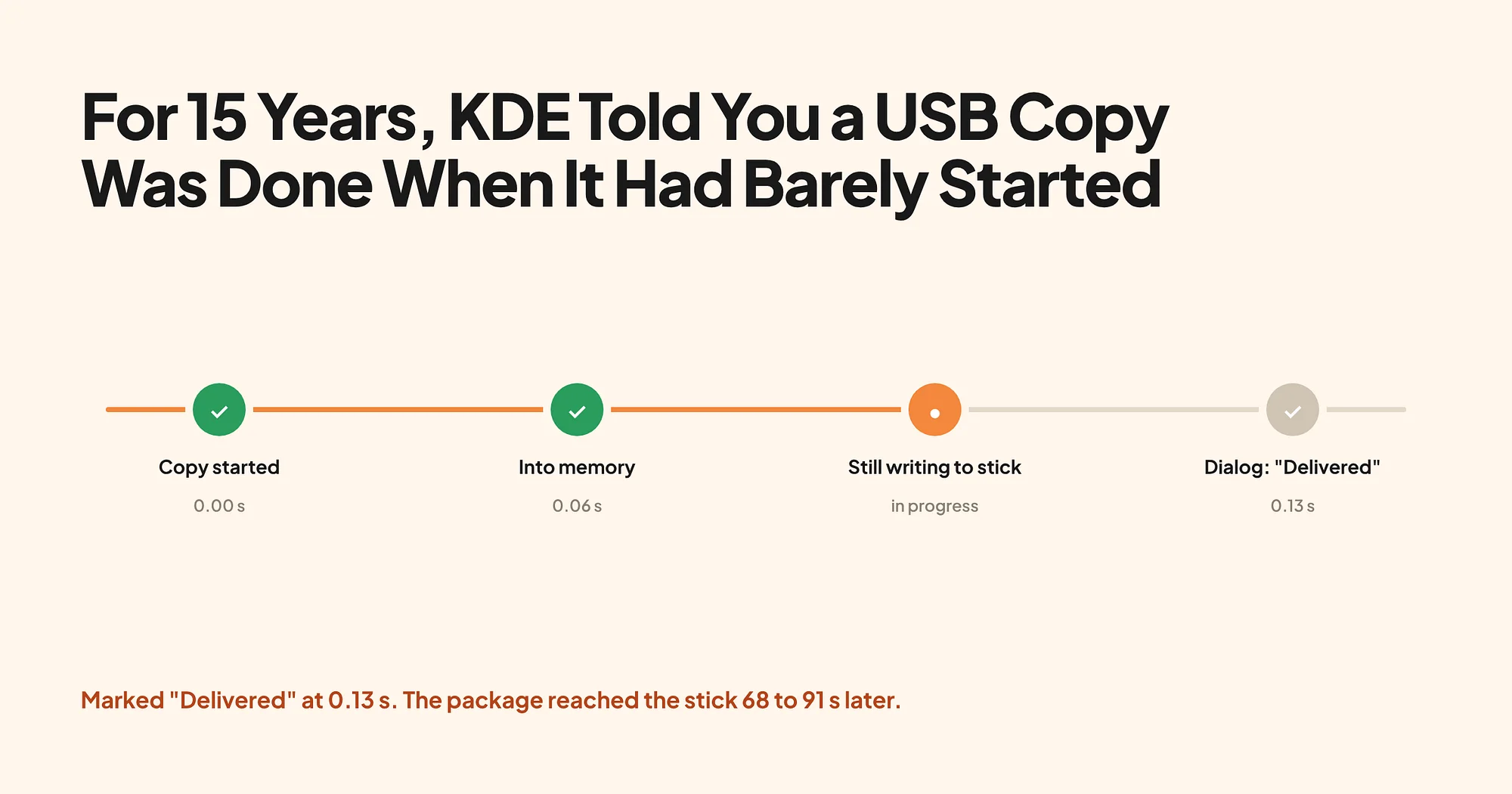
For 15 Years, KDE Told You a USB Copy Was Done When It Had Barely Started
A progress bar that timed the copy into memory, while the stick lagged far behind, corrupted files for anyone who trusted it and pulled the stick. The fix took 4 merge requests and a Linux call so sharp its own manual calls it extremely dangerous.
Security
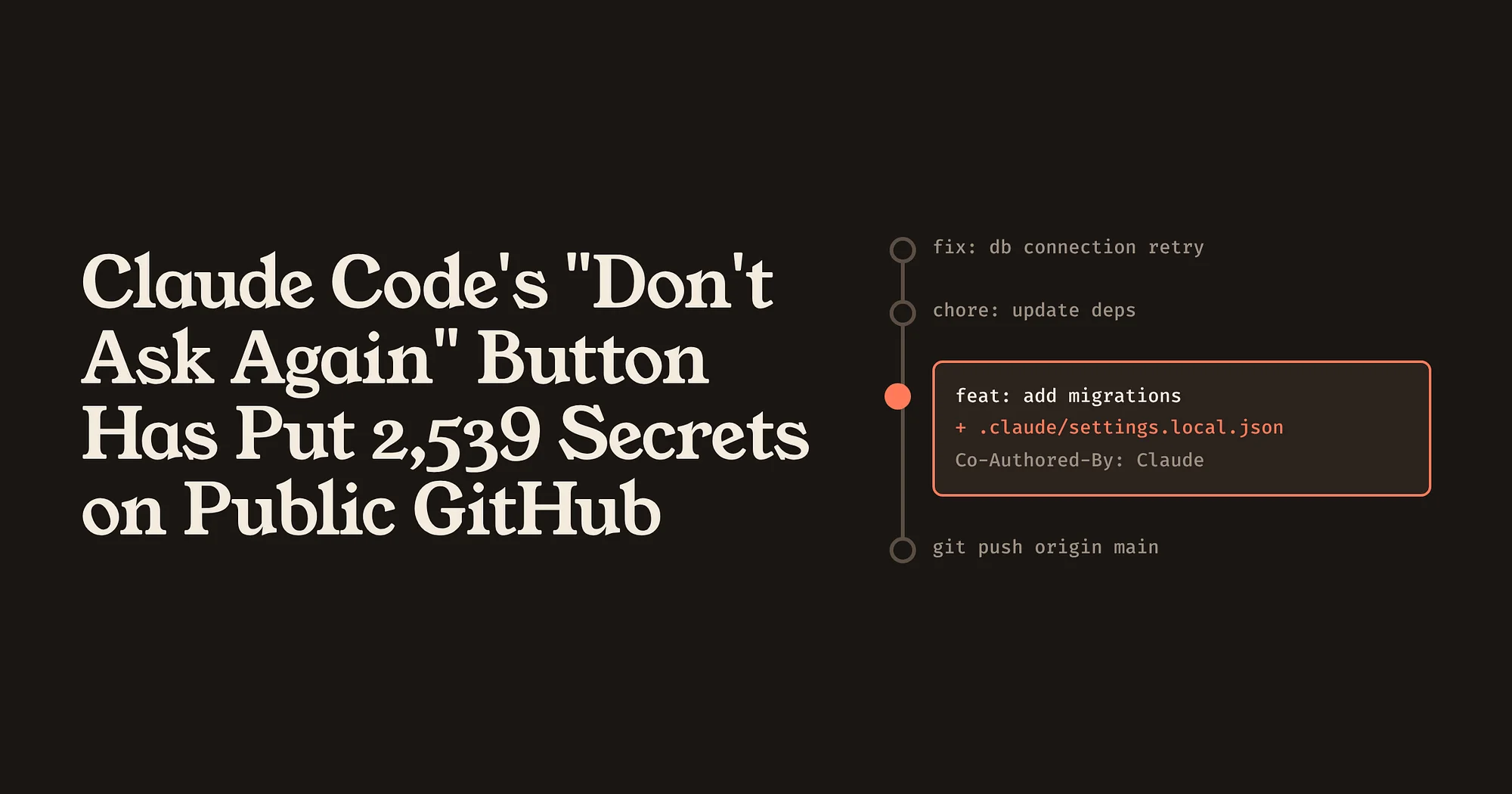
Claude Code’s “Don’t Ask Again” Button Has Put 2,539 Secrets on Public GitHub
A permission shortcut saves the exact command you approved, password included, into a project file that often gets committed. The bigger lesson is that AI coding agents have created new places for secrets to hide, and the usual scanners are not looking there.
Security
OpenAI’s Agents Built 948 Working Linux Root Exploits in a Single Run.
An AI pipeline found, proved and drafted fixes for 948 kernel bugs at about $1,279 each. Finding them was the cheap part. The bigger lesson is who now has to fix them, and how fast.