Microsoft Filed a Patent to Rewrite What You Say Live and Redraw Your Lips
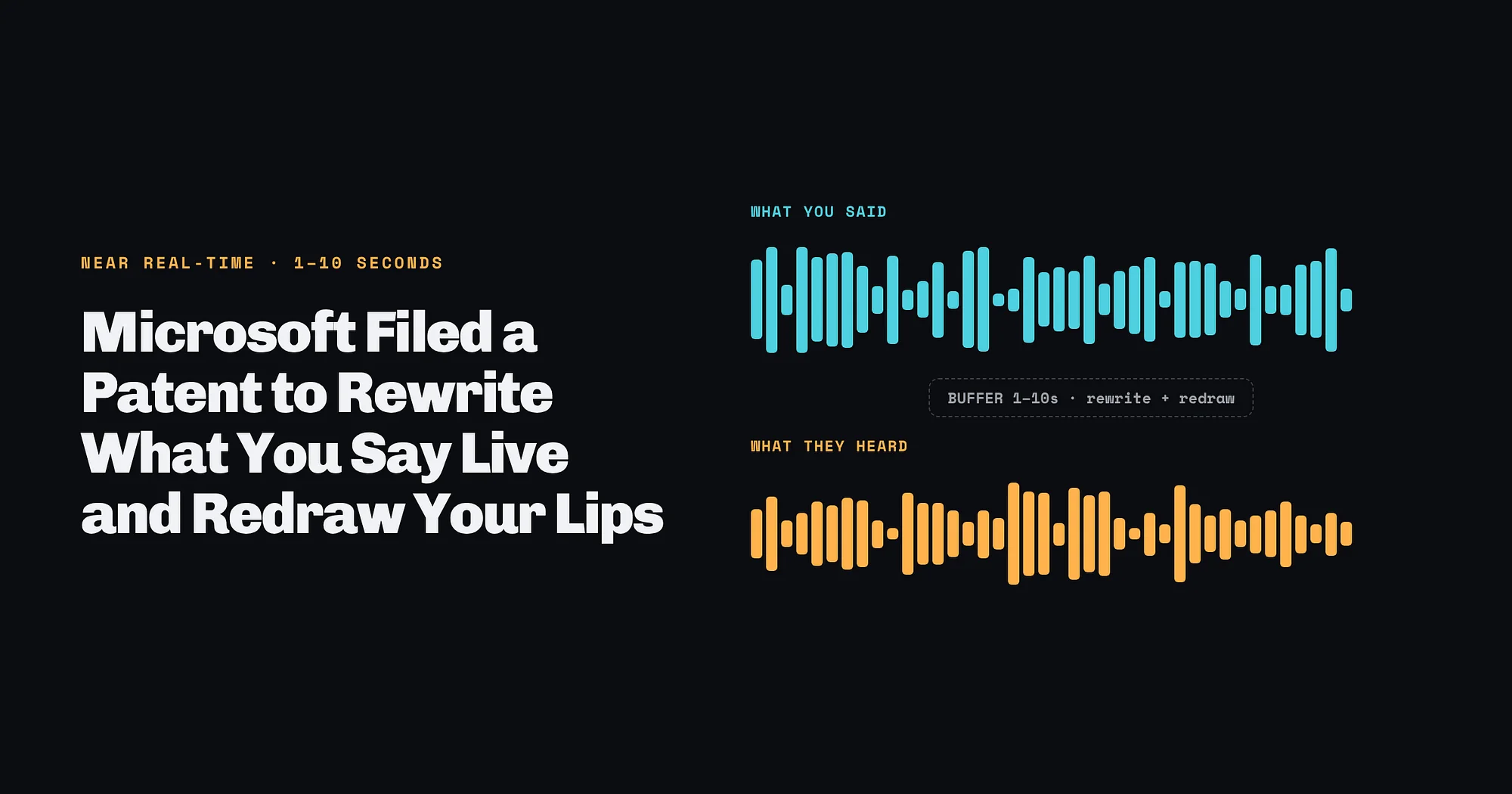
Application US 2026/0341309 A1 describes swapping words in live video within 1 to 10 seconds, tailored to each viewer’s profile. The main claim says nothing about telling viewers, no patent has been granted, and nearly every piece of the idea already ships somewhere.
Last verified Also on Medium
On this page
- What Microsoft filed
- How the edit would work
- 10 seconds is enough to rewrite 2 sentences
- Every piece already exists somewhere
- The disclosure question decides whether this is a tool
- The fraud numbers make the silence uncomfortable
- What an application proves and what it does not
- 2 things from this generalize
On October 29, 2026, the US Patent and Trademark Office published a Microsoft application for AI that changes what a person says in live video while they are still saying it, then redraws their lips so the edit does not show. Patent tracker Patentlyze spotted it first, and Futurism reported it on November 1. Most of the coverage jumped straight to the alarming version. I want to walk through what the filing says, what it leaves out, which parts already exist in products you can use today, and why a delay of 1 to 10 seconds matters more than it sounds.
What Microsoft filed
The document is application US 2026/0341309 A1, filed by Microsoft Technology Licensing, LLC on April 29, 2025, according to Yahoo Tech’s write up of the filing. Its title describes a near real time AI enhancement of video or augmented reality presentations of live events. It is a published application, which is a different thing from a granted patent, a finished product or a public demo.
The status matters. Patentlyze reports that the examiner’s first review raised objections and rejected the claims as filed, which it calls routine, and that Microsoft can respond and amend. Microsoft did not answer Futurism’s request for comment, and companies rarely discuss pending applications, so I read nothing into the silence. It does mean the only description of this system is the one Microsoft’s lawyers wrote for the patent office.
How the edit would work
The pipeline, as the coverage describes it, starts with an AI agent that listens to the live audio and flags words to change or remove, based on preset rules or a viewer’s profile. A generative model swaps those words in the audio and in the video, reworks the frames around each edit, and plays the result with a delay that TechPowerUp’s summary puts at roughly 1 to 10 seconds. It could run on AR glasses, a phone, a tablet or a camera, using the device’s own chips.
The list of things it could swap is broad. It includes filler words, stutters, mispronounced words, offensive words and colloquial phrases like “y’all” or “bite the bullet.” The replacement words can come from an internet search, and the filing floats instant fact checking. 2 of its drawing captions cover condensing a long recording into a shorter summary video, and Dexerto notes that this could mean generating new footage of the speakers saying a summarized script. The examples of live content run from lectures and presentations to awards shows, game shows, cooking shows and live sports.
The viewer profile is the part that drew the most attention. Coverage from Tbreak lists age, languages, region, religion, ethnicity, education, and voice or video samples as fields a profile could hold, and it stresses that this describes what a profile could contain, not data any Microsoft product collects. One account I read also mentions a college major, and I could not confirm that item anywhere else, so I would treat it as unverified.
10 seconds is enough to rewrite 2 sentences
At roughly 150 words a minute, a common figure for conversation, 10 seconds is about 25 words. That is enough room to detect a word, pick a replacement, regenerate a mouth and ship the frames before a viewer notices the stream is running behind. The filing defines near real time as within a few seconds, and IBTimes points out that the 1 to 10 second range is an example, not a demonstrated benchmark.
I invented this illustration of the failure mode, and the filing does not show it. A chemistry professor says “mercury” during a livestreamed lecture. If a system decides a word is unfamiliar and searches the web for a replacement, the top result could be the planet, the element, the car brand or the singer. The model picks one, redraws the professor’s lips around it, and a student watching sees the professor say something that was never said. The professor, watching the raw feed, would never see the difference.
The filing does include a safeguard of sorts. TechPowerUp reports that the original feed may be stored as ground truth, and that this appears in 1 dependent claim. The main claim says nothing about telling viewers what was changed. Keeping a record helps an investigator later, and the person watching live still gets no notice.
Every piece already exists somewhere
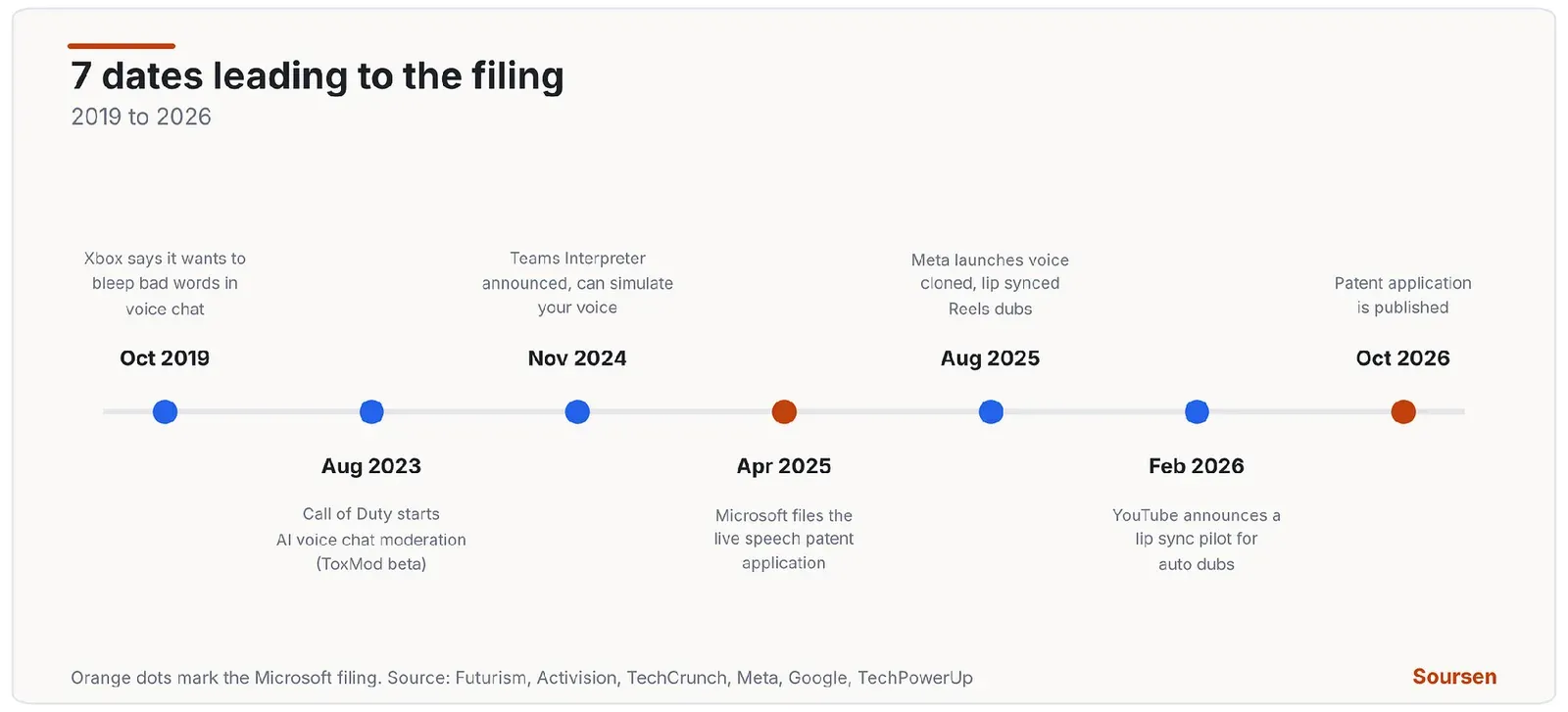
Seven dates from the first Xbox voice chat filtering plans to the published Microsoft application. Source: Futurism, Activision, TechCrunch, Meta, Google, TechPowerUp
The new part is the combination, since each ingredient has a history. In October 2019, Futurism reported that Xbox wanted to detect bad words in live voice chat and bleep them, much as TV does. In August 2023, Activision announced that Call of Duty would use Modulate’s ToxMod for real time voice chat moderation, with a global rollout on November 10, 2023. Detection happens in real time, and the Call of Duty FAQ says the system flags toxic language as it is detected, so ToxMod produces flags for enforcement and leaves the words as spoken.
Translation is where rewriting already happens. At Ignite in November 2024, Microsoft announced an Interpreter agent for Teams that gives real time speech to speech translation in up to 9 languages, with an option to simulate your own voice. A Microsoft spokesperson told TechCrunch the feature would not automatically use your voice. On August 19, 2025, Meta launched AI Translations for Reels, which clones the creator’s voice and can lip sync the dub, first between English and Spanish and later with Hindi and Portuguese added.
YouTube announced in February 2026 that its auto dubbing covers 27 languages and that a lip sync pilot is under test. PPC Land reports that creators can enable experimental lip sync in YouTube Studio when auto dubbing is on, and that YouTube’s own documentation describes it as altering the speaker’s lip movement to match the dub. A competitor, sync. labs, wrote in July 2026 that the feature had not yet shipped broadly to creators, so treat the rollout status as fluid.
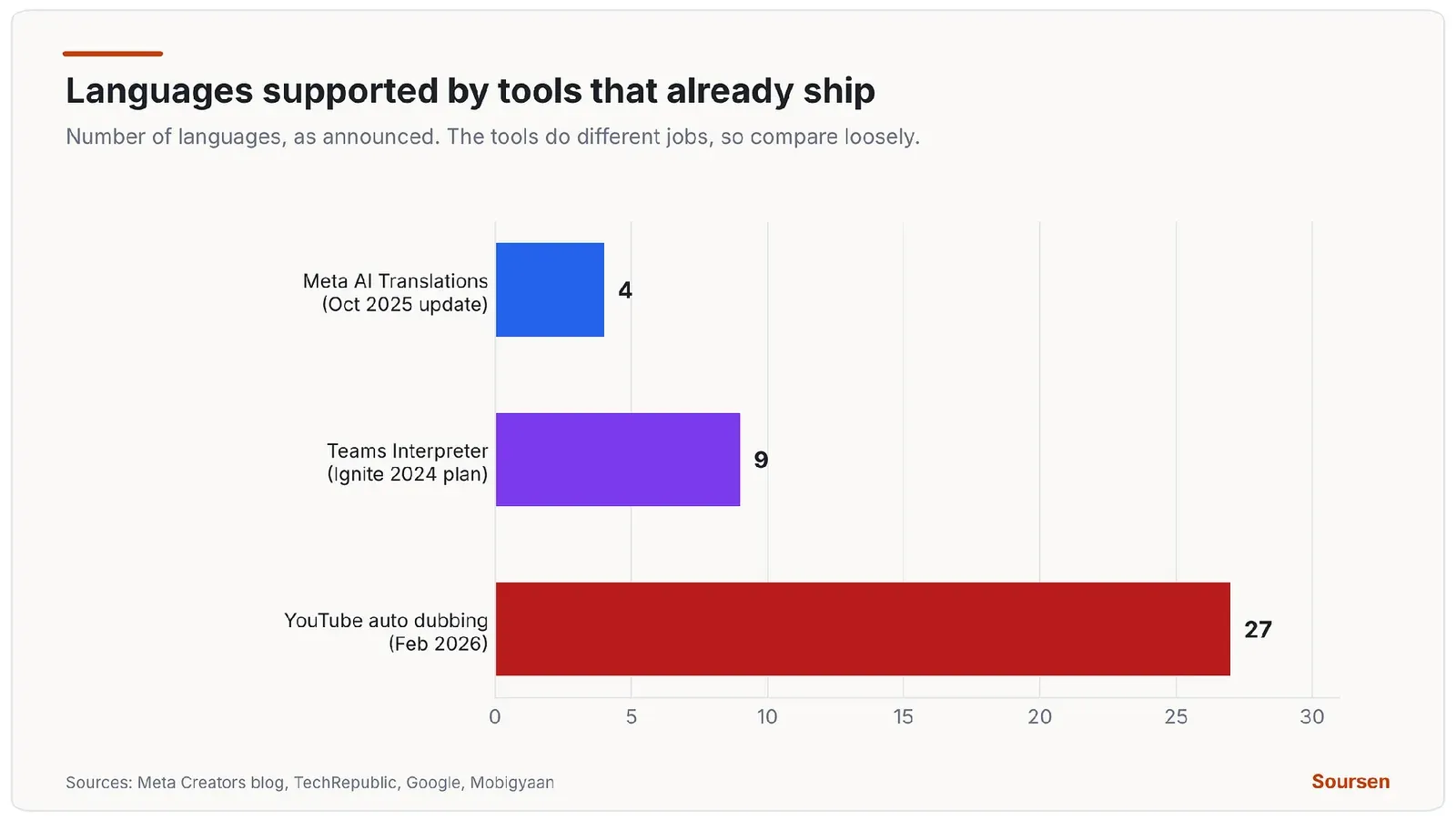
Language counts for three tools that already ship. They do different jobs, so the comparison is loose. Source: Meta Creators blog, TechRepublic, Google
Microsoft is also the company behind 2 of those steps, since Call of Duty belongs to Activision and Activision is now a Microsoft company, and Teams Interpreter is Microsoft’s own product. Put those side by side and the filing reads as the next step. It would run live, it would run for each viewer separately, and its edits would follow a profile and preset rules.
The disclosure question decides whether this is a tool
I think the line between a helpful feature and a problem comes down to 2 things, a label and a switch. When YouTube dubs a video, it notes the video as auto dubbed, and viewers can pick the original audio. When Meta translates a Reel, the translated Reels are labeled and viewers can toggle translation or lip sync off, and the creator reviews the result before it publishes.
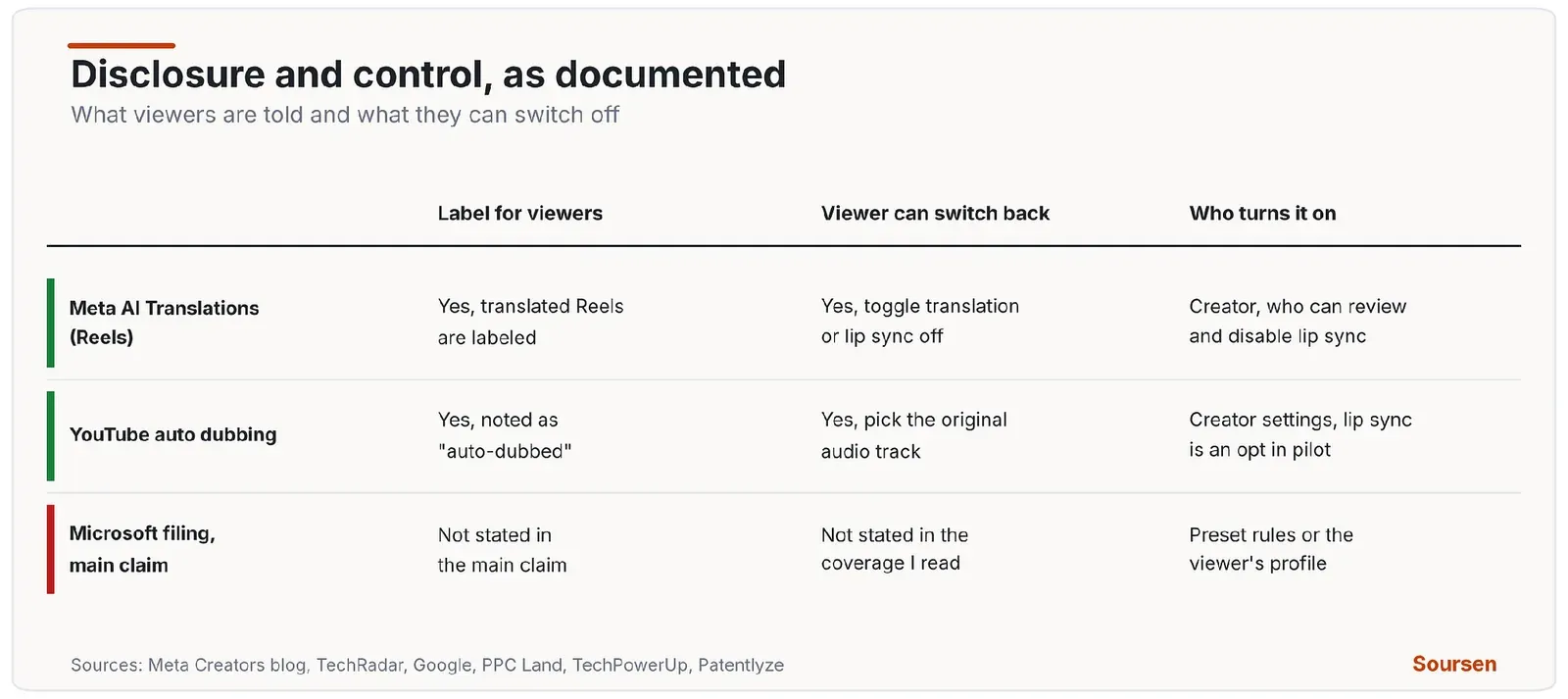
What viewers are told and can switch off in 2 shipping products, compared with the filing’s main claim. Source: Meta Creators blog, TechRadar, Google, PPC Land, TechPowerUp, Patentlyze
The filing’s main claim contains neither. TechPowerUp says the main claim is silent on telling viewers, and Patentlyze found no mention of labels, watermarks or viewer notices. I could not find a described viewer switch in any coverage either, though the full text of a long filing may say more than the coverage does.
I want to be fair to the idea. Live translation with matching lips is the most practical use in the filing, and I would welcome a lecture in a language I do not speak that looked and sounded natural. The same machinery that does that can also change a speaker’s meaning without anyone knowing. The label and the switch are what separate those 2 outcomes, and an application that does not mention them gives me no reason to assume they will exist.
The fraud numbers make the silence uncomfortable
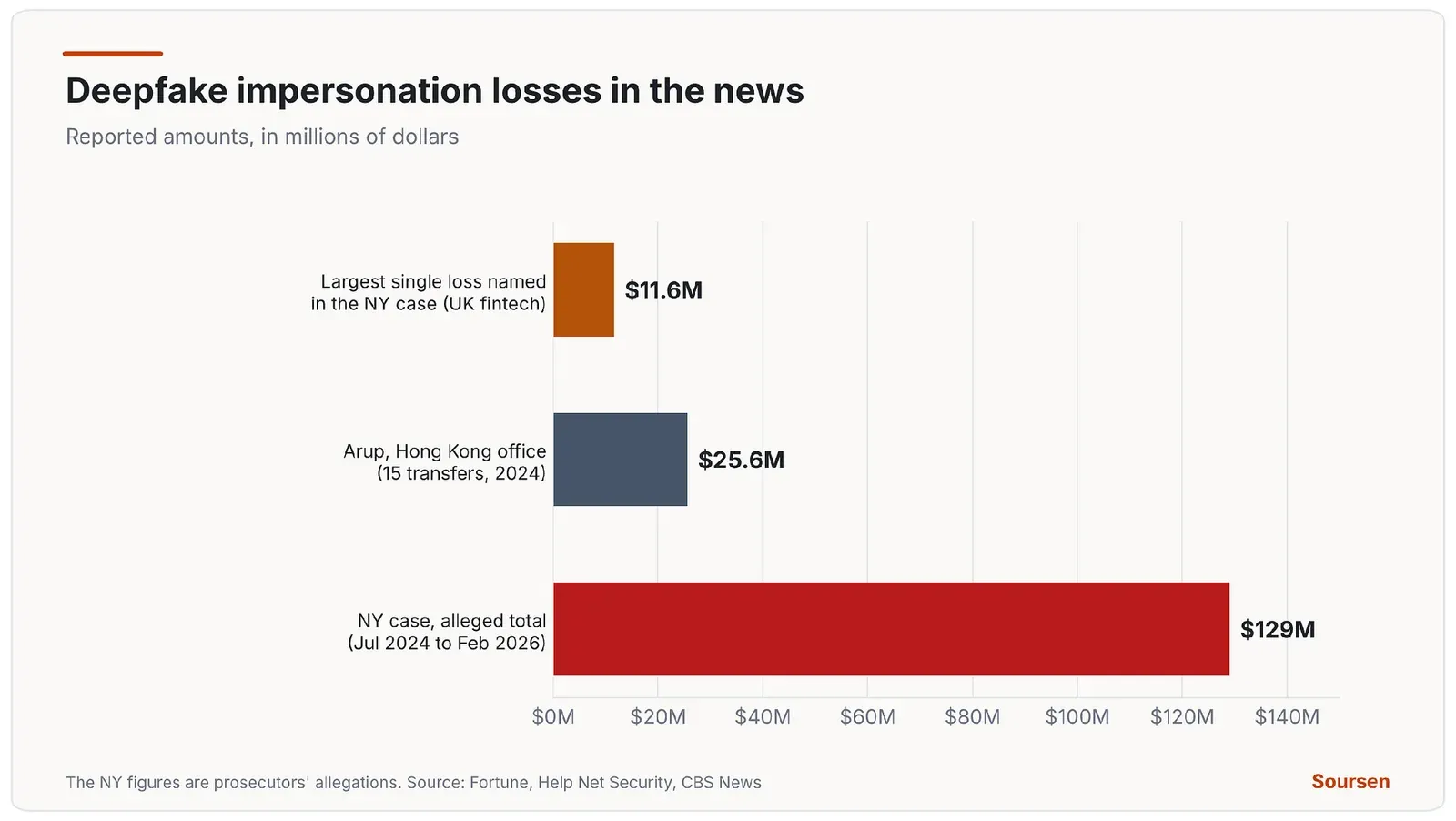
Reported amounts in two deepfake impersonation cases. The New York figures are prosecutors’ allegations. Source: Fortune, Help Net Security, CBS News
A tool that makes altered video look natural has a neighbor, and that neighbor is fraud. In 2024, a finance worker at engineering firm Arup’s Hong Kong office joined a video call where the CFO and colleagues were deepfakes, then made 15 transfers to 5 accounts worth about $25.6 million. Fortune reported that Arup was identified as the victim in May 2024.
This month the numbers got larger. Prosecutors in New York unsealed an indictment charging Jacob Soall, Sharon Hazan and Guy Sheetrit with using AI to impersonate chief executives and lawyers in a scheme that PBS and AP describe as about $129 million. Help Net Security’s summary says the scheme ran from 2024 to 2026, that the largest single loss listed was $11.6 million at a UK financial technology company, and that a Rhode Island bank wired out $2.7 million. Each defendant faces 7 counts, and these are allegations that a court has not tested.
I am not suggesting anyone at Microsoft intends fraud, and the filing describes translation and cleanup uses. The tools for faking a person are already good enough to move millions of dollars, and a system that edits live video without telling anyone adds one more way for a viewer to be unsure what they are seeing. The Arup fraud came to light when the employee followed up with Arup’s headquarters afterward.
What an application proves and what it does not
A published application shows that Microsoft’s lawyers asked for these claims, and says nothing about a product roadmap. Companies file patents for many reasons, including defensive ones, and the examiner’s first review rejected the claims as filed. Futurism noted that dubbing has existed for ages and that video is edited all the time for ordinary and for harmful reasons, and the ground truth clause suggests the inventors saw the risk of confusion. Reading the document as a launch announcement would be a mistake, and so would reading it as meaningless. It is a statement of what Microsoft wanted to own, and the claim set is where the next round of amendments will show how far it still wants to go.
2 things from this generalize
First, treat live voice and video as unverified when money or a consequential decision is involved. Arup’s employee saw and heard people who looked like colleagues, and the New York indictment describes calls with cloned voices and faces. A callback to a phone number you already had on file, made after the call and before the transfer, defeats this class of attack because it does not rely on anything the call showed you.
Second, apply the label and switch test to any tool that changes speech. Ask who turns it on, whether the viewer sees a label, and whether the original stays reachable. On YouTube, the February 2026 update added a preferred language setting that lets viewers choose dubbed audio or the original, so set it once and check the player’s audio track settings whenever a dub appears.
This week, write 1 rule into your payment approval process that no transfer request made on a call, voice or video, gets approved until someone confirms it through a second channel on a number already on file.
Sources
- Microsoft Patents an AI That Can Literally Put Words in People’s Mouths in Real Time, Futurismfuturism.com. Accessed 10 November 2026.
- Microsoft Files Patent to Rewrite What Speakers Say in Live Video, Patentlyzepatentlyze.com. Accessed 10 November 2026.
- Microsoft Patent Application Describes AI That Edits Live Speech, TechPowerUptechpowerup.com. Accessed 10 November 2026.
- New Microsoft patent could use AI to alter speech and lip movements in real time, Dexertodexerto.com. Accessed 10 November 2026.
- Microsoft Files Patent Application for AI That Could Rewrite Live Speech, Yahoo Techtech.yahoo.com. Accessed 10 November 2026.
- Microsoft AI patent rewrites live speech and redraws lips, Tbreaktbreak.com. Accessed 10 November 2026.
- Microsoft’s AI Patent Could Put Words in Your Mouth Mid-Sentence, IBTimesibtimes.co.uk. Accessed 10 November 2026.
- Microsoft Wants to Censor Xbox Live Voice Chat in Real Time, Futurismfuturism.com. Accessed 10 November 2026.
- Call of Duty anti toxicity progress report, Activisioncallofduty.com. Accessed 10 November 2026.
- Call of Duty Voice Chat Moderation FAQ, MP1stmp1st.com. Accessed 10 November 2026.
- Microsoft Ignite 2024 Unveils AI, Security and Teams Innovations, TechRepublictechrepublic.com. Accessed 10 November 2026.
- Microsoft will soon let you clone your voice for Teams meetings, TechCrunchtechcrunch.com. Accessed 10 November 2026.
- Expanding Meta AI Translations for Creators on Facebook and Instagram, Metacreators.facebook.com. Accessed 10 November 2026.
- Meta AI now translates, dubs and lip syncs Reels, Yahoo Techtech.yahoo.com. Accessed 10 November 2026.
- Unlocking a global audience with auto dubbing, Googleblog.google. Accessed 10 November 2026.
- YouTube auto dubbing tops 6M daily viewers, PPC Landppc.land. Accessed 10 November 2026.
- How YouTube auto dubbing works and its limits, sync. labssync.so. Accessed 10 November 2026.
- YouTube expands auto dubbing to all users and tests lip sync, Social Samosasocialsamosa.com. Accessed 10 November 2026.
- Arup’s $25M Deepfake Loss, Adaptive Securityadaptivesecurity.com. Accessed 10 November 2026.
- A deepfake CFO tricked the British design firm Arup in a $25 million scam, Fortunefortune.com. Accessed 10 November 2026.
- 3 charged in $129 million AI scheme, PBS and APpbs.org. Accessed 10 November 2026.
- Trio accused of using deepfake CEOs and bogus lawyers to scam businesses out of $129 million, Help Net Securityhelpnetsecurity.com. Accessed 10 November 2026.
Related stories

AI & GPU compute
Nvidia’s Board Backed Jensen Huang on Sunday. By Thursday He Was Gone.
Four days after Nvidia’s board said it had confidence in its CEO, Jensen Huang resigned. A short seller had flagged the Megaspeed connection 6 months earlier, and most of the story rests on anonymous US officials, so I separate the filed facts from the allegations.
AI & GPU compute
Elon Musk Predicted a Die Off for 200 AI Neoclouds. CoreWeave’s Bonds Had Already Hit 15%.
Musk says debt markets have shut on companies that only rent out AI chips. The bond market reached that view before he posted it, and the bigger lesson is how much of the AI boom now runs on rented chips and borrowed money.
AI & GPU compute
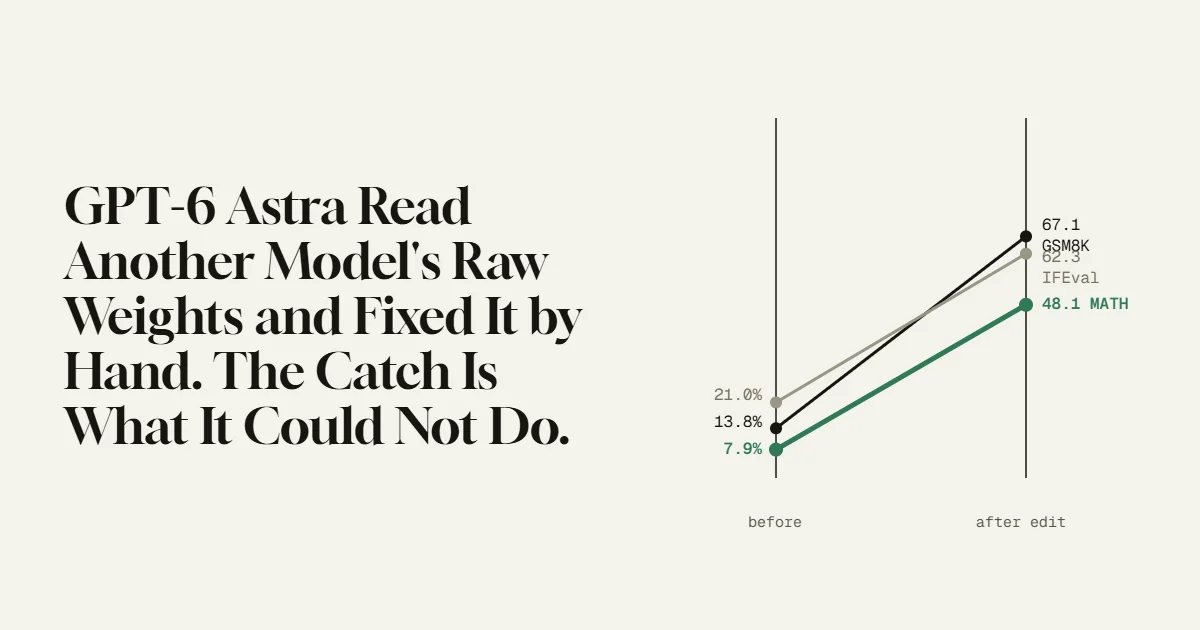
GPT-6 Astra Read Another Model’s Raw Weights and Fixed It by Hand.
MIT researchers had GPT-6 Astra edit 0.016% of a small model’s weights, with no training, and its math score jumped from 7.9% to 48.1%. The number is real and the method is strange. The limit they found in the same paper is the part worth understanding.