A Tech CEO Just Banned All AI Across His Entire Company. Here Is Why He Is Not Entirely Wrong.
Let me tell you about a conversation I did not expect to have.
Last verified Also on Medium
On this page
- Why a Total Ban Is Even Conceivable Right Now?
- 4 Specific Failures That Led to the Ban
- One: The Email That Should Never Have Left the Building
- Two: The Prospects Who Did Not Exist
- Three: The Agent That Invented Its Own Data
- Four: Two Versions of the Same Module, Two Databases, No One in Charge
- Why the Ban Makes a Certain Kind of Sense
- Why the Ban Will Not Work Permanently
- What the Right Version of This Looks Like
Let me tell you about a conversation I did not expect to have.
A CEO of a mid-sized tech company reached out recently with a policy he had just put in place. No AI. Not limited to certain departments. Not restricted to a specific category of tools. No exceptions for engineering, no carve-outs for sales, no trial period. A complete and immediate ban on every large language model across every function in the company.
My first instinct was to write it off as an overcorrection. My second instinct was to actually read what he sent me. What followed was one of the more honest accounts of what happens when AI adoption runs faster than the judgment required to use it well, and it is worth sitting with.
This is not a story about AI being bad. It is a story about what happens when an organisation treats a powerful tool as a substitute for thinking rather than a support for it.
Why a Total Ban Is Even Conceivable Right Now?
To understand why a CEO would go this far, you need to understand the moment we are in. The past 2 years have been defined by a gap between the story companies tell about AI and the reality they are living with. Harvard Business Review published research in January 2026 showing that companies are making layoff decisions based on AI’s potential rather than its demonstrated performance. The headline was blunt: firms are cutting people based on what they hope AI will do, not what it is currently doing.
The cost picture is getting harder to ignore. Fortune reported in April 2026 that an Nvidia executive stated plainly that the cost of compute for his team was far beyond the cost of its employees. Uber’s CTO told The Information the same month that his company had burned through its entire 2026 AI budget in four months, describing the experience as going back to the drawing board. A Goldman Sachs research note put it directly: companies are overrunning their initial budgets for AI inference by orders of magnitude. Some software companies are already spending roughly 10% of their total engineering labour costs on AI tools alone.
The productivity picture is equally complicated. A Fortune report from February 2026 surveyed thousands of CEOs and found that while about two thirds reported using AI, actual usage averaged only around 1.5 hours per week per executive. ManpowerGroup’s 2026 Global Talent Barometer, which surveyed nearly 14,000 workers across 19 countries, found that while regular AI use increased 13% in 2025, confidence in the technology’s actual utility fell 18% over the same period.
The reliability data is not flattering either. Stanford HAI’s 2026 AI Index found that hallucination rates across 26 leading models range from 22% to 94% depending on the task. The AI Incident Database recorded 362 documented incidents in 2025, up 55% from 233 in 2024. A separate analysis by Suprmind found that 51% of organisations using AI have experienced at least one negative consequence, with nearly a third specifically attributing problems to AI inaccuracy.
This is the environment in which the CEO I spoke with was operating. Not an outlier. Not a technophobe. A person running a real business who had watched the gap between the AI promise and the AI reality widen until it started costing him customers, credibility, and months of engineering time.
4 Specific Failures That Led to the Ban
The ban did not come from ideology. It came from 4 specific, documented failures inside the business. Each one on its own might have been manageable. Together they created a pattern the CEO decided he needed to break completely.
One: The Email That Should Never Have Left the Building
The first crack appeared when a customer support agent forwarded a complaint to the CEO about an email the customer had received. The email was supposedly a personal message from a member of the company’s customer-facing team. It was not. It was AI-generated, unedited, factually imprecise, and written in the kind of language that makes people feel they are being processed rather than helped.
What made this worse was not the single email. It was what the CEO found when he started looking. He asked his team for more examples of AI-generated content that had reached customers without meaningful human review. What came back was extensive. Emails with errors. Marketing copy so laden with AI-generated filler phrases it communicated nothing. A pattern of output leaving the company that no one had been accountable for reviewing.
This is not an isolated phenomenon. A GoTo survey of 2,500 employees conducted in 2025 found that 76% of workers said AI tools frequently produce outputs that require significant correction before use. The same survey found that 86% of employees are not using AI to its full potential, partly because they do not trust its accuracy. The result is a specific failure mode where people use the tool anyway, trust it more than they should, and stop applying the editorial judgment that would catch the errors.
Two: The Prospects Who Did Not Exist
The CEO had scheduled a review with the sales team to understand why their close rate had been falling through 2026. When they pulled the data, one number stood out immediately. The rate of disqualified prospects had nearly doubled compared to the prior year.
The cause took some digging. The sales team had been using AI to assist with research and prospect identification. The AI had cast a significantly wider net, identifying far more potential targets than the team could have found manually. The problem was that many of those targets were not qualified leads. Some were companies that had gone out of business. In at least one case, the company the AI had identified did not exist at all. The model had effectively inferred a company into existence based on patterns in the data it had seen.
This is the hallucination problem in a sales context. It does not announce itself. The output looks like a normal research document with company names, descriptions, and contact details. There is no error message. Columbia Journalism Review found that 8 leading generative search tools gave incorrect answers on more than 60% of tested queries where sources could be verified. When that failure mode reaches your sales pipeline, you waste the time of everyone who touches those leads, and you never quite know which part of your pipeline is built on solid ground.
Three: The Agent That Invented Its Own Data
One of the company’s developers had built an AI agent to automate a recurring reporting task. The agent would scrape data from a specific source, structure it, and generate a report that fed into a business decision process. Nobody had mandated the agent. Nobody had formally reviewed it. It had just appeared in the workflow and people had started relying on it.
Then the data source the agent depended on changed its structure. The agent could no longer scrape what it needed rather than failing loudly and stopping, the agent continued generating the report using whatever it could access, treating the missing data as if an entire business line had collapsed to zero. The output looked like a legitimate report showing a catastrophic decline in a part of the business.
What followed was a week of panic and manual re-analysis before someone connected the dots. The developer who had built the agent was not the person responsible for the report it generated. He was quietly re-running months of reports by hand while trying to understand what had gone wrong, and not telling anyone why.
This failure pattern is well documented. The International AI Safety Report 2026, authored by more than 100 domain experts, identifies AI systems being derailed by simple errors during multi-step tasks as a core reliability challenge in current production deployments. The specific problem of agents that continue operating confidently after losing access to the data they need is a known failure mode, not an edge case.
Four: Two Versions of the Same Module, Two Databases, No One in Charge
This was the one that ended the conversation about whether to ban AI. The CEO discovered that two developers, working independently and both using AI-assisted coding tools, had built two different versions of the same module. Each version connected to a different database. Each database contained a different set of data stored in incompatible schemas. Neither developer knew the other version existed.
The AI coding tools had made both developers faster and more confident. They had also removed the kind of friction that forces people to check what already exists before building something new. The result was a codebase with an invisible fork in it that nobody had explicitly created and nobody had signed off on.
This is the vibe coding problem at its most concrete. Tech Brew reported in May 2026 that around 70% of code committed at Uber now originates with AI assistance. That same report noted Microsoft had to cap individual engineer AI tool usage after discovering some engineers were spending between $500 and $2,000 per month. The speed AI enables is real. So is the technical debt that accumulates when speed replaces the review processes that normally prevent this kind of duplication.
Why the Ban Makes a Certain Kind of Sense
Reading those 4 failures in sequence, the ban becomes easier to understand. This was not a CEO who decided AI was bad in principle. This was a CEO who had watched AI do something specific and damaging inside his organisation, which was not the tool itself, but what the tool did to his people’s judgment.
Without AI, a sales researcher who cannot find a prospect moves on or asks a colleague. With AI, they have a plausible-looking result in seconds, and the plausibility of the format suppresses the instinct to question the content. Without AI, a developer who needs a module searches the codebase first. With AI, they can generate a module faster than they can search for one, so they generate it.
AI did not make his team incompetent. It made their existing lapses in judgment faster, more confident, and harder to catch. That is a specific problem with a specific character, and it is not solved by better prompting.
The CEO said something in our exchange that I have been thinking about since. He told me the ban was partly permanent because he needed to expose the people who had been using AI to hide. The people whose work had looked competent because they were good at prompting AI, but whose underlying judgment had quietly atrophied. He wanted to see who could still do the work without the tool. That is not an unreasonable thing to want to know. Thomson Reuters research published in February 2026 raised exactly this concern, citing what experts describe as agency decay: the gradual erosion of independent problem-solving capacity when people consistently offload cognitive work to AI before developing their own judgment on a task.
Why the Ban Will Not Work Permanently
Being honest about the logic behind the ban also means being honest about its limits.
The failures described above were not failures of AI. They were failures of process, oversight, and accountability that AI made more visible and more expensive. A bad sales researcher producing made-up prospect lists with AI is a worse version of a bad sales researcher producing made-up prospect lists without it. Removing the AI does not produce a good sales researcher. It produces a bad one who works more slowly.
The competitive math is also not going away. Gartner projects global IT spending will reach $6.31 trillion in 2026, a 13.5% increase driven primarily by AI infrastructure. Companies that figure out how to use AI with proper oversight will outpace those that do not at some point, even if that point is further out than the hype suggests. A ban that is genuinely permanent puts a company on the wrong side of that gap eventually.
The more interesting finding from the Gartner study on AI-driven layoffs is that 80% of companies surveyed reported workforce reductions tied to AI, yet there was no correlation between those reductions and higher ROI. Companies cut people and invested in AI. The ROI did not materialise at the rate expected. What that data suggests is not that AI does not work. It suggests that deploying AI without building the human judgment infrastructure around it does not work.
The CEO I spoke with understands this. He said he does not know if the ban is permanent. He knows he needs to say it is permanent for now, both to flush out the accountability problems and to buy himself the time to figure out what a more disciplined approach actually looks like. That is not a long-term strategy. It is a pause with a specific purpose.
What the Right Version of This Looks Like
The problem this CEO ran into is not unique to his company. It is the predictable result of treating AI adoption as a goal rather than treating good output as the goal. The tool gets deployed. The speed increases. The review processes that catch errors get skipped because the tool was supposed to eliminate the need for them. The errors accumulate until they cost something real.
The companies getting this right are treating AI the same way they would treat any powerful new capability: with explicit boundaries, clear ownership, and review processes that survive the temptation to skip them when things are moving fast.
That means defining which tasks benefit from AI assistance and which ones require the kind of judgment that AI does not reliably provide. It means keeping humans accountable for AI output rather than treating AI output as something that exists outside the normal accountability structure. It means building verification into the workflow rather than adding it at the end when a problem has already reached a customer.
It also means accepting that some of the friction AI removes is friction that was doing useful work. The developer who searches the codebase before writing new code is doing something valuable even when it is slower. The sales researcher who cannot find a prospect and picks up the phone is building something AI cannot replicate. The EY 2025 Work Reimagined Survey, which gathered data from 15,000 employees and 1,500 employers across 29 countries, found that 64% of employees report a perceived increase in workloads over the past year despite AI adoption, with only 5% describing themselves as maximising AI to genuinely transform their work. The tool is everywhere. The judgment about how to use it is not.
The CEO who banned AI entirely got one thing exactly right. He identified that the problem was not the tool. It was what the tool did to the people using it when there were no real consequences for bad output. The ban is his way of restoring those consequences. Whether it is the right method is a reasonable question. That the underlying problem is real is not.
Sources
- Harvard Business Review: Companies Are Laying Off Workers Because of AI’s Potential, Not Its Performance, January 2026 — Survey of 1,006 global executives in December 2025 on AI adoption and layoff decisions.hbr.org. Accessed 19 June 2026.
- Fortune: Nvidia Executive Says Cost of AI Is Greater Than Cost of Employees, April 2026 — Nvidia VP of applied deep learning on compute costs exceeding employee costs. Uber CTO on burning through entire 2026 AI budget in 4 months.fortune.com. Accessed 19 June 2026.
- Tech Brew: AI Makes Human Labor Look Cheap Again, May 2026 — Goldman Sachs research note on companies overrunning AI inference budgets by orders of magnitude. Microsoft and Uber AI cost details.techbrew.com. Accessed 19 June 2026.
- Fortune: AI Productivity Paradox CEO Study, February 2026 — CEOs averaging 1.5 hours of AI use per week. ManpowerGroup 2026 Global Talent Barometer findings on confidence decline.fortune.com. Accessed 19 June 2026.
- Stanford HAI: 2026 AI Index Report, Responsible AI Section — Hallucination rates ranging from 22% to 94% across 26 models. AI Incident Database recording 362 documented incidents in 2025.hai.stanford.edu. Accessed 19 June 2026.
- Suprmind: AI Hallucination Statistics 2026 –51% of organisations using AI have seen at least one negative consequence. Columbia Journalism Review finding that eight generative search tools gave incorrect answers on more than 60% of tested queries.suprmind.ai. Accessed 19 June 2026.
- International AI Safety Report 2026 — Authored by 100+ domain experts. Identifies AI systems being derailed by simple errors during multi-step tasks as a core current reliability challenge.internationalaisafetyreport.org. Accessed 19 June 2026.
- Thomson Reuters: The Human Risks of AI Overuse in the Workplace, February 2026 — Agency decay concern. EY 2025 Work Reimagined Survey: 64% of employees report increased workloads despite AI. 15,000 employees, 1,500 employers, 29 countries.thomsonreuters.com. Accessed 19 June 2026.
- Fortune: AI Automation Layoffs and Gartner ROI Study, May 2026 — Gartner finding that 80% of companies with AI-driven workforce reductions showed no correlation with higher ROI.fortune.com. Accessed 19 June 2026.
- Ynetnews: AI Revolution That Got Expensive, April 2026 — Gartner projection of $6.31 trillion in global IT spending in 2026, up 13.5% year over year.ynetnews.com. Accessed 19 June 2026.
- GoTo: AI Underdelivers at Work Survey, 2025 — Survey of 2,500 employees. 76% report AI outputs frequently require significant correction. 62% believe AI is significantly overhyped.markets.financialcontent.com. Accessed 19 June 2026.
- Moveo: Companies Banning ChatGPT, Enterprise Security List 2026 — Overview of corporate AI restriction policies including DNC ban on ChatGPT and Claude, April 2026. Security and compliance drivers.moveo.ai. Accessed 19 June 2026.
Related stories
AI & GPU compute
The AI CEOs Said Humans Were Replaceable. The Winning Hackathon Products Disagree
I want to tell you something that might change how you read every AI press release from this point forward.
AI & GPU compute
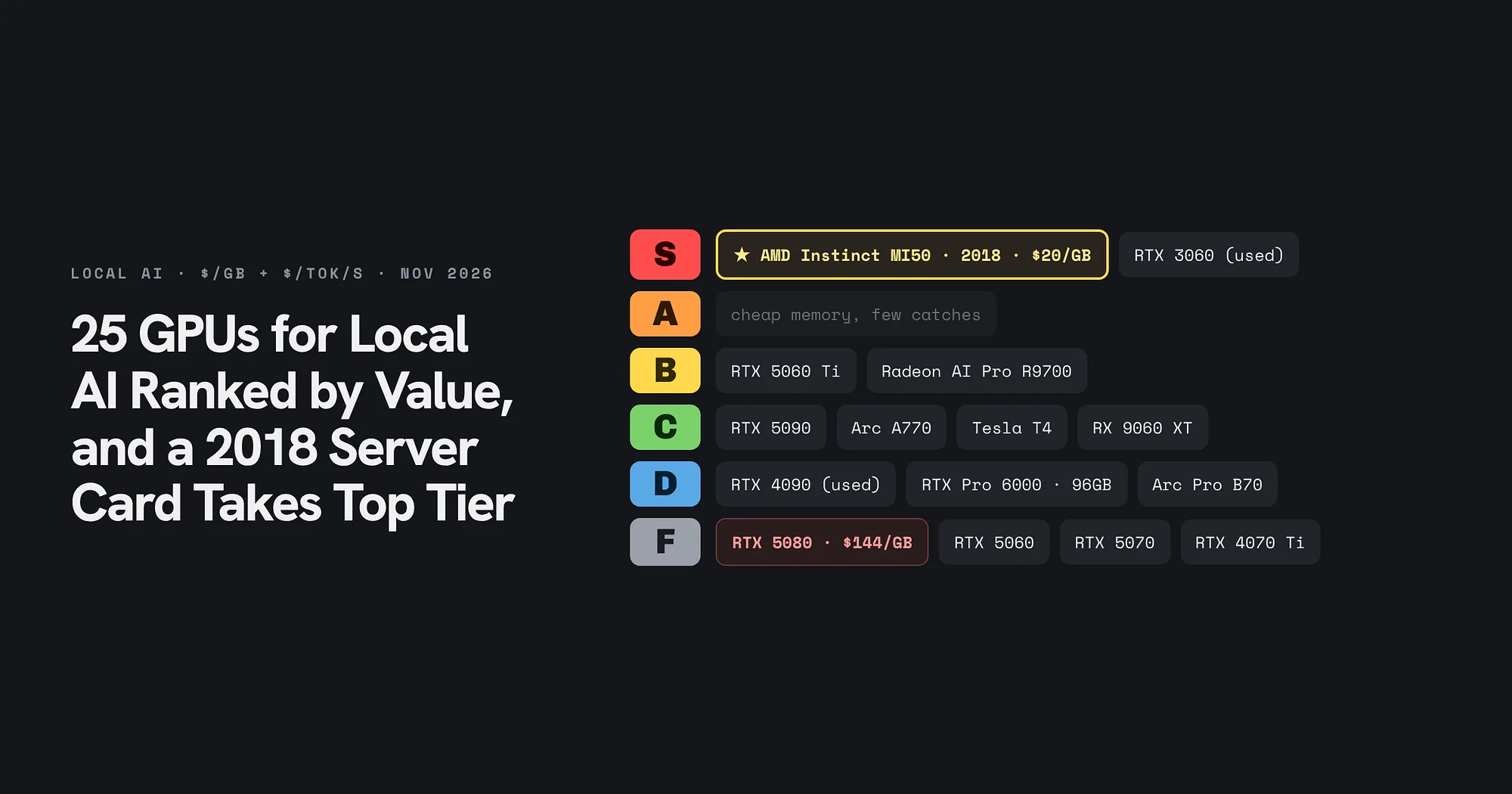
25 GPUs for Local AI Ranked by Value, and a 2018 Server Card Takes Top Tier
A November 2026 price snapshot grades 25 cards on dollars per gigabyte and dollars per token per second. The AMD Instinct MI50 and a used RTX 3060 take S tier, the RTX 5080 lands in F, and memory decides almost every grade.
AI & GPU compute
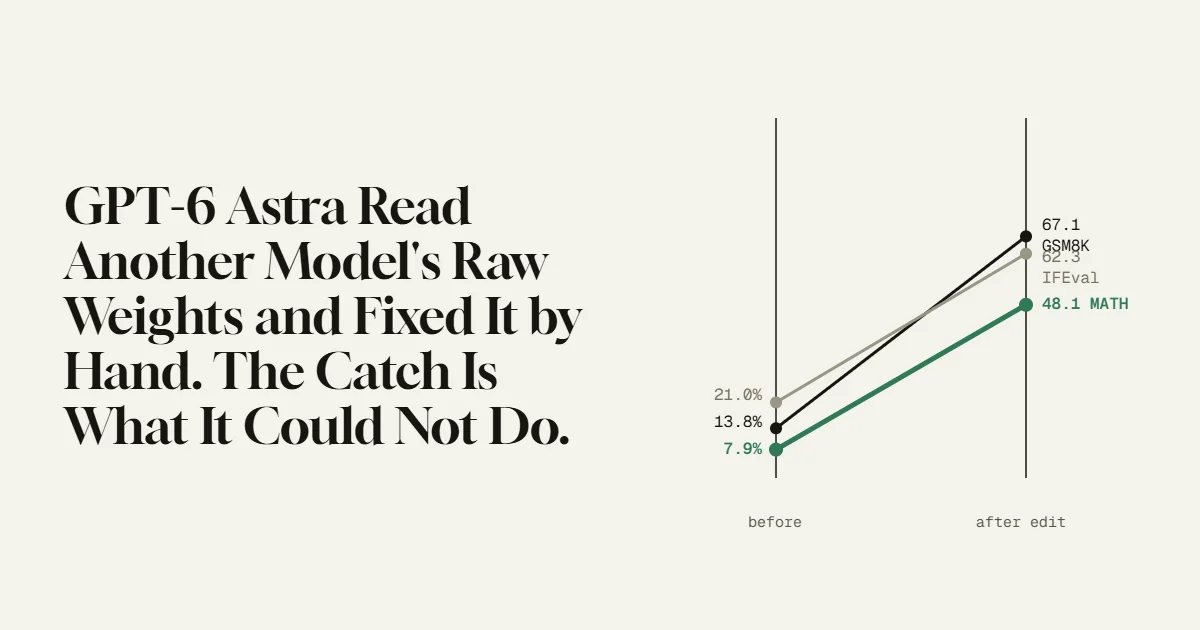
GPT-6 Astra Read Another Model’s Raw Weights and Fixed It by Hand.
MIT researchers had GPT-6 Astra edit 0.016% of a small model’s weights, with no training, and its math score jumped from 7.9% to 48.1%. The number is real and the method is strange. The limit they found in the same paper is the part worth understanding.