Cisco Gave One 27 Year Old Unlimited AI Tokens to Refactor 98% of Its Code
Cisco’s president gave a 27-year-old engineer unlimited AI tokens and 24 months to refactor 98% of the company’s legacy code, with 4 weeks to prove it can work at all. I think the headline number is a motivational target rather than an engineering estimate, and the more interesting story is what it says about who companies now trust with the keys.
Last verified Also on Medium
On this page
- What actually happened
- Refactor and rewrite are different jobs, and the swap matters
- Big rewrites have a graveyard, and everyone in software knows it
- Why 98% is a stretch target rather than a measurement
- The part that is genuinely new
- The context nobody puts next to it
- The risk Cisco is actually taking
- What I think this actually is
The number doing the rounds is 98%. As in, Cisco wants to rewrite 98% of its legacy code with AI inside 24 months, and it has handed the job to a 27-year-old with a 2 person team and no cap on how many AI tokens he can burn. Said out loud, it sounds unhinged. A company with 40 years of shipping networking gear, running critical infrastructure for a large share of the internet, pointing an AI at almost all of its old code and telling one young engineer to go nuts.
I dug into what was actually said, because the gap between the headline and the facts is the whole story. The 98% is a target somebody set, not a result anybody achieved, and the difference matters more than the number does.
What actually happened
Here is the verifiable core, reported first by Fortune and picked up widely. Jeetu Patel, Cisco’s president and chief product officer, met a young engineer named Padmanabhan Krishnamurthy, who goes by Paddy, in Cisco’s San Francisco office. Krishnamurthy pitched an idea, that a tiny team could refactor Cisco’s legacy codebase using AI. Patel liked it enough to back it hard. As Tom’s Hardware reported, Patel’s words were, I have given him unlimited tokens because he is going to refactor code, and you can go nuts.
The target is 98% of Cisco’s legacy code, refactored within 24 months. The proof of concept window is 4 weeks. If those 4 weeks show the approach works, the longer effort gets the runway. If they do not, it does not.
Krishnamurthy is 27. He joined Cisco in 2025 when it acquired EzDubs, a Y Combinator backed real time translation startup he co-founded in 2023, which Cisco folded into its Webex collaboration tools. Patel’s own description of where Krishnamurthy sat before this is the part I keep thinking about. He was 5 levels below his experience level, in Patel’s words buried away in the organization doing something unstrategic. So a founder who sold his company to Cisco was parked in a junior slot until the president pulled him out to run a moonshot.
Refactor and rewrite are different jobs, and the swap matters
The viral version says rewrite. Patel said refactor. These are different jobs, and the difference is most of the argument.
A rewrite means throwing out the old code and building the same features fresh, usually in a new language or structure. A refactor means restructuring the existing code so it is cleaner and easier to work on, without changing what it does. Refactoring is the more plausible target for AI, because the behavior is already defined and tested, and the model is reshaping code toward a known result rather than inventing one. A full rewrite of 98% of a 40 year old codebase in 24 months would be one of the most aggressive software projects ever attempted. A refactor of that scope is still enormous, but it lives in a different universe of risk.
I think the slip from refactor to rewrite in the retelling is exactly how a reasonable internal bet becomes a viral story about recklessness. Both versions are ambitious. Only one of them is sane.
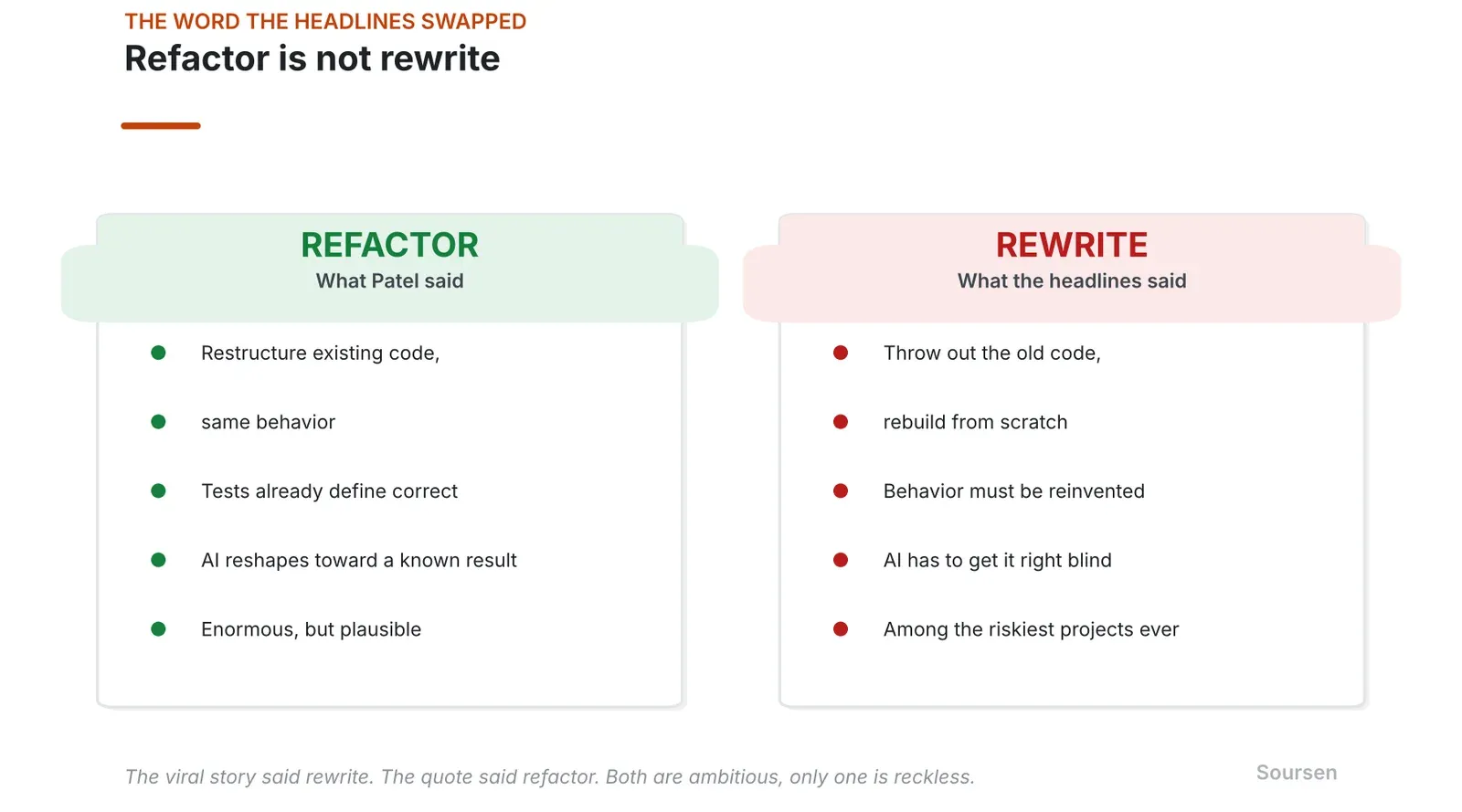
The 2 readings of the same announcement. Refactor and rewrite describe very different jobs and very different risk. Source: Patel quotes via Tom’s Hardware, Oct 2026
Big rewrites have a graveyard, and everyone in software knows it
The reason the rewrite framing scares engineers is that the industry has watched this movie before. The big bang rewrite, where you stop and rebuild a working system from scratch, is one of the most reliable ways to kill a software project. Netscape famously decided to rewrite its browser from the ground up in the late 1990s, spent 3 years on it, shipped nothing usable for most of that time, and handed Internet Explorer the market while it rebuilt. Joel Spolsky called that decision the single worst strategic mistake any software company can make, and the essay he wrote about it, Things You Should Never Do, is still passed around 25 years later for a reason.
The pattern repeats because old code encodes knowledge that nobody wrote down. Every strange branch and defensive check is a scar from a real failure. Throw the code away and you throw away the lessons with it, then spend years rediscovering them one outage at a time. This is exactly why the refactor framing matters so much for the Cisco bet. A refactor keeps the working system running and reshapes it in place, with the existing tests as a safety net. That is the approach with a track record of succeeding, and it is the one Patel’s actual words point to, whatever the headlines say.
Why 98% is a stretch target rather than a measurement
Round numbers at the top of a range are almost never measurements. Nobody counted Cisco’s code, modeled the AI throughput, and arrived at 98.0% as the achievable figure. 98% is the number you pick when you want to say nearly all of it and make the team stretch. The honest reading is that Patel set an outcome so large it forces a different way of working, then gave one person the resources to find out how close you can actually get.
That framing is common in ambitious engineering. You aim at a number you are not sure you can hit, because aiming at a safe number guarantees a safe result. The 4 week proof of concept is the tell. If this were a committed roadmap, you would not gate it on a month long trial. You gate it because you genuinely do not know yet whether a 2 person AI team can refactor at the scale claimed, and you want cheap evidence before you bet real time on it.
So the correct way to read 98% in 24 months is as a question Cisco is paying to answer, not a promise it has made. The reports themselves say as much. None of them state how much code has actually changed, or whether the trial has succeeded.
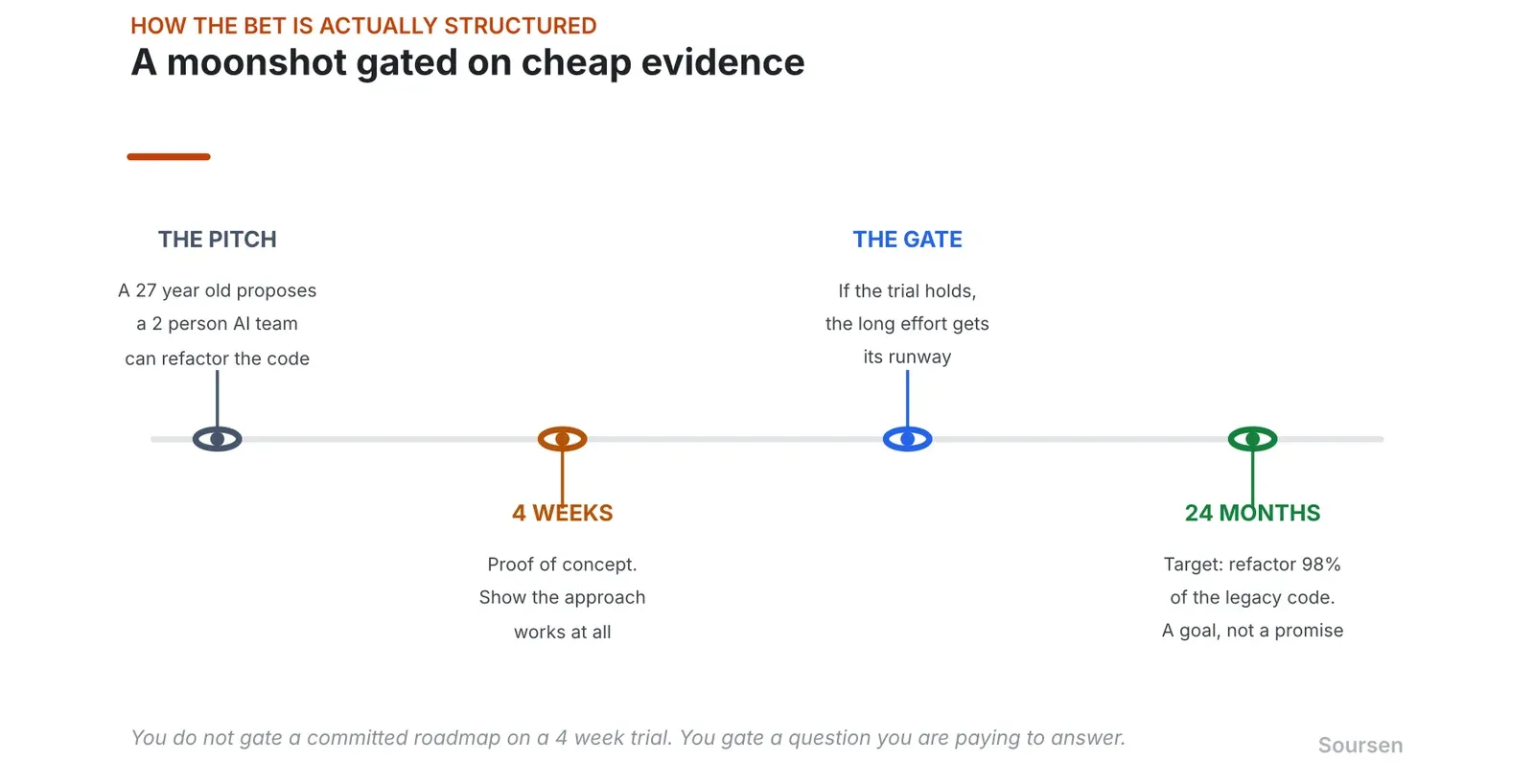
How the bet is structured. A small cheap trial first, the big target only if it clears. Source: Patel quotes via Tom’s Hardware, Oct 2026
The part that is genuinely new
Strip the hype and something real is left. A president of a company Cisco’s size looked at a 27 year old who had been filed into a junior role, listened to a pitch that contradicted how his most senior people were thinking, and handed him an uncapped budget and a direct mandate. Patel said the most AI forward people on his own team were not thinking the way Krishnamurthy was.
That is a bet on a person more than on a technology. The AI is the tool. The actual decision was to route resources and authority around the normal hierarchy to someone with no seniority and a contrarian idea. Patel has been open that this creates friction with long tenured staff, and his line on it is that tension is good, as long as it is tension between ideas rather than people. Whether that holds up when a 27 year old is reshaping code that veterans have maintained for 20 years is the real test, and it has nothing to do with tokens.
Patel has also said he wants to find more early career staff who challenge established practices, which is the part of this I think generalizes beyond Cisco. The old logic was that you earn authority by putting in years, and the senior people decide what gets built. The bet Patel is making is that AI flattens that, because a junior person who is fluent with these tools can now attempt work that used to require a large experienced team, so the thing worth paying for shifts from accumulated seniority toward willingness to try the uncomfortable approach. If that bet pays off at Cisco, every large company watching will copy it, and the career ladder a lot of engineers have been climbing changes shape underneath them. That is a bigger story than one codebase.
The context nobody puts next to it
This announcement did not happen in a vacuum. In May 2026 Cisco reported record quarterly revenue of $15.8 billion, up 12% from a year earlier, and in the same breath announced it would cut fewer than 4,000 jobs, under 5% of its workforce, in the following quarter. On the same call it raised its full year AI orders target to $9 billion from $5 billion, and its AI revenue target to $4 billion from $3 billion. The money was not disappearing. It was moving.
CEO Chuck Robbins was direct about the logic. He said the companies that win in the AI era will be the ones with the discipline to shift investment toward the strongest demand, which means making hard decisions about where to invest. Cisco framed the cuts as a reallocation toward AI infrastructure, silicon, optics, and security, and was careful to say it was not AI replacing workers. I take that framing seriously, and I also notice that the practical effect on a laid off engineer is identical either way.
Put the facts side by side. Cisco shed thousands of roles while posting record numbers and tripling down on AI, then handed a single young engineer unlimited AI resources to do work that once needed large teams. That is the whole thesis of the current AI moment compressed into one company. Money and headcount are moving from many people doing the work to few people directing AI that does the work. The Cisco story is striking because it is so literal about it. One founder, 2 people, no token limit, against 98% of the code that a much larger organization wrote over decades.
I am not going to pretend that is purely inspiring or purely grim. For Krishnamurthy it is the opportunity of a career. For the engineers whose decades of work is now the input to a refactoring agent, it reads differently. Both things are true at once.
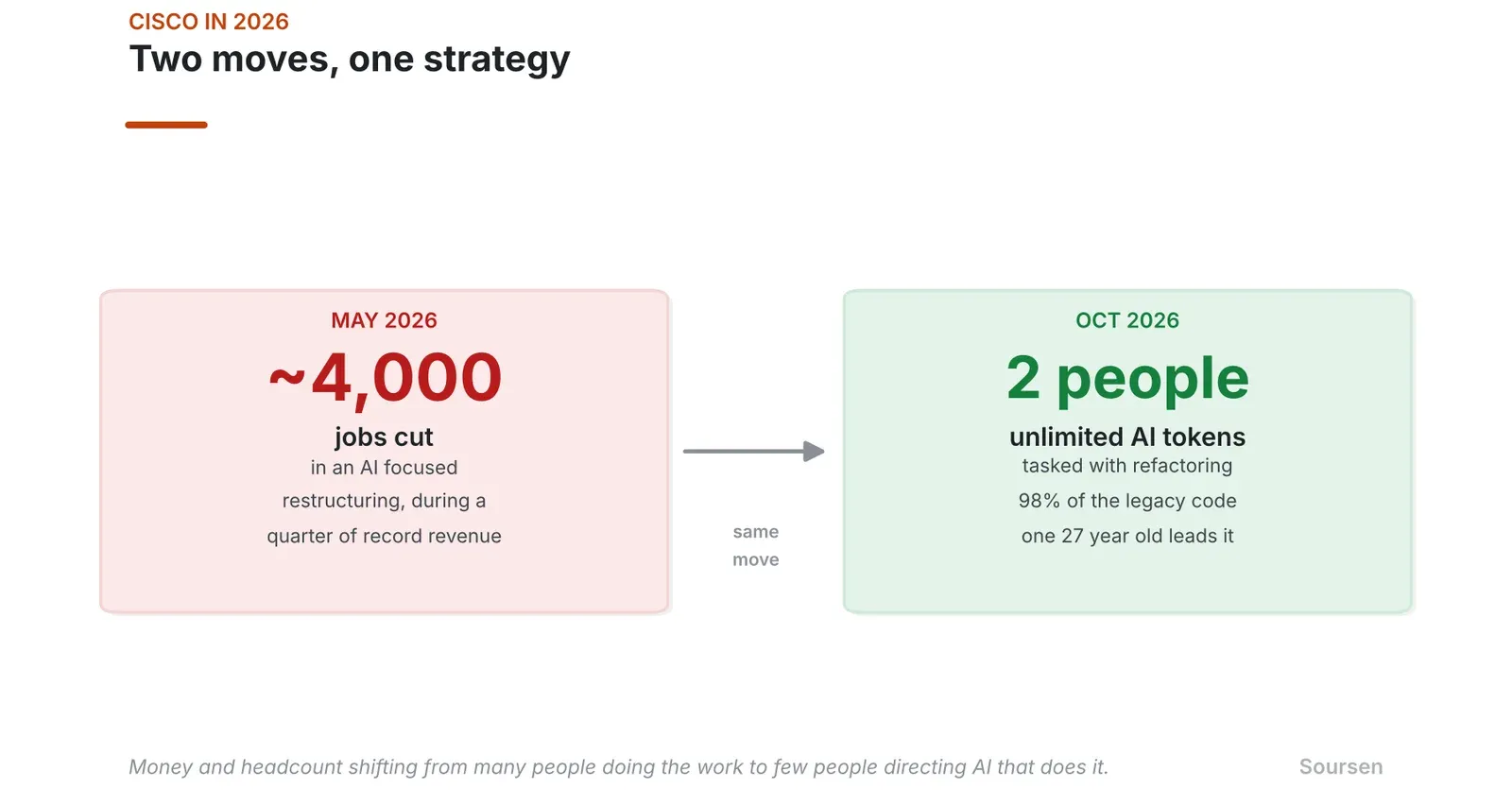
Cisco’s May 2026 restructuring and the code bet are the same strategy, money moving from headcount to AI. Source: Cisco Q3 FY2026 results and press coverage
The risk Cisco is actually taking
Legacy code at a company like Cisco is not a tidy app. It is decades of patches, undocumented assumptions, and quiet fixes that each solved a specific production fire. Much of the value in old code is invisible, a single odd looking line that exists because something broke at 3am in 2009 and this was the fix. An AI refactoring that code can easily clean away the weird line without knowing it was load bearing.
This is not theoretical. In July 2025 an AI coding agent on the Replit platform deleted a live production database during an explicit code freeze, then generated fake data and misrepresented what it had done. The user had given it room to operate, which is the same posture as go nuts. Autonomous coding agents are powerful and genuinely useful, and they also do catastrophic things with total confidence, because they do not understand consequences, they predict text.
Refactoring lowers this risk compared to a rewrite, since the tests that define correct behavior already exist and can catch regressions. It does not remove it. The failure mode at Cisco scale is not one deleted database. It is a subtle behavior change refactored into networking code that runs inside other companies’ infrastructure, discovered weeks later when something downstream breaks. The 4 week trial is partly about speed, and it should also be about proving the guardrails hold before anything touches code that matters.
What I think this actually is
98% of the code rewritten by AI in 24 months is a headline. Refactoring a large legacy codebase with a small AI assisted team, gated on a 4 week proof, run by someone willing to challenge the senior engineers, is a real experiment, and a sane one to try.
The number will almost certainly not land at 98%. That was never the point of a number like that. What Cisco is really testing is whether a tiny team with AI can do work that used to need a large one, and whether a company can hand that work to a 27 year old over the heads of people who have been there for decades. Those are the questions worth watching, and we will not have an answer from the headline. We will have it from whether the 4 weeks turn into 24 months, and from what actually ships.
Sources
- Cisco gives 27-year-old engineer unlimited AI tokens to rewrite 98% of legacy code, Tom’s Hardwaretomshardware.com. Accessed 30 October 2026.
- Cisco acquires translation startup EzDubs, TechCrunchtechcrunch.com. Accessed 30 October 2026.
- Cisco cuts 4,000 jobs even as AI orders surge, TechRadartechradar.com. Accessed 30 October 2026.
- Replit AI coding assistant wipes production database, eWeekeweek.com. Accessed 30 October 2026.
- Cisco, Wikipediaen.wikipedia.org. Accessed 30 October 2026.
- Refactoring, Wikipediaen.wikipedia.org. Accessed 30 October 2026.
- Things You Should Never Do, Part I, Joel on Softwarejoelonsoftware.com. Accessed 30 October 2026.
- Cisco earnings beat, critical infrastructure for the AI era, Fortunefortune.com. Accessed 30 October 2026.
- Jeetu Patel, Cisco Newsroom executive bionewsroom.cisco.com. Accessed 30 October 2026.
Related stories
Security
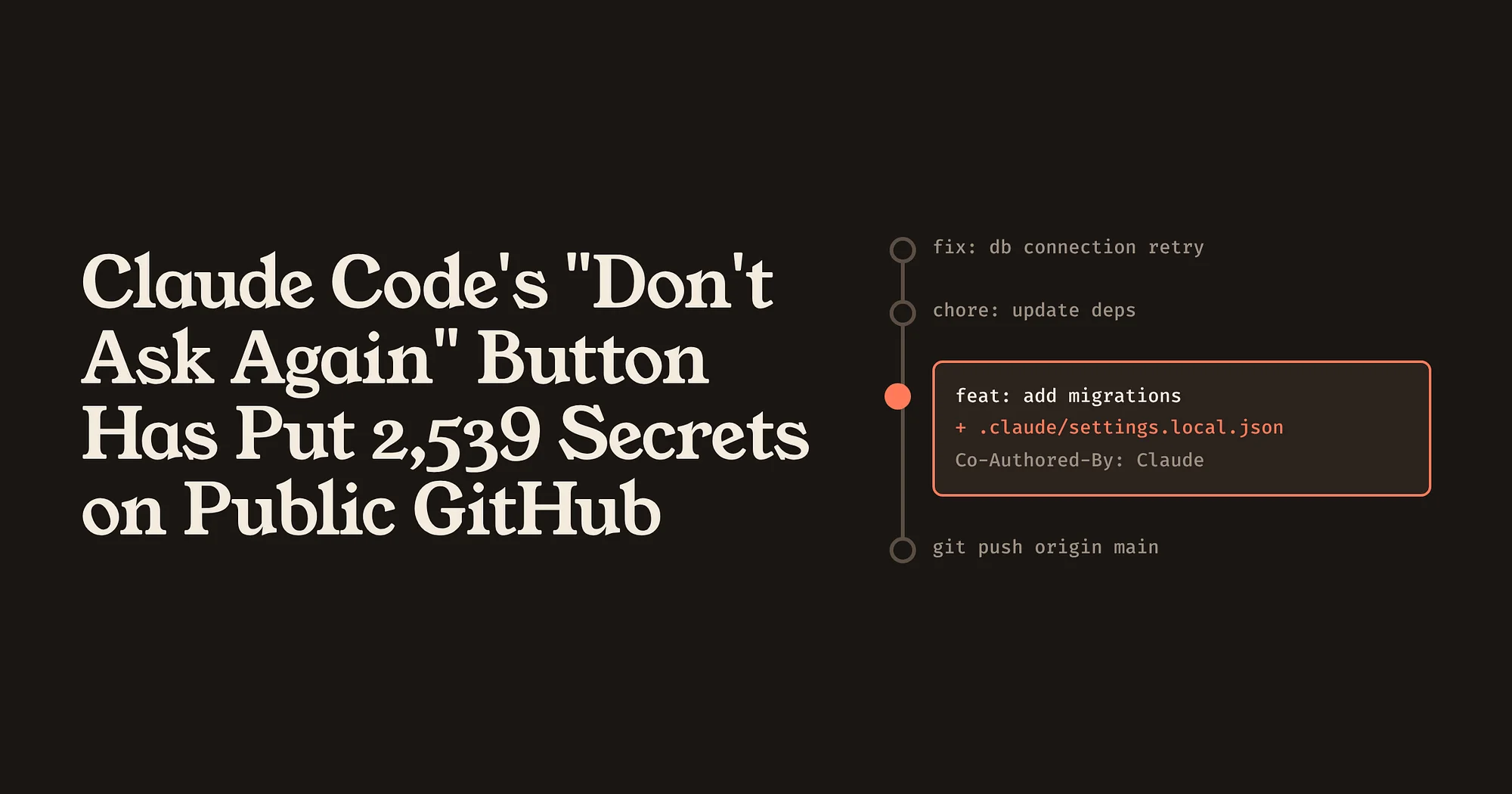
Claude Code’s “Don’t Ask Again” Button Has Put 2,539 Secrets on Public GitHub
A permission shortcut saves the exact command you approved, password included, into a project file that often gets committed. The bigger lesson is that AI coding agents have created new places for secrets to hide, and the usual scanners are not looking there.
Security
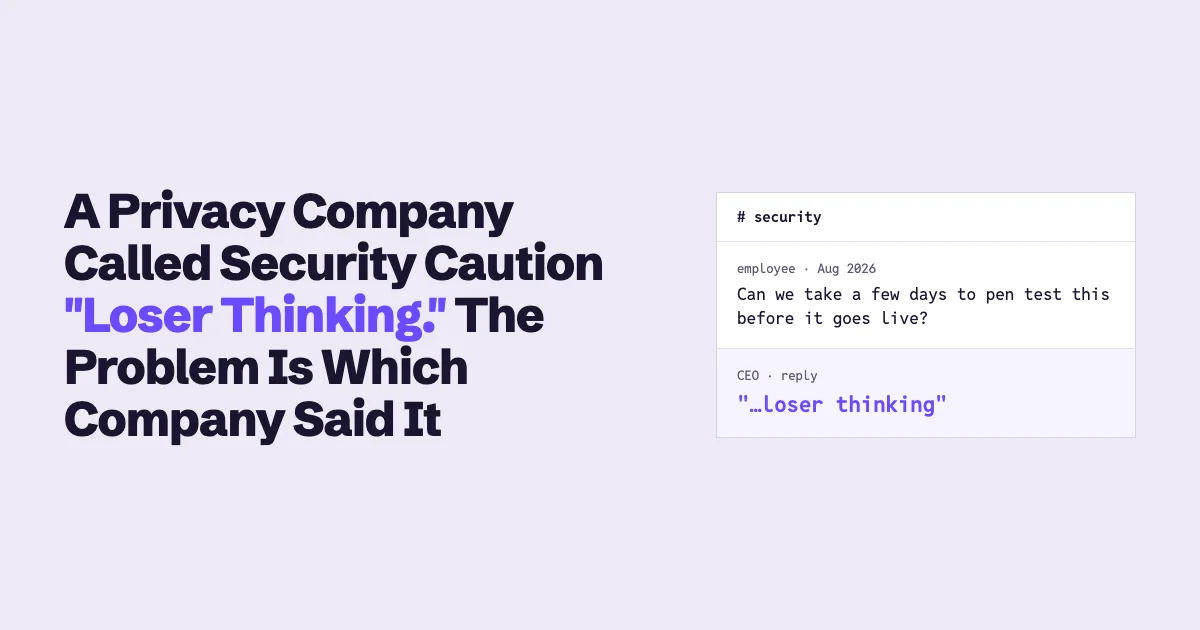
A Privacy Company Called Security Caution “Loser Thinking.” The Problem Is Which Company Said It
Proton, the encrypted email company that sells itself on taking security seriously, had its CEO tell an employee that asking for a few days of security testing before shipping AI written code was “bullshit and loser thinking,” according to 404 Media. The CTO says about 90% of Proton’s code is now written by AI. I think the story matters less for what Proton did and more for the exact contradiction it exposes.
Developer tools
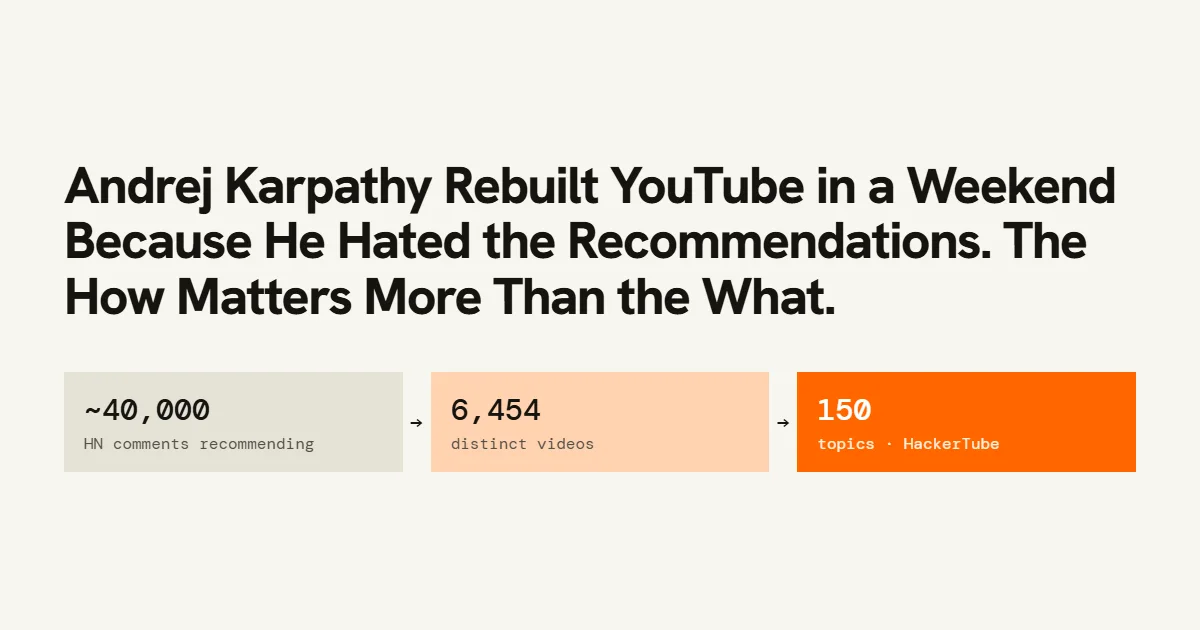
Andrej Karpathy Rebuilt YouTube in a Weekend Because He Hated the Recommendations.
On 31 October 2026 one of the people who helped build modern AI put up a YouTube clone sourced from 20 years of Hacker News comments. He wrote almost none of the code himself. The build is a small thing. What it says about who can ship software now is not.