A Privacy Company Called Security Caution “Loser Thinking.” The Problem Is Which Company Said It
Proton, the encrypted email company that sells itself on taking security seriously, had its CEO tell an employee that asking for a few days of security testing before shipping AI written code was “bullshit and loser thinking,” according to 404 Media. The CTO says about 90% of Proton’s code is now written by AI. I think the story matters less for what Proton did and more for the exact contradiction it exposes.
Last verified Also on Medium
On this page
- What Andy Yen actually said
- The 90% number, and what it does not tell you
- The manifesto that told engineers their job was gone
- The re-interviews, and why they landed badly
- The nonprofit that says it exists for the mission
- Why a privacy company has less room than most
- The quote that explains the rest
- What this is really a test of
Most companies pushing hard on AI are selling you convenience, and if their AI written code ships a bug, you get an annoying outage. Proton sells you privacy. Encrypted email, a VPN, a password manager, the whole pitch is that you trust them with the things you cannot afford to have leak. So when the reporting says Proton’s own CEO called a request to security test new code before release “loser thinking,” the alarming part is which company said it. Moving fast is ordinary. A privacy company treating caution as weakness is the story.
The story broke through 404 Media, reported by Joseph Cox, built on internal Slack messages, leaked documents, audio of an all hands meeting, and 6 current employees. Proton has not disputed the quotes. I went through what was actually said, because the specifics are sharper than the headline.
What Andy Yen actually said
In late August 2026, an employee posted in Proton’s security Slack channel asking the company to take a few days to run penetration testing on new code before pushing it live. Penetration testing is the practice of attacking your own software the way a hacker would, to find the holes before someone else does. For a company whose entire product is security, that is a normal, careful request.
CEO Andy Yen replied, according to 404 Media, that it was bullshit and loser thinking, and that of course it is possible to be fast and secure. He followed with, stop thinking always of how to be slower, and focus more on how to be faster, and separately told engineers to stop lovingly handcrafting all our code and use AI more.
Read that again with the product in mind. The person asking to test before shipping was not sandbagging. They were doing the one thing a privacy company is supposed to do. Being told that caution itself is loser thinking, inside the security channel, is the part that should worry Proton’s users more than any productivity memo.
The 90% number, and what it does not tell you
The other number driving the story comes from Proton’s CTO, Bart Butler. 404 Media reports that in early October Butler told staff that about 90% of Proton’s code was now written by AI, and that employees say much of it is written with Anthropic’s Claude.
That figure sounds enormous, and it is close to meaningless without definition. Written by AI can mean the AI generated a first draft that a human heavily edited, or it can mean the AI wrote code that shipped with light review, and those are completely different risk profiles. Nobody has published how Proton counts it, or how much of that 90% a human actually read before it went live. The number is unaudited, and I would not put weight on it as a measure of anything except how hard the company is pushing.
Anthropic, the company that makes Claude, has said similar things about its own code being mostly AI written. The difference is that Anthropic is an AI lab testing the limits of its own tools on its own product. A privacy company doing the same thing with the code that guards other people’s secrets is a different bet, with other people’s data as the stake.
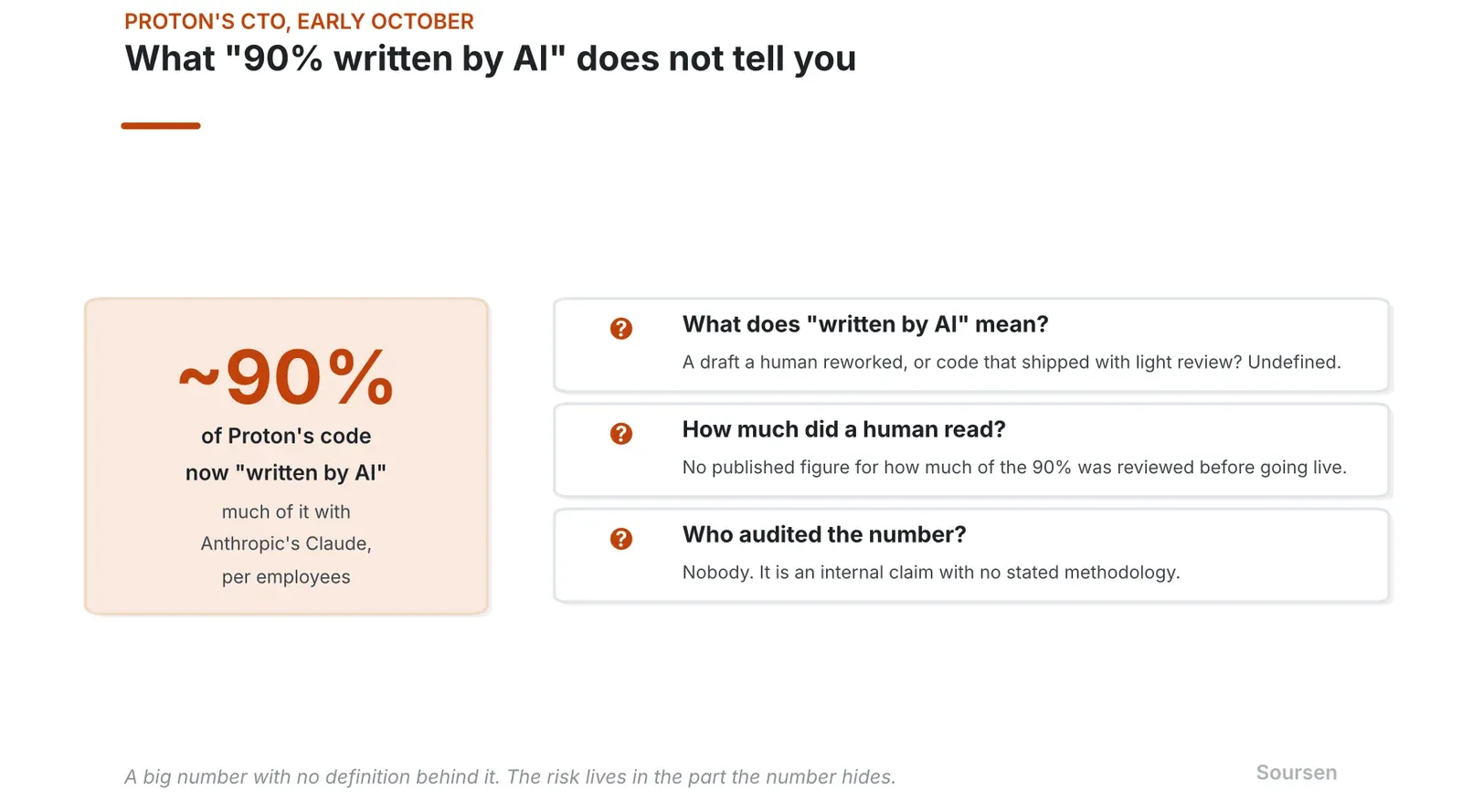
The claim, the caveat, and why “90% written by AI” is not the reassurance it sounds like. Source: 404 Media reporting, Oct 2026
The manifesto that told engineers their job was gone
Around the same time, Butler posted an internal AI manifesto to Slack. The leaked version opens by telling engineers their old job is gone, and frames failure to adopt AI as an existential threat to the success of the mission itself. One line reported from it is blunt about where this goes, that Proton needs to get to the point where most code is not reviewed by humans but by AI.
I actually agree with parts of the manifesto as a description of where software is heading. The argument that an engineer’s job is shifting from writing code to directing and correcting models is a real and defensible read of the moment. Plenty of serious engineering organizations are reorganizing around exactly that idea. The content is not the problem.
The problem is the pairing. A manifesto saying humans should stop reviewing code, published by the same leadership that called human security review loser thinking, at a company whose product is security, reads very differently than the same words would at a company selling food delivery. Context is doing all the work here, and the context is that these are the people holding your encrypted inbox.
The re-interviews, and why they landed badly
The push did not stop at words. 404 Media reports that Proton planned near company wide re-interviews, where employees would have to explain how they use AI, with the metrics feeding into performance reviews and, employees believed, into whether they kept their jobs. An internal email reportedly called the interviews consequential.
On the Friday the story was becoming public, Yen cancelled them. His explanation, per the reporting, was that in an unintentional way they had already served their purpose. Employees read the timing differently. One said the re-interviews were not cancelled until the investigation became public. Another called the whole response consistent with damage control.
To his credit, Yen did own part of it at the all hands meeting. 404 Media quotes him saying there was a communication failure on his part, while adding that he is still going to push, and that a reorganization coming the next month would involve no loss of jobs from AI. Butler was more direct, saying we fucked up, we know we fucked up, and that using AI effectively does not mean giving up on security.
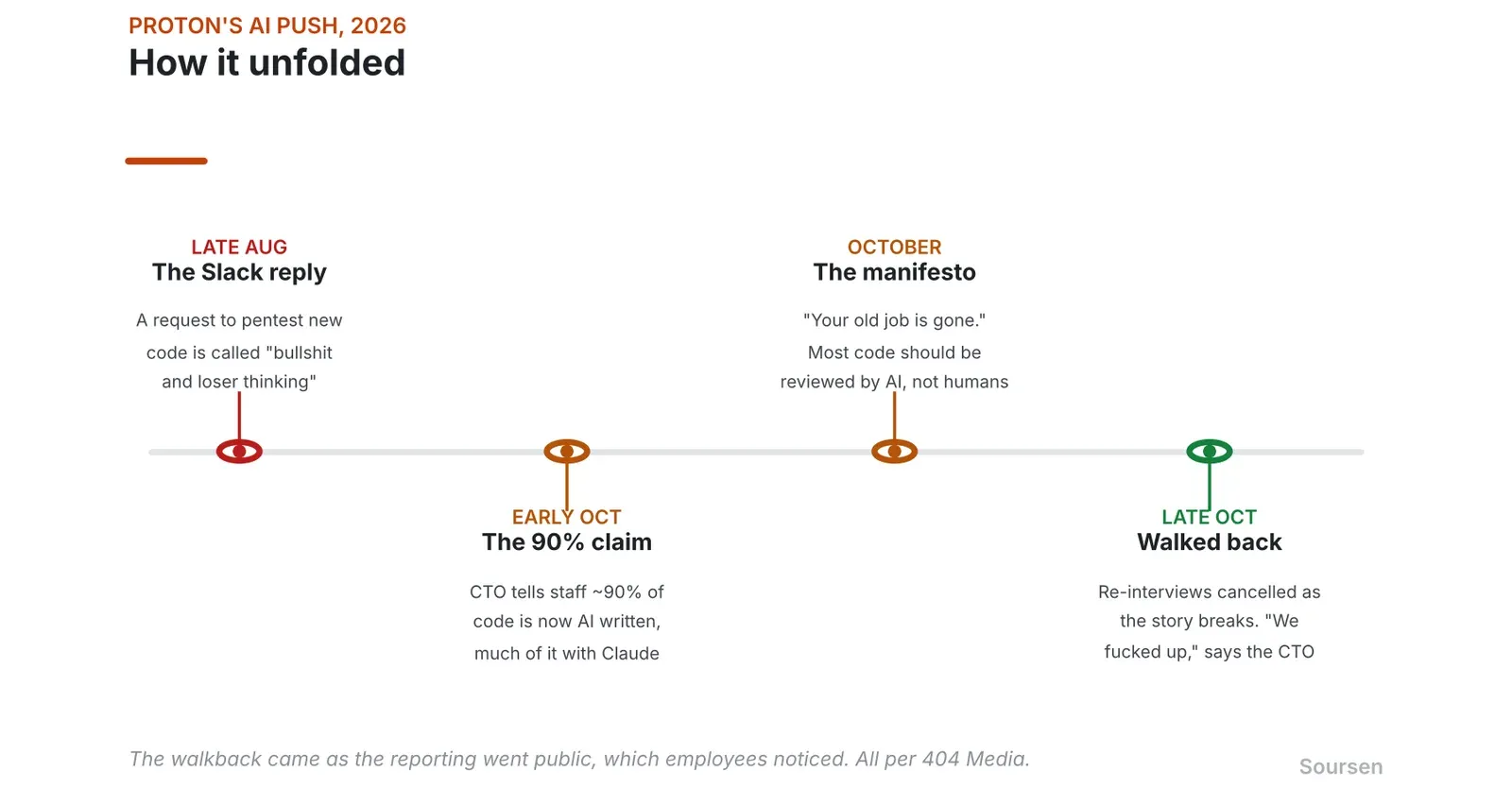
The sequence, from the August Slack reply to the cancelled re-interviews in late October. Source: 404 Media reporting, Oct 2026
The nonprofit that says it exists for the mission
There is a detail that makes this sharper. In June 2024 Proton moved to a nonprofit foundation structure, putting the Proton Foundation in control of the company. Yen framed it at the time as insulating Proton from the pressure to maximize profit, so it could stay loyal to its users and its privacy mission ahead of any shareholder demand. The whole pitch was that the mission comes first and the money follows.
Hold that next to the manifesto, which calls failing to adopt AI an existential threat to the success of the mission itself. The same word, mission, is now the reason to move faster and review less. 404 Media and others report that part of the urgency is commercial, that Proton’s revenue growth had been under pressure and the AI push is partly about protecting it. I cannot audit Proton’s internal numbers, so I will not state them as fact. What I can say is that the mission framing cuts both ways, and the version where the mission justifies shipping code with less human security review is the uncomfortable one for a company that told its users the mission was exactly what would keep them safe.
Why a privacy company has less room than most
Here is the thing a food delivery app can do that Proton cannot. It can ship fast, break something, apologize, and patch it, and almost nobody gets hurt. The cost of a bug is an outage.
For an encrypted service, the cost of a bug is the entire product. The only reason to pay Proton instead of using free email is the promise that your messages stay private. A single security hole in the wrong place does not degrade that promise, it voids it, because privacy is binary in a way uptime is not. You are either secure or you are not, and the person whose data leaks does not care that the other 99% of the code was fine. That is why a security team asking for a few days to test is not friction to route around. At a privacy company, it is the job.
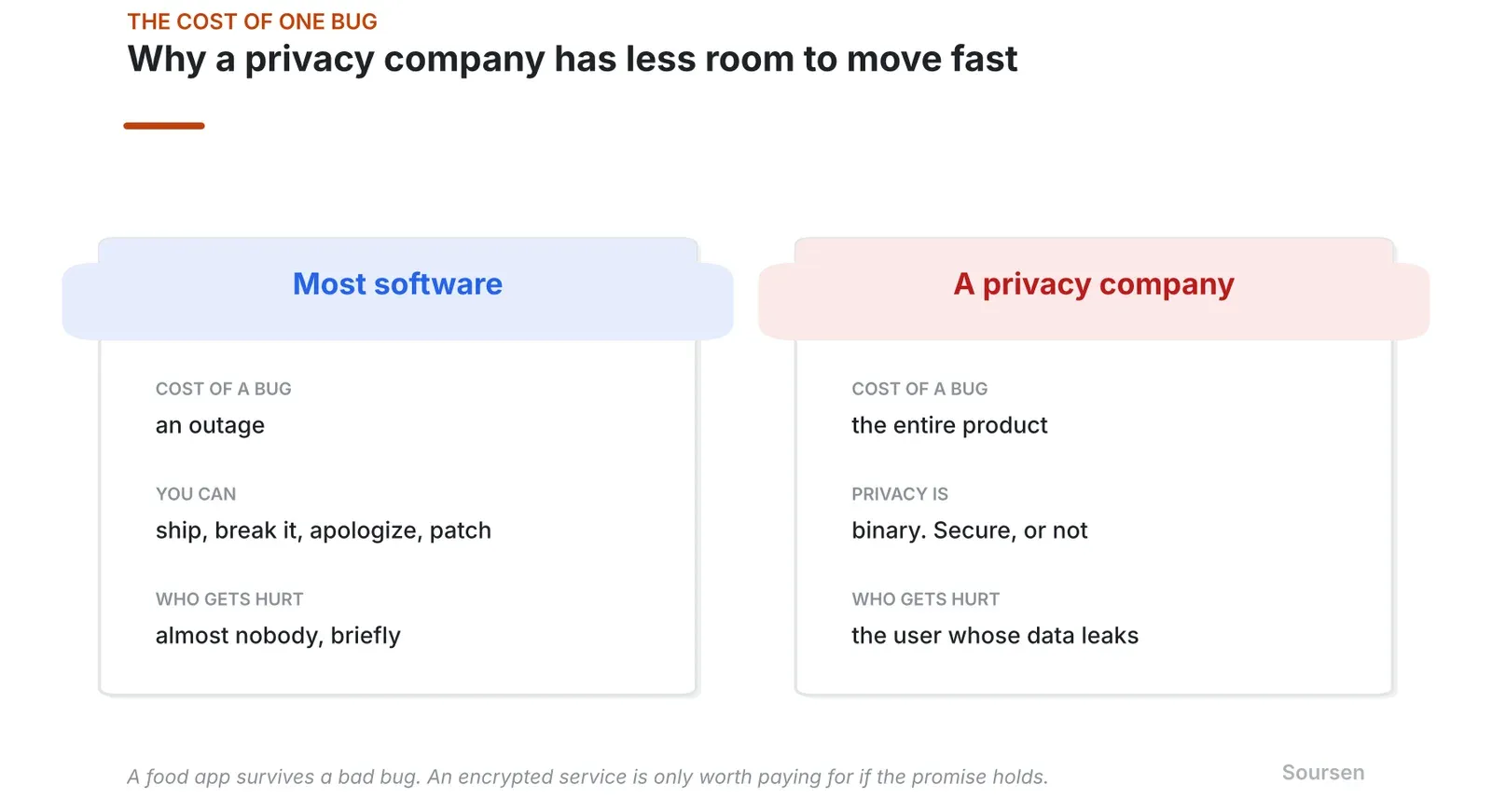
The same bug costs a food app an outage and costs a privacy company its whole reason to exist. Source: Soursen analysis
This is where skipping the review step gets genuinely dangerous, because AI code has a measurable security problem. Veracode’s 2025 GenAI Code Security Report ran 80 coding tasks across more than 100 models and found that when a model could choose a secure or an insecure way to write something, it picked the insecure one 45% of the time. The flaws were not obscure. They were OWASP Top 10 issues like cross site scripting and log injection, the exact category a privacy product cannot afford. Larger models were not meaningfully safer, and security did not improve even as the models got better at writing correct looking code. The AI gets more fluent without getting more careful.
None of this means AI written code is automatically insecure. It can be tested like any other code, and used well it can even find vulnerabilities faster than humans do. The issue reported at Proton is the framing. Leadership treated the testing step as the enemy. You can move fast with AI and keep the security gate. What you cannot do, at a company like this, is call the gate loser thinking, when 45% of the time the thing writing your code is reaching for the insecure option.
The quote that explains the rest
One line from the reporting stuck with me more than the loser thinking one. 404 Media reports that after an employee raised a complaint that had surfaced on Reddit, Yen told a colleague that perception is more important than truth, the truth does not matter if you do not win on perception.
For most CEOs that is a cynical but survivable thing to believe. For the CEO of a company whose only asset is being trusted with the truth of what you say in private, it is closer to a mission statement in reverse. An anonymous employee in the reporting put it more plainly, saying that whatever persona Yen has outside Proton, inside it he is a straight up bully, and another described the mood as the CEO being in full AI psychosis. Those are one sided accounts from people who are angry, and they are worth reading as that. They also do not come from nowhere.
What this is really a test of
Proton is not unusual for pushing AI hard. Almost every software company is, and the general direction, engineers directing models rather than hand writing everything, is probably correct. What makes Proton a story is that it ran the experiment out loud, in the one business where the gap between moving fast and keeping your promise is widest.
The real test has nothing to do with whether Proton can get AI to write 90% of its code. Plenty of companies will clear that bar. The test is whether a company that sells trust can treat the people guarding that trust as an obstacle and still deserve the word privacy on the box. We will find out from Proton’s next security incident, or from the absence of one, and not from any manifesto.
Sources
- Proton’s CEO cancels AI re-interviews, 404 Media404media.co. Accessed 30 October 2026.
- Proton is AI-pilled and calls caution loser thinking, Ben Werdmullerwerd.io. Accessed 30 October 2026.
- Manifestos, fear, and loser thinking, inside Proton’s AI reckoning, Tildes discussiontildes.net. Accessed 30 October 2026.
- Proton, official siteproton.me. Accessed 30 October 2026.
- Penetration testing, Wikipediaen.wikipedia.org. Accessed 30 October 2026.
- Proton transitions to a nonprofit foundation structure, TechCrunchtechcrunch.com. Accessed 30 October 2026.
- AI generated code poses major security risks in nearly half of all tasks, Veracodeveracode.com. Accessed 30 October 2026.
Related stories
Security
Claude Code’s “Don’t Ask Again” Button Has Put 2,539 Secrets on Public GitHub
A permission shortcut saves the exact command you approved, password included, into a project file that often gets committed. The bigger lesson is that AI coding agents have created new places for secrets to hide, and the usual scanners are not looking there.
Developer tools
Cisco Gave One 27 Year Old Unlimited AI Tokens to Refactor 98% of Its Code
Cisco’s president gave a 27-year-old engineer unlimited AI tokens and 24 months to refactor 98% of the company’s legacy code, with 4 weeks to prove it can work at all. I think the headline number is a motivational target rather than an engineering estimate, and the more interesting story is what it says about who companies now trust with the keys.
Security
Your AI Agent Is Probably Driving an Outdated Browser With the Sandbox Switched Off
Playwright bundles its own Chromium that lags Chrome stable, and it launches with the sandbox off by default. For a human running tests that is a small risk. For an AI coding agent browsing the open web on your laptop, it is a bigger one. The fix takes 2 settings.