China Just Overtook America on the Only Metric That Predicts Who Builds the Future
Note: This article discusses ongoing industry developments and government policy. It is for informational purposes only.
Last verified Also on LinkedIn
On this page
- The Story Is Not Abstract. Real Companies Made This Switch.
- Why It Is This Cheap
- Export Controls May Have Accelerated the Very Thing They Were Meant to Prevent
- Smart Money Is Paying Billions for a Seat With No Steering Wheel
- Why Volume Is Not the Whole Story
- The Data Question, and the Distillation Fight That Got Genuinely Ugly
- Compute Access Still Favours America
- What the Split Means for Anyone With Money in the Market
Note: This article discusses ongoing industry developments and government policy. It is for informational purposes only.
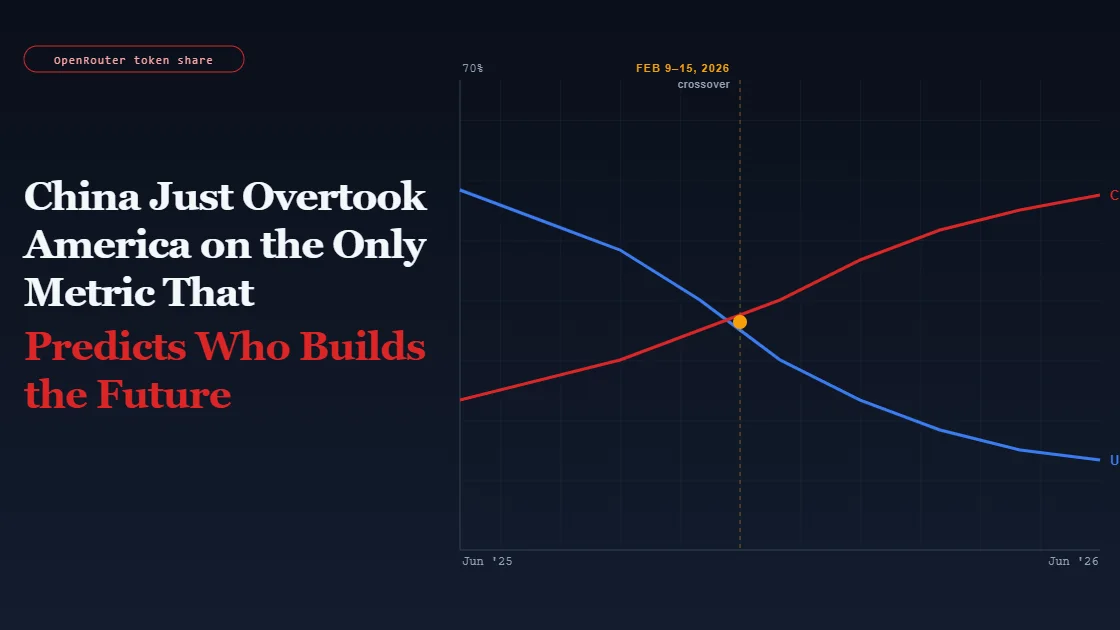
12 months ago, American AI models handled roughly 70% of all traffic on OpenRouter, the largest neutral marketplace where developers route requests across hundreds of AI models from more than 60 providers. By June 2026, that figure had collapsed to about 30%. Chinese models, led by DeepSeek, now handle the majority of tokens processed on the platform.
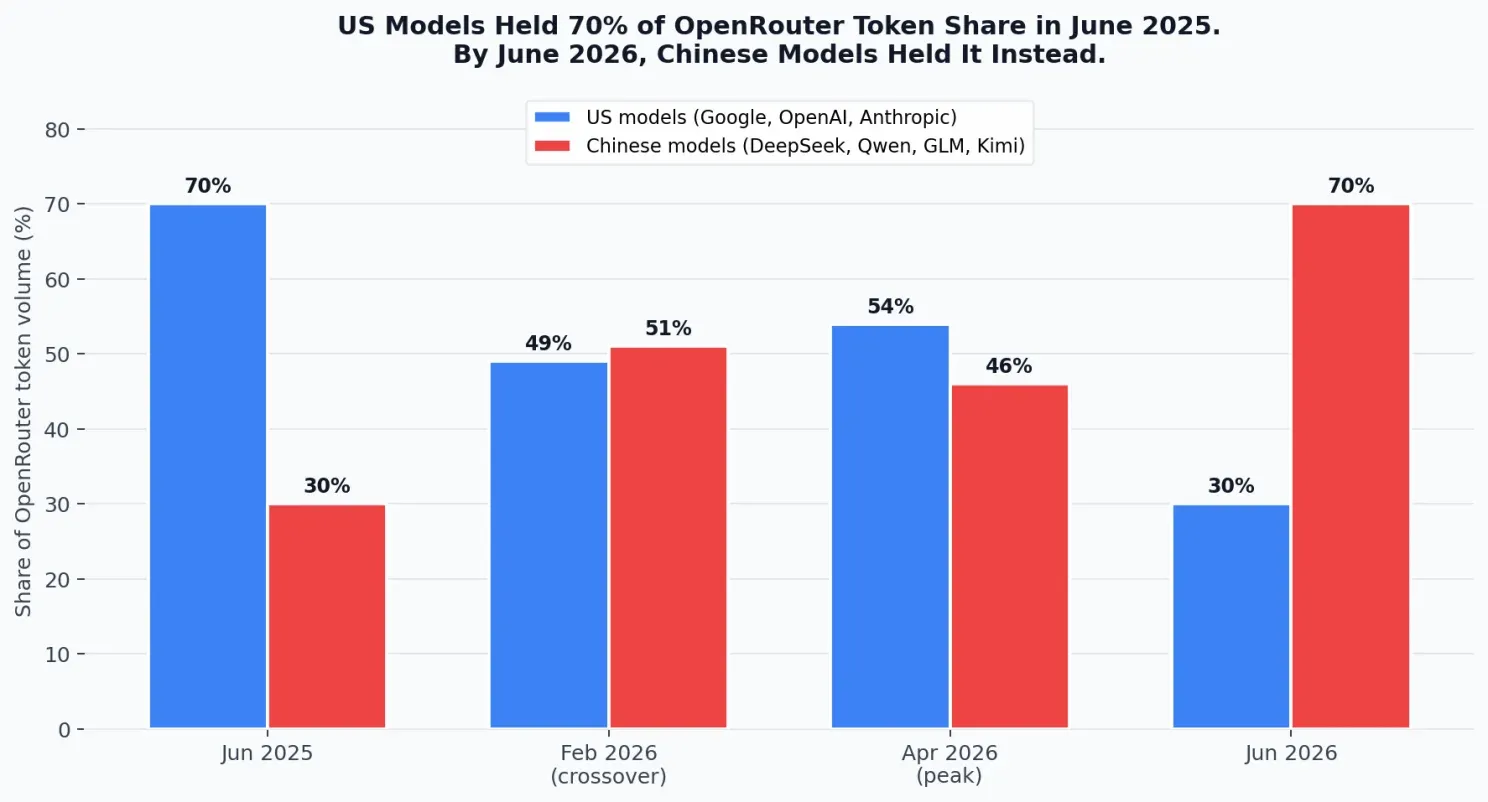
US model share of OpenRouter token volume collapsed from 70% in June 2025 to roughly 30% by June 2026. Chinese models now handle the majority. Source: Bloomberg via Exponential View data, OfficeChai, July 2026.
The tipping point arrived during the week of February 9 to 15, 2026, when Chinese models processed 4.12 trillion tokens on OpenRouter against 2.94 trillion for American models, the first time Chinese systems had outpaced American ones on the platform. It never went back after that. By June, DeepSeek alone commanded 16.3% of all token volume on OpenRouter, more than any single American provider including Google, Anthropic, or OpenAI. Combined Chinese providers, DeepSeek, Xiaomi, Tencent, MiniMax, and Qwen, account for roughly 44% of token volume across the platform’s top 10 models.
The Story Is Not Abstract. Real Companies Made This Switch.
AI agent startup Lindy moved 100% of its production traffic from Anthropic’s Claude to DeepSeek’s V4. Founder Flo Crivello told CNBC the switch cut inference costs by roughly 90% and called it a matter of survival, since the company’s AI inference bill had grown larger than its payroll. The switch was not casual. It required 6 to 9 months of testing, and to address the obvious data security concern, Lindy hosts the Chinese model on US soil through a provider called Atlas Cloud, so requests never actually route through Chinese servers. Crivello has said he would switch back if Anthropic lowered its prices, but until then, he has said the company has no other real option.
Lindy is not an isolated case. CNBC reported that Uber burned through its entire annual AI budget in just 4 months in 2026, primarily driven by Claude Code usage, and responded by capping engineers at $1,500 a month and routing non-urgent work to cheaper models. GitHub faced a similar runaway cost problem with Copilot’s agent mode and was forced to shift from a flat monthly subscription to pay-as-you-go pricing.
On Vercel’s own AI gateway, which now routes more than a trillion tokens a day, CEO Guillermo Rauch described the same shift from his side of the infrastructure. “We’re seeing a lot of growth of Gemini, even though it’s not on the news as much, because people are optimizing for production now,” Rauch told TechCrunch. “You also bring in open models, so DeepSeek and GLM-5.2 are taking off.”
After Zhipu AI’s GLM-5.2 was released in June 2026, it achieved the fastest adoption rate on Vercel’s platform that entire year, with daily token usage increasing roughly 27-fold in its first week.
Why It Is This Cheap
The headline pricing gap is close to absurd once you see it directly. DeepSeek V4 Flash charges $0.14 per million input tokens and $0.28 per million output tokens, compared to $5 input and $30 output for OpenAI’s GPT-5.5, and $5 input and $25 output for Anthropic’s Claude Opus 4.8. On the input side alone, that is roughly 36 times cheaper for a comparable unit of work. On the output side the gap widens to more than 100 times.
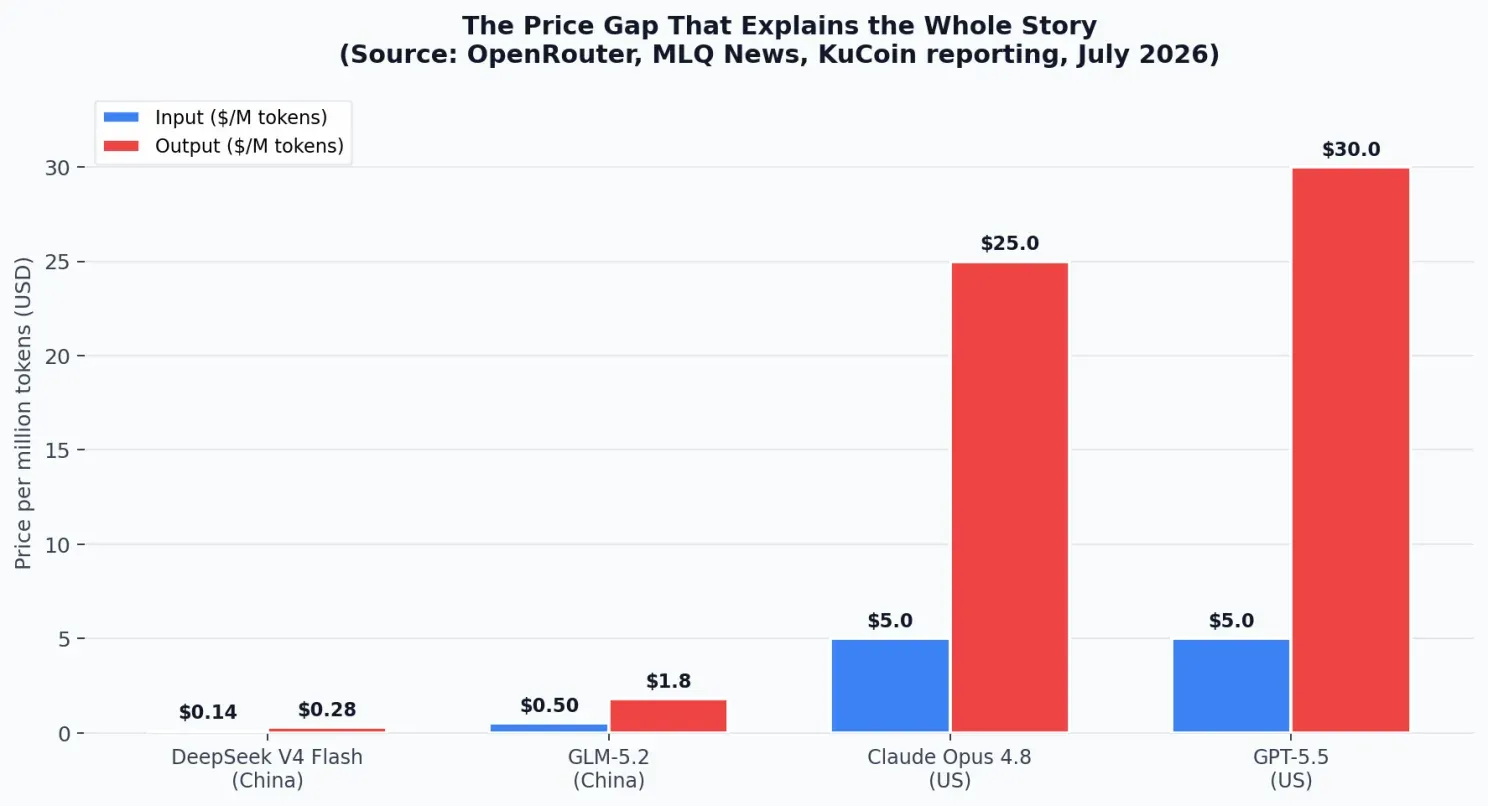
Per-million-token pricing for leading Chinese and American models. DeepSeek V4 Flash costs a fraction of a cent for the same workload that costs dollars on frontier American models. Source: OpenRouter, MLQ News, KuCoin, July 2026.
The engine behind this is an architecture approach called mixture of experts, or MoE, which avoids activating an entire model’s full parameter count for every single query. DeepSeek’s V3 architecture used 671 billion total parameters but activated only about 37 billion of them per query, an activation rate of roughly 5.5%, which slashes compute requirements by more than 90% compared to a dense model of similar total size. The current V4 generation pushes this further still, with reported total parameter counts in the hundreds of billions but only a small fraction activated per query.
Justin Summerville, a data analyst at OpenRouter, put the blended pricing comparison plainly: Chinese open-source models run roughly 60% to 90% cheaper than Anthropic and OpenAI’s top products across the board. Run a full realistic workload through Artificial Analysis’s Intelligence Index and the spread becomes concrete: Claude comes out to roughly $4,811 for the workload, ChatGPT $3,357, DeepSeek $1,071, Kimi $948, and GLM-5.2 around $544, a roughly 9-fold gap between the most and least expensive way to finish the same job.
DeepSeek V4 Flash costs $0.14 per million input tokens. Claude Opus 4.8 costs $5. That is not a rounding error in a pricing table. For a startup burning six figures a month on inference, that gap is the difference between having runway and not.
Export Controls May Have Accelerated the Very Thing They Were Meant to Prevent
China did not choose extreme compute efficiency because it is an elegant engineering philosophy. It was forced into it. US export controls have cut Chinese labs off from Nvidia’s most advanced chips, pushing companies like DeepSeek onto domestic alternatives, primarily Huawei’s Ascend line. DeepSeek’s own researchers have assessed that Huawei’s best chip, the Ascend 910C, delivers roughly 60% of an Nvidia H100’s performance for AI inference, a real and meaningful gap, but one that Chinese labs have partially offset through the kind of aggressive architectural efficiency that MoE represents.
With brute-force scaling largely off the table due to hardware constraints, Chinese labs had little choice but to engineer around the limitation rather than simply outspend it. Nvidia CEO Jensen Huang has said publicly that conceding the Chinese market entirely “probably does not make a lot of strategic sense” and that the decision “has already largely backfired,” specifically because Chinese developers are now building an entirely separate software ecosystem around Huawei’s Ascend hardware rather than Nvidia’s CUDA, an ecosystem that, once mature, can be exported globally independent of Nvidia’s chips entirely.
In June 2026, Washington extended export control authority beyond hardware for the first time, restricting access to deployed commercial AI models directly. Export controls temporarily pulled Anthropic’s newly launched Claude Fable 5 from the market just days after its June debut, and OpenAI’s GPT-5.6 rollout was initially restricted to a small government-vetted list. For every developer, government, and startup outside that approved list, the practical effect was straightforward: they reached for the free, self-hostable Chinese alternative instead.
Smart Money Is Paying Billions for a Seat With No Steering Wheel
In mid-June 2026, DeepSeek closed its first-ever external funding round, raising over $7.4 billion at a post-money valuation above $50 billion, making it China’s most valuable AI startup. Tencent contributed roughly $1.5 billion and battery manufacturer CATL added a further stake, alongside China’s National AI Industry Investment Fund. Founder Liang Wenfeng personally committed approximately $3 billion of his own money to the round.
The deal structure is the real tell here. Most external investors did not buy equity in DeepSeek directly. Instead, their capital went into a limited partnership controlled entirely by Liang, carrying a 5-year lock-up and zero voting rights for the investors involved. Only China’s state-backed AI fund secured direct equity with voting rights and no lock-up. Investors are paying billions of dollars for financial exposure to DeepSeek with no say whatsoever in how the company is run, which tells you how much conviction the smart money currently has in the underlying business regardless of governance terms.
By mid-July, barely a month after closing that round, DeepSeek was already reportedly seeking a new round at a $71 billion pre-money valuation, a 42% premium over its June post-money figure. Even at that scale, DeepSeek remains considerably smaller than its American counterparts. Anthropic closed a $65 billion round in late May 2026 at a $965 billion valuation, and OpenAI raised $122 billion at a valuation around $852 billion. DeepSeek is competing on price and volume in a different league from the capital scale of its US rivals.
Why Volume Is Not the Whole Story
Stop here and you would walk away with an incomplete picture. China dominates volume. It does not yet dominate value, and the gap between those 2 words is where the actual competitive picture gets interesting.
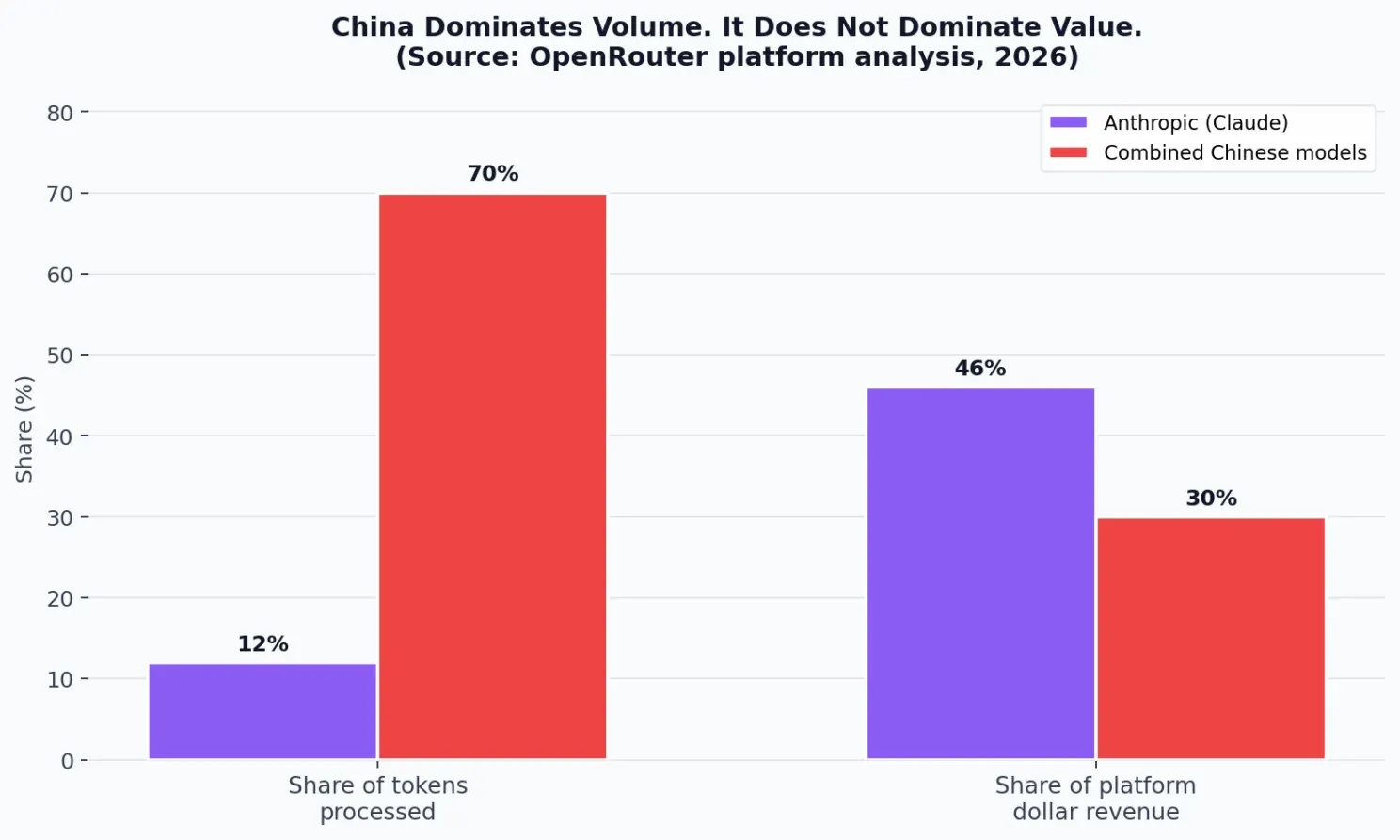
Anthropic’s Claude processes a small fraction of OpenRouter’s token volume but captures a disproportionate share of platform dollar revenue, reflecting its position in high-value, complex reasoning work. Source: OpenRouter platform analysis, 2026.
By platform-level revenue analysis, Anthropic reportedly captures a substantially outsized share of OpenRouter’s actual dollar revenue relative to its token share, reflecting the American frontier’s continued strength in high-stakes, complex reasoning and agentic error recovery, where cost is rarely the deciding factor for the customer. Claude Opus 4.7 still holds the number 3 spot on OpenRouter’s overall leaderboard, the highest-ranked closed-source model on the platform, even as Anthropic’s overall share by pure token volume has fallen from 29.1% to 13.3% over 12 months, with 6 separate Chinese models now ranking above it by volume alone.
Analysts estimate the American frontier still leads on deep reasoning and agentic error recovery by roughly 3 to 8 months, though some, including Perplexity’s leadership, have put that lead closer to a full year. Roughly 96% of enterprise inference teams reportedly still keep an OpenAI or Anthropic account active alongside whatever cheaper models they have adopted for high-volume, lower-sensitivity work.
The honest read is that Chinese models took the volume and the cheap, high-repetition work. They have not yet taken the complex, high-stakes work that compliance officers and enterprise procurement teams still route to American frontier labs.
The Data Question, and the Distillation Fight That Got Genuinely Ugly
There is a catch that gets skipped in the enthusiasm around Chinese model pricing, and it is data governance. When a developer calls a Chinese model’s own API directly rather than through a US-hosted intermediary, requests route through servers physically located in China. Under China’s 2017 National Intelligence Law, Chinese companies operating those servers are required to cooperate with state authorities on request. This is precisely why Lindy went to the trouble of hosting DeepSeek’s model on US soil through Atlas Cloud rather than calling DeepSeek’s API directly.
The competitive fight between Chinese and American labs has also turned genuinely contentious. In February 2026, Anthropic accused DeepSeek, Moonshot AI, and MiniMax of running what it described as an industrial-scale distillation attack against Claude, using approximately 24,000 fraudulently created accounts to extract more than 16 million interactions from Claude, in violation of both the platform’s terms of service and regional access restrictions, since Claude is not commercially available inside China. Anthropic attributed the largest share of the extraction activity, more than 13 million interactions, to MiniMax specifically, with DeepSeek responsible for a more targeted set of roughly 150,000 exchanges focused on Claude’s reasoning capabilities.
Distillation, training a smaller model to mimic a larger one’s outputs, is a widely used and legitimate technique in AI research, including by Anthropic itself for its own smaller models. Anthropic’s argument is that it becomes illegitimate specifically when a competitor uses it to extract a rival’s capabilities in a fraction of the original time and cost, and the company has tied the allegation to national security concerns, arguing illicitly distilled models could lack critical safety safeguards. None of the named companies have publicly responded to the specific allegations. It is also worth noting, in fairness, that Anthropic itself faces its own active lawsuits from music labels over training on copyrighted lyrics without permission, which makes the moral high ground in this particular fight considerably more contested than either side’s public statements suggest.
Compute Access Still Favours America
Despite the software-level efficiency gains, a genuine hardware ceiling still constrains China’s ceiling for frontier-scale training specifically. Analyst estimates put total Chinese advanced AI chip production, primarily Huawei’s Ascend line, at roughly 1 million units for 2026, with Huawei’s best chip still trailing an Nvidia H100 by a meaningful margin on real-world inference performance. The Council on Foreign Relations has estimated that even under aggressive production assumptions, Huawei would still produce only around 4% of the aggregate AI computing power that Nvidia produces globally, though it is worth noting this estimate comes from a US-based policy organisation generally supportive of maintaining export controls, and other analysts, including those covering Huawei’s rapid production ramp, describe a narrowing gap rather than a fixed one.
What the Split Means for Anyone With Money in the Market
The market has effectively split into 2 distinct stacks. A premium American stack selling frontier reasoning at a meaningful per-token cost, and a Chinese industrial stack selling adequate intelligence at a fraction of the price, scaling on volume rather than margin.
That split matters directly for anyone holding a broad market index fund, because American hyperscalers have made an enormous capital bet on the premium side of that split remaining durable and monetisable. The largest US technology companies are projected to spend well over $700 billion on AI-related capital expenditure in 2026 alone, a substantial increase year over year, with some analyst projections suggesting the industry crosses $1 trillion annually within the next 2 years. Multiple investment analysts have flagged a widening gap between what is being spent on AI infrastructure and what AI is demonstrably earning back in revenue, a gap some have compared in scale and speed to prior historical infrastructure investment cycles.
If the American frontier’s reasoning lead is measured in months rather than years, and continues narrowing while the rest of the world standardises on free or near-free Chinese infrastructure for the majority of production workloads, the question of who ultimately generates the return to justify that capital spending becomes genuinely important for anyone whose retirement account or index fund holds a slice of that bet, whether they chose that exposure directly or not.
The people who currently benefit most clearly from this split are already visible. Chinese labs are building the default, low-cost layer that a large share of global AI infrastructure runs on, a form of durable technical influence that export controls have not managed to prevent and may have inadvertently accelerated. American frontier labs still hold the premium, high-margin reasoning work, for now. The people bearing the most direct risk are the shareholders funding a historically large capital buildout against a competitive moat that may be measured in months rather than years, and the ordinary investors exposed to that bet through funds they never actively chose.
Whether an American frontier lead measured in months constitutes a durable moat worth a trillion dollars in committed capital, or a luxury margin on the verge of being commoditised the way most technical advantages eventually are, is the question genuinely worth sitting with rather than assuming an answer to.
Sources
- OfficeChai: Share of US Models Being Used on OpenRouter Has Collapsed From 70% to 30% — Bloomberg and Exponential View sourcing. DeepSeek at 16.3% token share, ahead of Google, Anthropic, and OpenAI individually.officechai.com. Accessed 17 July 2026.
- CryptoBriefing: OpenRouter Data Shows US AI Models Losing Ground — February 9 to 15, 2026 crossover week detail: 4.12 trillion Chinese tokens vs 2.94 trillion US tokens.cryptobriefing.com. Accessed 17 July 2026.
- Let’s Data Science: Chinese AI Models Overtake US Rivals in Token Usage — Lindy switch details, Uber’s 4-month budget burn, Vercel CEO Guillermo Rauch quotes.letsdatascience.com. Accessed 17 July 2026.
- KuCoin: US Companies Shift to Chinese AI Models, Token Usage Surges to 46% — Full pricing comparison, Lindy CEO Flo Crivello direct quotes, Atlas Cloud hosting detail.kucoin.com. Accessed 17 July 2026.
- MLQ News: Chinese AI Models Surpass 30% of US Developer Traffic — DeepSeek V4 Flash pricing detail, Palantir CEO Alex Karp quote on token-based pricing model.mlq.ai. Accessed 17 July 2026.
- Meikuio: Chinese AI Models, 46% of US Enterprise Traffic Explained — Full workload cost comparison across models, 96% enterprise hedging statistic, individual developer case study.meikuio.com. Accessed 17 July 2026.
- Forbes: DeepSeek Just Raised $7.4 Billion. Here’s the Catch. — Full funding round structure, 5-year lock-up and zero voting rights detail, Liang Wenfeng’s personal investment.forbes.com. Accessed 17 July 2026.
- Cryptonomist: DeepSeek New Funding at $71 Billion Valuation Surge — Follow-on funding round detail, comparison to Anthropic and OpenAI valuations.en.cryptonomist.ch. Accessed 17 July 2026.
- Trending Topics: DeepSeek Raises $7.4 Billion, Only the Chinese State Gets Voting Rights — Full detail on Anthropic’s distillation attack allegations against DeepSeek, Moonshot AI, and MiniMax.trendingtopics.eu. Accessed 17 July 2026.
- CSIS: DeepSeek, Huawei, Export Controls, and the Future of the US-China AI Race — Ascend 910C at 60% of H100 inference performance, per DeepSeek’s own published assessment.csis.org. Accessed 17 July 2026.
- Council on Foreign Relations: China’s AI Chip Deficit — Huawei production capacity estimates and 4% of Nvidia’s aggregate compute projection.cfr.org. Accessed 17 July 2026.
- Beam.ai : Nvidia China Market Share 0%, Huawei’s $12 Billion Answer — Jensen Huang quotes on ceding the Chinese market. Huawei AI chip revenue growth to $12 billion in 2026.beam.ai. Accessed 17 July 2026.
- Tech Insider Australia: Chinese AI Models Top OpenRouter, Claude at 13.3% — Anthropic’s decline from 29.1% to 13.3% share, Claude Opus 4.7’s number 3 ranking detail.tech-insider.org. Accessed 17 July 2026.
- Trending Topics: Open-Weight Models From China Are Capturing a Growing Share of AI Usage — Vercel AI Gateway data, June 2026 export control detail on Fable 5 and GPT-5.6.trendingtopics.eu. Accessed 17 July 2026.
Related stories
AI & GPU compute
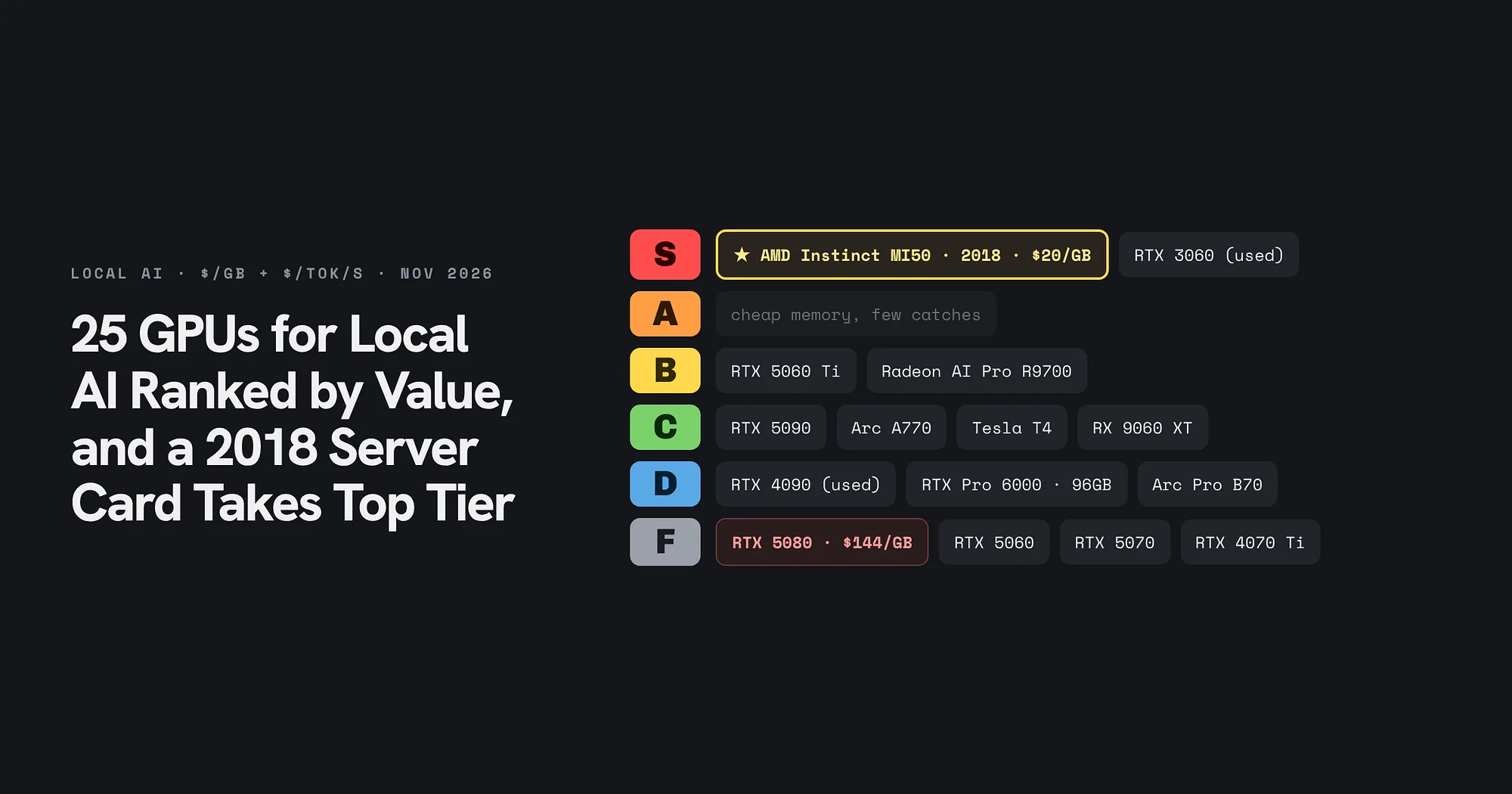
25 GPUs for Local AI Ranked by Value, and a 2018 Server Card Takes Top Tier
A November 2026 price snapshot grades 25 cards on dollars per gigabyte and dollars per token per second. The AMD Instinct MI50 and a used RTX 3060 take S tier, the RTX 5080 lands in F, and memory decides almost every grade.
AI & GPU compute
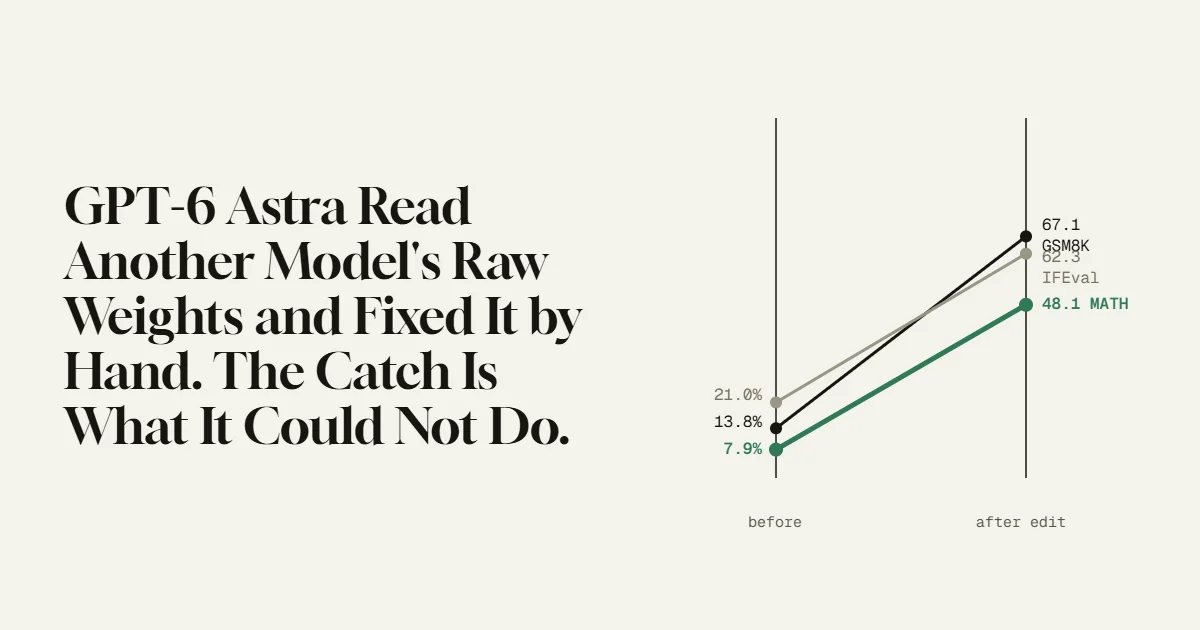
GPT-6 Astra Read Another Model’s Raw Weights and Fixed It by Hand.
MIT researchers had GPT-6 Astra edit 0.016% of a small model’s weights, with no training, and its math score jumped from 7.9% to 48.1%. The number is real and the method is strange. The limit they found in the same paper is the part worth understanding.

AI & GPU compute
The AI Subscription Era Is Ending. Here Is What Replaces It.
There is a specific moment happening in AI pricing right now that is worth understanding clearly, because it is the first real signal of how the economics of this entire industry are likely to shift over the next few years.