Your AI Writing Tool Is Running on Borrowed Time and Borrowed Money
Let me start by asking you something honest. If every AI writing tool disappeared tomorrow, could you still do your job?
Last verified Also on Medium
On this page
- The Money Behind AI Is Not What You Think It Is
- But Wait. Is It Not Working in Business Either?
- How AI Writing Actually Works, and Why That Matters
- The Only Smart Way to Use AI If You Are a Writer
- The Method That Actually Works
- The Specific Questions to Ask AI About Your Draft
- What This Means for Your Career and Where the Real Opportunities Are
- The Thing Nobody Wants to Hear, But You Need to
Let me start by asking you something honest. If every AI writing tool disappeared tomorrow, could you still do your job?
If the answer is yes, great. If there is a long pause before you answer, then this piece is for you. And I want to have a straight conversation with you about something most people writing about AI are not willing to say clearly. AI might not be around in the form you know it forever. And if you have built your writing practice on top of it as a crutch rather than a teacher, that is a problem you need to start solving today.
I know that sounds alarming. So let me show you exactly what I mean, and then I will show you what to do about it. Not in a vague, motivational way. In a concrete, this is the actual thing to try right now way.
The Money Behind AI Is Not What You Think It Is
Here is something most people using AI tools every day have no idea about. The companies building those tools are not profitable. Not even close.
According to internal financial documents obtained by the Wall Street Journal, OpenAI is projected to post roughly $74 billion in operating losses in 2028 alone. The company does not expect to turn a profit until 2030 at the earliest. Over the entire period from 2023 through 2028, OpenAI is forecasting $44 billion in cumulative losses before it sees a single year in the black.
To give you a sense of the scale, Microsoft’s SEC filings revealed that OpenAI lost $12 billion in a single quarter, the three months from July to September 2025. That is not a typo. Twelve billion dollars. In 3 months. From one company and their revenue growth, while real and impressive, is still not keeping pace with how fast the costs are growing.
So where is all the money coming from? Investors. Trillions of dollars of investment capital flowing into AI companies based on a promise of future returns that the companies themselves are not yet able to deliver.
Harvard economist Jason Furman has estimated that AI investment accounted for roughly 92% of US GDP growth in the first half of 2025. Nearly every dollar of economic growth in the world’s largest economy is now connected, in some way, to the assumption that AI will deliver on its promises. That is a staggering level of concentration.
This is not a secret. Financial analysts are talking about it openly. The question they are debating is not whether the math is sustainable. It is whether there is a graceful landing or an ugly one.
THE NUMBERS IN ONE PLACE
OpenAI projected losses: $14B in 2026, $74B operating losses in 2028, total $44B from 2023 to 2028
OpenAI in Q3 2025: lost $12 billion in a single quarter (Microsoft SEC filings)
OpenAI current spend: approximately $1.69 for every $1.00 of revenue it generates
AI investment share of US GDP growth H1 2025: approximately 92% (Harvard economist Jason Furman)
OpenAI expected break-even: 2029 to 2030, assuming everything goes to plan
But Wait. Is It Not Working in Business Either?
Here is the part that gets even more interesting. The pitch to investors has been that corporations will adopt AI at scale, reduce their labour costs, and pay handsomely for the tools that make it possible. That was the whole business case. That was what was supposed to justify the trillions.
It is not working out that way.
A study from MIT found that 95% of generative AI pilots failed to produce meaningful business impact. Not 10%. Not 30%. Ninety-five percent. Boston Consulting Group found that 74% of companies are struggling to generate real business value from AI at any meaningful scale.
Gartner found that 40% of agentic AI projects get cancelled before they even launch and the US Census Bureau, which tracks AI adoption across the economy, recently reported something notable: for the first time since 2023, AI adoption among large companies is dipping, not growing. The six-week rolling average for companies with more than 250 employees dropped from a high of 13.5% to around 12%. That is a small number but it is the first reversal of a previously unbroken upward trend.
Man Group, one of the world’s largest hedge funds, published an analysis at the end of 2025 stating plainly that “it is increasingly a question of when, not if, the AI bubble bursts.”Brookings Institution has published similar analysis. These are not fringe voices. These are mainstream financial institutions doing the math.
None of this means AI disappears tomorrow. Some version of it will absolutely survive. AI tools for translation, image editing, data processing, code completion. Those are genuinely useful, the costs are manageable, and they work. Some will run locally on your laptop or phone without needing a data centre the size of a small city.
What might not survive, or might change dramatically in cost and availability, is the version you rely on right now. The always-on, generate-anything-on-demand model running on someone else’s servers, subsidised by investor capital that is still waiting for a return.
That is the specific version of AI you should not be dependent on.
WHAT THE CORPORATE DATA SAYS
95% of generative AI pilots fail to produce meaningful business impact (MIT)
74% of companies struggle to scale AI value at all (Boston Consulting Group)
40% of agentic AI projects are cancelled before launch (Gartner, 2026)
Large company AI adoption declined for the first time since 2023 (US Census Bureau, 2026)
Built In estimates the AI bubble may be 17 times the size of the dot-com crisis
How AI Writing Actually Works, and Why That Matters
Before we talk about what to do, I want to make sure you understand what AI is actually doing when it writes for you. Because once you understand the mechanism, the right strategy becomes obvious.
Think about how you learned to write. You read thousands of books, articles, letters, essays, terrible blog posts, brilliant ones. Over time your brain started to pattern-match. You developed a sense of rhythm. You learned which sentences land and which ones clunk. You do not consciously calculate this anymore. You just feel when a sentence is right.
AI does something structurally similar, but mechanically. The companies behind these tools scraped an enormous amount of professionally written text and broke it down into what are called tokens. Every word is a token. Common phrases are tokens too. The AI learned the statistical probability of which tokens follow which other tokens, across billions of examples.
So when you type a prompt, the model runs a chain of probability calculations and assembles an output that is, statistically, very likely to resemble good writing. It knows that ‘once upon a time’ is a phrase. It knows ‘once upon a fish’ is not. It knows which sentence structures tend to appear in persuasive essays and which tend to appear in instruction manuals.
And it is genuinely good at certain things. Research published by Grammarly in 2024 found that AI scores 32% better than humans on grammar accuracy. It is consistent. It does not have bad days. It will not accidentally use passive voice in paragraph four after being told not to. It is a remarkable pattern-matching machine.
But here is the fundamental ceiling it cannot break through.
AI can only assemble combinations of tokens that have a reasonable probability of appearing together based on what it has already seen. It cannot say something that has never been said before. It cannot make a genuine observation drawn from lived experience. It cannot have a point of view that is not, in some sense, a synthesis of points of view that already existed in its training data.
That is not a temporary limitation waiting for the next model release. It is structural. It is what the technology is. A very sophisticated echo of everything that has already been written.
And readers can feel it. Princeton’s Center for Digital Humanities published research in November 2025 finding that both humans and AI systems show a strong preference for human-authored writing over AI-authored writing, even when the content quality is equivalent. We are wired to respond to genuine human voice. We can tell the difference, often without being able to articulate why.
The engagement data reflects this too. WordCount AI’s 2026 analysis of thousands of content pieces found that human-written content gets 40 to 60% longer average time on page than AI-written content and social sharing rates favour human content by 3 to 4 times on average. AI-only content has bounce rates 20 to 30% higher. Pure AI output scores 47% worse on originality than human writing.
This is the thing most people using AI to write have not sat with long enough. The tool that feels like it is helping you write better might actually be making the output less worth reading.
The Only Smart Way to Use AI If You Are a Writer
Okay. So the business model behind AI is under real strain. The corporate adoption story is not playing out as promised. And the writing AI produces, while technically competent, consistently underperforms human writing on the metrics that actually matter for building an audience.
So what do you do? You stop using AI as the writer. You start using it as the teacher.
This is not a semantic distinction. It is a completely different relationship with the tool that produces completely different outcomes, and it is the only approach that makes sense given everything we just covered.
Here is what most writers currently do. They type a prompt. They get a draft. They edit it. They change some words. They adjust the tone. Essentially, the AI pulls the words and the human supervises. The writer becomes an editor of someone else’s work, except the someone else is a probability engine that has no actual understanding of what they are trying to say.
The problem with that approach is not just that the output is weaker. The problem is that you are not getting better. You are outsourcing the part of writing that builds the skill. And when the tool changes or disappears or gets expensive or gets paywalled, you are left having made no progress.
The Method That Actually Works
Start with a blank page. Write your own draft. Yes, it will be rough. That is entirely fine. Every good writer in history has written terrible first drafts. Hemingway said all first drafts are garbage. He was right and he was one of the greatest writers of the twentieth century.
Write the whole thing yourself. Your thoughts. Your structure. Your argument. Your examples. Your voice. The mess of it is where the actual thinking happens.
Then bring AI in. But not to rewrite. To critique.
Ask it specific questions about your draft. Which paragraph is the strongest? Why? What is the weakest sentence in the piece? Where does the argument lose its thread? Where did I use passive voice when active would have been sharper? Is the opening doing enough work, or is it just warming up?
Here is a critical instruction when you do this: tell it not to praise you. Tell it you want critique, not encouragement. AI is a sycophant by default. It is designed to please the person it is talking to. If you do not explicitly instruct it to be critical, it will tell you everything is great and offer only minor suggestions. That is useless. You want it uncomfortable. You want it to find the weak spots.
Once you have the critique, go back to your draft and make changes yourself. Do not ask AI to rewrite the weak paragraph. Rewrite it. Use what it told you as the brief. Now you are learning. Now the feedback is building your skill rather than bypassing it.
Feed the revised draft back in. Run another round of critique. Focus this time on sentence level. Which sentences are doing nothing? Where is the pacing slow? Which transitions are lazy?
Do this as many rounds as it takes. Each round, you are not just improving this piece. You are building the internal editor that will make your next piece better without needing the external feedback loop at all.
THE SIMPLE WORKFLOW
- Step 1: Write your own first draft from scratch. All of it. No prompts.
- Step 2: Ask AI to critique it. Not rewrite it. Critique.
- Step 3: Tell it explicitly not to praise you. Tell it to find the problems.
- Step 4: Take the critique and rewrite the weak parts yourself.
- Step 5: Feed the revised draft back in. Repeat at sentence level.
- Step 6: Keep going until you have genuinely improved the piece, not just changed words.
What you are building is not better output. You are building a better writer.
The Specific Questions to Ask AI About Your Draft
The quality of your critique session depends entirely on how you ask. Here are questions that actually produce useful feedback:
- “What is the single strongest paragraph in this draft and why?” Move it to the opening. Your best material should come first.
- “What is the weakest sentence and what makes it weak?” This trains your ear over time.
- “Where does this piece lose momentum?” Pacing problems are hard to self-diagnose.
- “Is there anything in here that does not belong? Any section that drifts from the main point?” Ruthless editing is a learnable skill.
- “Is my ending strong or does it just stop?” Endings are where most writers go wrong.
- “Am I saying anything here that a thousand other articles have already said, or is there a genuine original observation?” This is the most important question.
That last question is where AI earns its keep as a teacher. Because it has read everything. It knows when you are being original and when you are just echoing what already exists. ScienceDirect research from 2025 found that AI-generated text consistently uses fewer interactional markers and shows weaker authorial presence than human writing. AI can spot the absence of those things in your draft and tell you where you sound generic. That is genuinely useful feedback.
What This Means for Your Career and Where the Real Opportunities Are
Understanding AI clearly, its real capabilities and its structural limits, is not just useful for improving your writing. It is one of the most valuable professional assets you can have right now.
Because here is what the market actually needs and cannot find enough of: people who can write with genuine voice, understand what AI can and cannot do, and use that combination intelligently. Not people who are anti-AI. Not people who are fully dependent on AI. People who can do both, strategically.
The data backs this up. Parse.ly’s 2025 analysis found that human-edited AI content sees 16% higher engagement than even fully human-written content. The winning combination is a human who understands AI using it as a tool, not a replacement. 78% of top-ranking content now follows a hybrid model where human expertise shapes AI-assisted output. That is the standard.
The writers getting hired in 2026 are not the ones who produce the most volume. They are the ones who produce the most signal in an environment drowning in noise. That requires a real voice, formed through practice, not borrowed from a language model.
The Thing Nobody Wants to Hear, But You Need to
Here is the uncomfortable truth at the centre of all of this.
The writers who are going to thrive in whatever version of AI-assisted media comes next are not the ones who learned to use AI most fluently. They are the ones who used AI as an accelerant on top of a real underlying skill. The ones who will struggle are the ones who used AI as a shortcut around the hard part. The ones who never really wrote because they did not have to. The ones who got a lot done but did not get better.
If that describes you, today is the day to change the relationship. Not because AI is going away necessarily. But because your skill should not be contingent on whether it stays.
Think about a person who spent years working a job they disliked to support their family, and now finally has the time to write. That person does not need ten years to develop a writing practice. They need the right feedback loop applied consistently over a manageable period of time. AI as teacher can compress that timeline significantly. AI as ghostwriter cannot help them at all.
The tool is genuinely useful. It is just most useful when you point it at your weakness rather than your blank page. Start with the draft. Let the AI find the holes. Patch them yourself. Repeat until the piece is good. Then do it again on the next one.
That is the whole method. And if the bubble bursts tomorrow, you will still have everything you built.
If this changed how you think about using AI, share it with a writer who might need to hear it.
Disclaimer: This article reflects personal analysis and commentary. All financial figures and statistics are sourced from cited research and publicly available reporting. Opinions on the AI industry trajectory are the author’s own.
Sources
- Fortune / WSJ: OpenAI projects $74B operating losses in 2028, profits by 2030 (Nov 2025)fortune.com. Accessed 5 June 2026.
- The Information / Yahoo Finance: OpenAI forecasts $14B loss in 2026, $44B losses 2023 to 2028finance.yahoo.com. Accessed 5 June 2026.
- Medium / Kevin O’Shaughnessy: OpenAI lost $12B in Q3 2025 per Microsoft SEC filingsmedium.com. Accessed 5 June 2026.
- Oliver Wyman: Harvard economist Furman estimates AI investment at 92% of US GDP growth H1 2025oliverwyman.com. Accessed 5 June 2026.
- Built In: AI bubble could be 17x the dot-com crisis; 95% of AI pilots fail (MIT); Gartner 40% canceled (Nov 2025)builtin.com. Accessed 5 June 2026.
- Medium / Iram Ahmed: BCG found 74% of companies struggle to scale AI value; MIT 95% pilots fail (Jan 2026)medium.com. Accessed 5 June 2026.
- US Census Bureau / AOL Finance: AI adoption declining among large companies first time since 2023 (2026)aol.com. Accessed 5 June 2026.
- Man Group: “It is increasingly a question of when, not if, the AI bubble bursts” (2025)man.com. Accessed 5 June 2026.
- AllAboutAI: AI Writing Statistics 2025 ( Parse.ly , SEMrush, Nielsen, Grammarly, Reuters)allaboutai.com. Accessed 5 June 2026.
- WordCount AI: Human content gets 40 to 60% longer time on page; AI content 20 to 30% higher bounce rates (2026)wordcountai.com. Accessed 5 June 2026.
- Princeton CDH: Both humans and AI show strong bias toward human authorship over content quality (Nov 2025)cdh.princeton.edu. Accessed 5 June 2026.
- ScienceDirect: AI text uses fewer interactional markers; human writers show stronger authorial presence (2025)sciencedirect.com. Accessed 5 June 2026.
- Brookings: AI bubble indicators including adoption levels, public trust, and investment sustainability (Nov 2025)brookings.edu. Accessed 5 June 2026.
- Zippia: Employee referrals 4x more likely to be hired than cold applicants (2026)zippia.com. Accessed 5 June 2026.
Related stories
AI & GPU compute
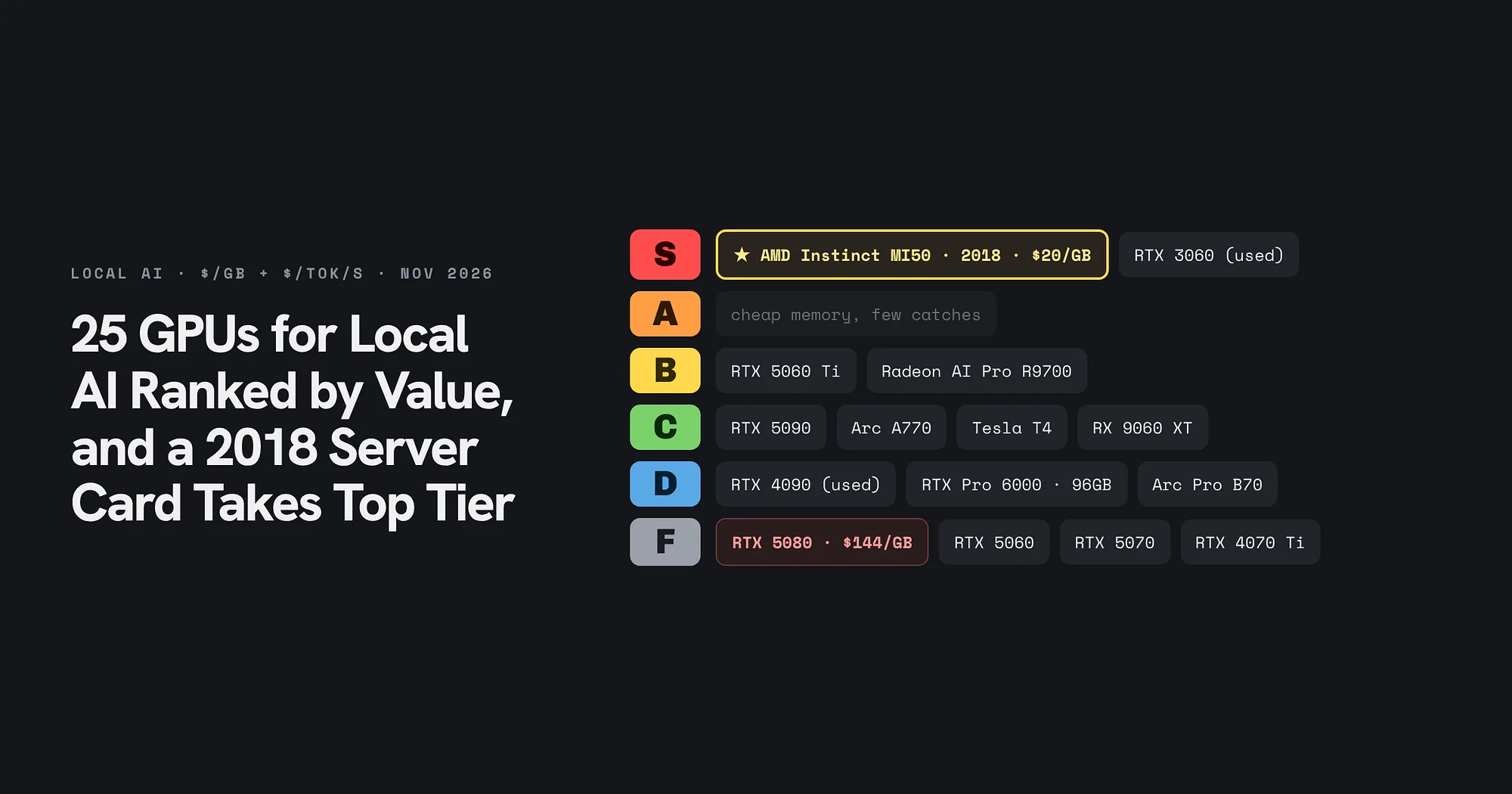
25 GPUs for Local AI Ranked by Value, and a 2018 Server Card Takes Top Tier
A November 2026 price snapshot grades 25 cards on dollars per gigabyte and dollars per token per second. The AMD Instinct MI50 and a used RTX 3060 take S tier, the RTX 5080 lands in F, and memory decides almost every grade.
AI & GPU compute
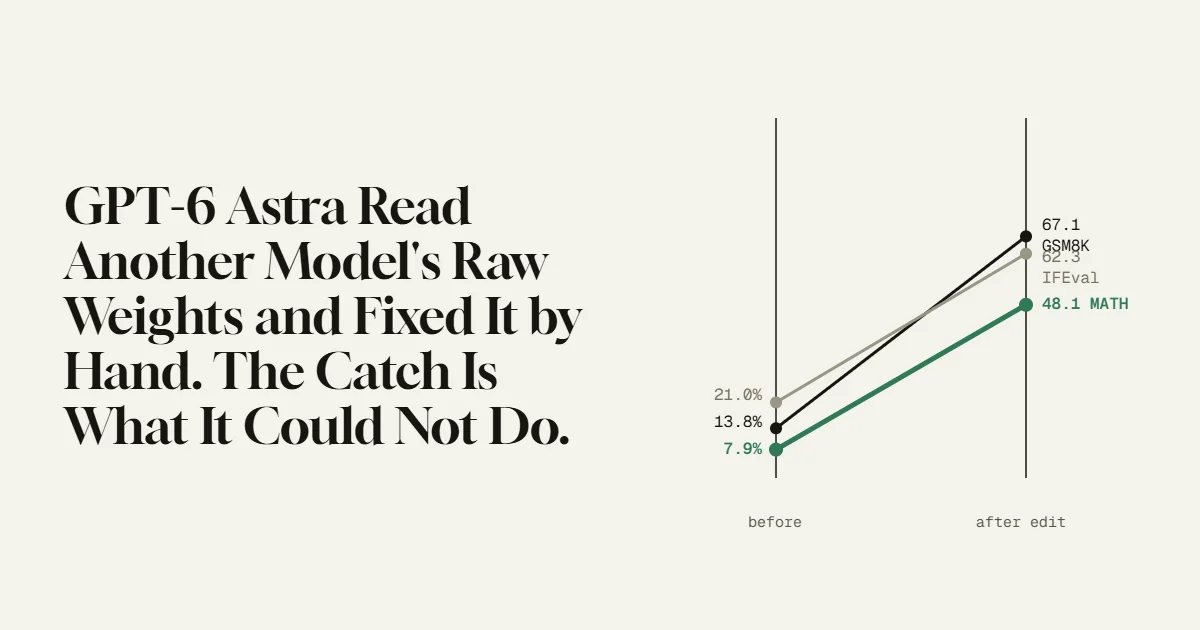
GPT-6 Astra Read Another Model’s Raw Weights and Fixed It by Hand.
MIT researchers had GPT-6 Astra edit 0.016% of a small model’s weights, with no training, and its math score jumped from 7.9% to 48.1%. The number is real and the method is strange. The limit they found in the same paper is the part worth understanding.
AI & GPU compute
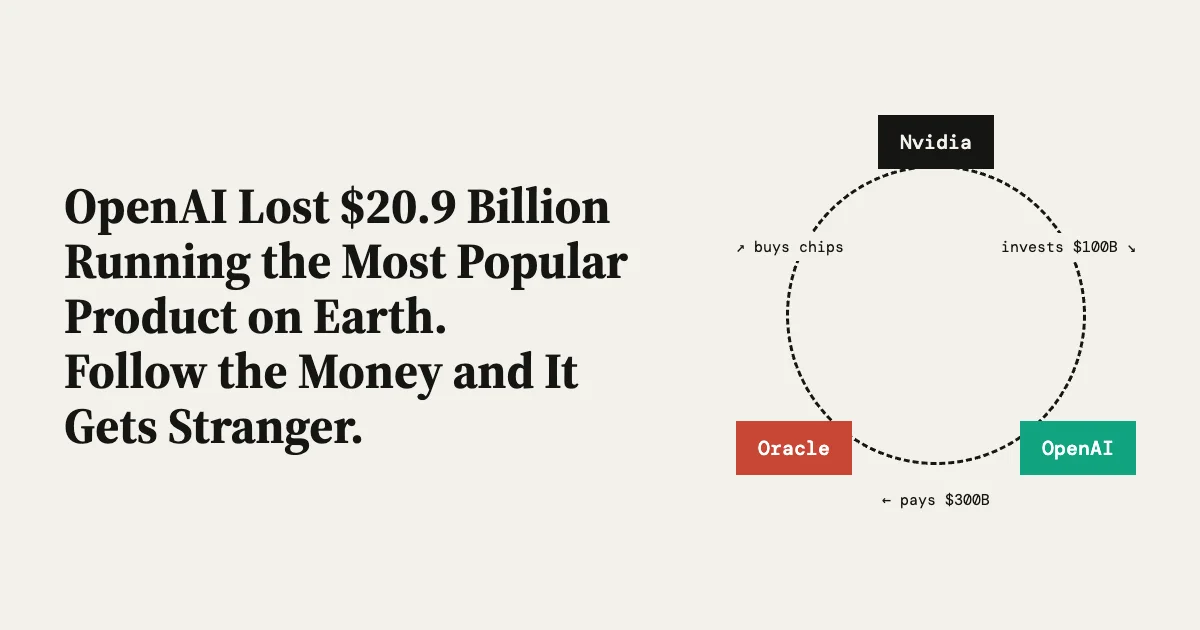
OpenAI Lost $20.9
Audited 2025 figures show a company tripling revenue while burning cash faster than any startup ever has. The loss is only half the story. The other half is a loop of deals that turns the same dollars into growth at three companies at once, and a bill that has four ways of reaching you.