Your Dev Tool Isn’t Showing Up in AI Answers? Here’s Why and How to Fix It
Let’s be real, the way developers find tools has changed dramatically. They’re not Googling anymore, at least not the way they used to. They’re opening ChatGPT, Perplexity, or Claude and just asking. And if your product isn’t in the answer they get back? You weren’t even in the running.
Last verified Also on Medium
On this page
- The Shift Nobody Saw Coming (But Everyone Felt)
- AEO vs. GEO: Not the Same Thing (But Close Enough to Matter Together)
- What Google’s February 2026 Discover Core Update Actually Means
- What Actually Matters in GEO/AEO (And What You’ve Been Wasting Time On)
- What Matters Most
- What Doesn’t Matter as Much Anymore
- The Numbers Behind the Shift: What the Research Actually Shows
- The AI Content Paradox
- Where Your Brand Needs to Live (And How to Get It There)
- The 5 Content Types That Win in the AI Era
- How to Adapt Without Starting From Scratch: Your 90-Day Playbook
- Days 1–30: Audit and Foundations
- Days 31–60: Content and Structure
- Days 61–90: Distribution and Brand Mentions
- The Companies Who Win This Are Already Starting
- Quick-Start Summary
Let’s be real, the way developers find tools has changed dramatically. They’re not Googling anymore, at least not the way they used to. They’re opening ChatGPT, Perplexity, or Claude and just asking. And if your product isn’t in the answer they get back? You weren’t even in the running.
The Shift Nobody Saw Coming (But Everyone Felt)
Let me walk you through what this used to look like. A developer needs an observability platform. They open Chrome, search ‘best Prometheus alternatives for high-cardinality metrics,’ skim a few blog posts, check some GitHub star counts, and build a shortlist. That was the whole funnel. You optimized for it, it worked, everyone was happy.
Now picture that same developer in 2026. They open Claude and type: ‘I’m running about 200 microservices on GCP, what observability stack would you go with and why?’ Thirty seconds later, they’ve got a synthesized answer comparing Grafana Cloud, Datadog, and Honeycomb complete with notes on pricing tiers, cardinality handling, and community reputation. They never opened your comparison article. They never saw your landing page. They got their answer and moved on.
And this isn’t a niche behavior anymore. The Stack Overflow 2025 Developer Survey which polled over 49,000 developers across 177 countries found that 84% of respondents are using or planning to use AI tools in their development process, up from 76% the year before. Discovery has moved upstream, and it now happens inside a conversation with a model.
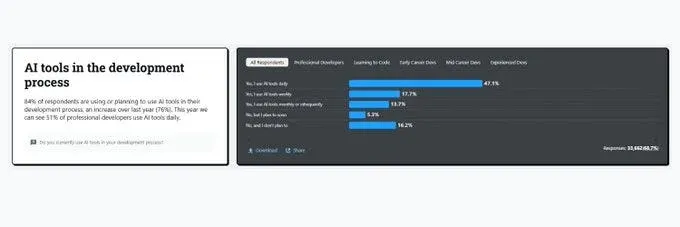
Among professional developers, 51% use AI tools daily, indicating that AI has moved beyond experimental adoption into routine practice. While the survey doesn’t explicitly cite a “65% weekly or more” figure, it emphasizes that daily usage stands at 51% and overall adoption (including those planning to use AI) reaches 84%, underscoring rapid AI integration across the global developer community.. With the preponderance of developer tools integrating AI features, that number is only growing in 2026.
So what do you do about it? That’s what AEO and GEO are about. Answer Engine Optimization and Generative Engine Optimization, two overlapping disciplines that define how you stay visible when the discovery layer is a language model, not a crawler.
And here’s the thing if you’ve been producing quality technical content already, you’re not starting from scratch. You just need to understand what changed, what stayed the same, and what moves you can make in the next 90 days to stop ceding ground to competitors who figured this out first.
AEO vs. GEO: Not the Same Thing (But Close Enough to Matter Together)
You’ll see these two terms used interchangeably all the time, but they’re actually targeting different parts of the problem. For a deeper look at how each discipline is defined, the Wikipedia entry on Generative Engine Optimization is a solid starting point. Here’s the practical difference:
Answer Engine Optimization (AEO): AEO is about real-time retrieval. When a developer asks Perplexity “what’s the best CI/CD tool for a Node.js monorepo,” Perplexity actively crawls the web, pulls content from recent sources, and synthesizes an answer. AEO is optimizing for that moment making sure your content is structured, fresh, and clear enough that an AI retriever can extract the relevant snippet and cite it in the answer.
Generative Engine Optimization (GEO): GEO is about training data influence. When a developer asks Claude “what’s a good alternative to Datadog for a small startup,” the model is pulling from what it learned during training and it’s not real-time retrieval. GEO means getting your brand, your product category associations, and your use-case anchors into the content that LLMs trained on.
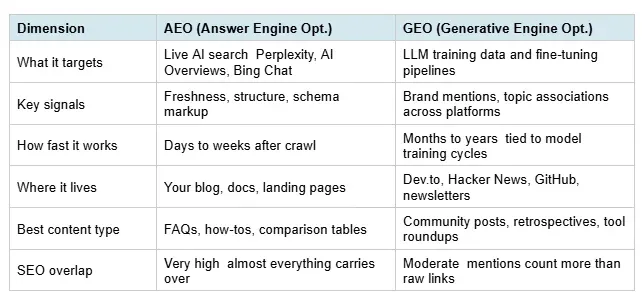
In practice, the best strategies run both tracks at once. Take a post like ‘Choosing a feature flag service for a multi-region SaaS product.’ You optimize it for AEO on your own site. FAQ schema, comparison table, clean structure, then distribute adapted versions across GEO surfaces: a Dev.to post, a Reddit thread contribution, an engineering newsletter write-up. One piece of content, two optimization tracks running in parallel.
What Google’s February 2026 Discover Core Update Actually Means
On February 5, 2026, Google released its first-ever Discover-specific core update. Google is now treating Discover as a separate ranking ecosystem with its own quality criteria, totally distinct from Search.
Three things changed that matter for developer content teams:
1. Topic-by-Topic Expertise Evaluation: Google’s systems now identify expertise per subject area. Core Mountain Media’s analysis puts it clearly, sites relying on sensational headlines and thin AI content saw drops of 30–60%, while sites with deep, consistent expertise gained ground. A regional tech news site with a deeply-covered DevSecOps vertical can outrank a large enterprise blog that published a single WebAssembly post.
What this means for you? If you want to rank for ‘MLOps pipeline tooling,’ you need a real content cluster there. Not one overview post a cluster. Tutorials, integration guides, failure mode analyses, benchmark comparisons. Depth signals ownership. One article signals curiosity.
Practical implication: Do a topic cluster audit right now. Pick one subject you want to own. Say, ‘edge computing for IoT.’ Can you point to a dozen pieces that build on each other? Architecture guides, provider comparisons, latency benchmarks, real-world case studies? If not, you’re not owning it yet, no matter how good your single best article is.
2. Anti-Sensationalism Enforcement: The updated Discover documentation is explicit about this GA Agency’s summary notes that Google now explicitly names ‘clickbait’ and ‘sensationalism’ as ranking demotions in updated guidance. Titles have to accurately reflect what’s actually in the piece.
If your team has been A/B testing emotionally charged headlines, it’s time to stop. ‘How we cut p99 API latency from 800ms to 120ms using connection pooling’ will outperform ‘The shocking reason your API keeps failing under load’ for developers reading it and for AI systems interpreting it. Specific, descriptive, honest titles win on both fronts.
3. Original, In-Depth Content Prioritization: The update rewards content that brings something genuinely new. ClickRank’s guide to the February 2026 update confirms: original analysis, proprietary data, and first-hand experience signal the kind of depth Google’s systems are now prioritizing. Aggregation posts that collect existing coverage without adding a fresh perspective are algorithmically disadvantaged.
The practical takeaway: your best content is written by engineers who ran the benchmarks, hit the edge cases, and have real opinions from building in production. Secondhand summaries are everywhere. Actual experience is scarce and that’s exactly what gets cited.
This isn’t new advice but it’s now a ranking signal.
What Actually Matters in GEO/AEO (And What You’ve Been Wasting Time On)
Not every tactic deserves equal attention. Let me give you a straight take on what’s moving the needle in 2026, what’s become less relevant, and what’s actively working against you.
What Matters Most
Topic-by-topic depth: This is the single biggest shift in how content strategy works in 2026. Isolated articles about a tool category no longer build the kind of authority that drives AI citations. Draft.dev’s 2026 Developer Marketing Survey found that 58% of dev tool companies are increasing content investment this year, with budget shifting specifically toward depth-first strategies. The high-volume publishing play is losing ground.
Content freshness: Recency matters to AI retrieval systems and in developer tooling, it matters double. An outdated tutorial that references a deprecated API or a renamed CLI flag doesn’t just fail to rank. It actively damages your credibility. A developer who follows your three-year-old Redis Streams walkthrough, hits a deprecation error on step three, and has to go figure it out themselves? That’s a trust hit that affects how they think about your whole brand.
Google’s February 2026 update calls out timeliness explicitly as a Discover ranking signal. Build a refresh cadence into your content calendar at minimum once a year for technical pieces, quarterly for anything in fast-moving areas like AI tooling or cloud infrastructure
Article structure: Here’s something that’s easy to overlook, AI retrieval systems favor pages that are built for extraction. A March 2026 study from researchers at the University of Tokyo and University of Tsukuba found that structural optimization alone independent of content quality produces a consistent 17.3% improvement in AI citation rates. Practically, this means:
- Skimmable (summary or bullet points at the top)
- Structured (tables and matrices for comparisons)
- Self-explanatory (each section makes sense independently)
- Conclusive (key takeaways or FAQs at the bottom)
- Well linked (internally and externally)
Good news: none of this is AI-specific. It makes your content better for human readers and for traditional SEO too. It’s just that the stakes are higher now for AI systems, the difference between a well-structured article and a flowing narrative essay can determine whether you get cited at all.
External brand mentions: Here’s a mental model shift worth making, in a world where LLMs weight distributed brand signals over concentrated link authority, your content strategy can’t stop at your own domain. Research cited in Mersel AI’s GEO guide references the original Princeton GEO study finding that citations boosted AI visibility by +30% and quotations by +41%. A mention of your tool in a well-read engineering newsletter even without a link contributes to LLM training data in ways that a tenth backlink from a low-traffic blog simply doesn’t.
- Organic references in online engineering newsletters with archived web versions
- Posts from your own team and early customers on developer-first platforms like Hashnode and Dev.to
- Genuine participation in relevant subreddit discussions and not promotional drops or links, but actual technical contributions that happen to mention your product
- User-generated case studies and retrospectives hosted on personal or company blogs
And here’s the leveling opportunity: newer companies can catch up faster through distributed brand presence than they ever could through backlink campaigns. If you’ve been building in public, shipping technical content to community platforms, and cultivating users who write about their experience you’re already accumulating LLM mind-share in ways that a company with a bigger domain authority might not be.
What Doesn’t Matter as Much Anymore
Domain Age or Authority Rating: Domain Rating, Moz DA, and similar metrics have always been proxies useful approximations. In 2026, they’re even less predictive. The February 2026 Discover update evaluates expertise per subject, which means a newer domain with deep, genuine coverage of a specific developer tool category can outrank a well-established domain that’s only touched that subject superficially. Age is no longer a moat. Depth is.
Traditional Backlinking Campaigns: Link-building as a standalone play has diminishing returns in the AI discovery context. LLMs aren’t running PageRank on your inbound link graph they’re looking at brand presence, topical association, and community sentiment across a distributed set of crawled surfaces. A genuine recommendation in a relevant forum thread carries more weight in model training data than a link from an off-topic guest post.
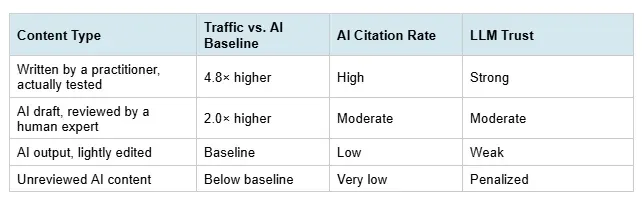
High-Volume, Pure AI-Generated Content: This one is worth being blunt about. Draft.dev’s 2026 survey found that 96% of developer marketing teams have used AI generation in their workflow but only 7% describe the results as ‘very useful.’ Practitioner-written content generates 4.8× more engagement than unreviewed AI output. The problem isn’t using AI tools most high-performing teams do. It’s removing domain expertise from the authoring process entirely.
Gated content without an ungated version: If LLMs can’t index it, it doesn’t exist for AI-powered discovery.
PATTERNS THAT HURT YOU — GOOGLE AND LLMS BOTH PENALIZE THESE: Filler phrases (“with that in mind…”, “at the end of the day”) · Headlines that promise more than you deliver · Intros that just restate the title · Hub pages that only link to other pages · Every section starting with the same template sentence · Gated content with no crawlable preview
The Numbers Behind the Shift: What the Research Actually Shows
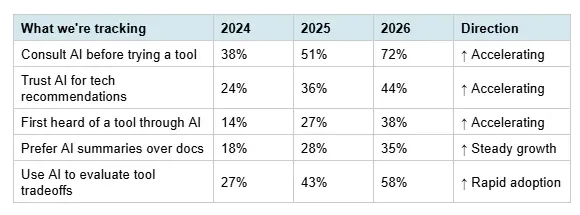
Let’s ground this in actual data. Not the kind that gets dressed up for strategy decks, but the kind that should actually change where you put your time and budget.
The AI Content Paradox
Here’s the stat that should genuinely give you pause: according to Draft.dev’s 2026 Developer Marketing Survey, 96% of developer marketing teams have used AI generation in their content workflow. But only 7% say the results are ‘very useful’ and practitioner-authored content generates 4.8× more engagement than unreviewed AI output.
So why does everyone keep doing it? Because it feels productive. Volume is up, turnaround is faster, the calendar looks full. But the performance gap is real and it’s growing. The companies winning in 2026 are using AI to accelerate a workflow that still starts and ends with genuine domain knowledge.
Where Your Brand Needs to Live (And How to Get It There)
One of the most important mindset shifts in AEO/GEO is this, the surfaces that matter are no longer limited to your own domain. LLMs train on a distributed ecosystem of crawled content. Real-time retrieval engines index all of it. Your content strategy has to reflect the full picture of where developer conversations actually happen.
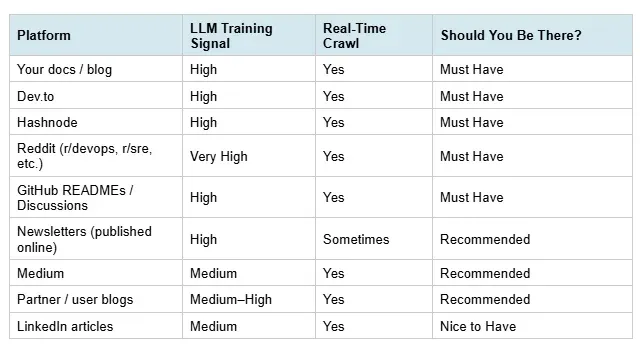
The opportunity here is real, especially for newer companies. An established player might have a strong backlink profile but thin community presence. A startup that ships genuine technical content on Dev.to, participates honestly in relevant subreddits, and builds an audience of users who write publicly about their experience? That company can close the LLM mind-share gap faster than traditional SEO ever allowed.
The 5 Content Types That Win in the AI Era
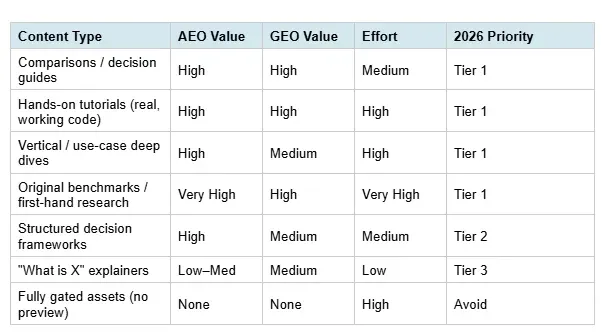
Not all content formats get treated equally by AI retrieval systems. These five consistently outperform and there are concrete reasons why each one works.
1. Comparison and Roundup Content: Comparison content is one of the most-cited formats in AI-generated recommendations, and it’s not hard to understand why. A post titled ‘Kafka vs. Pulsar vs. Redpanda: picking a streaming platform for an event-driven microservices architecture’ gives AI systems exactly what they need a structured evaluation across defined criteria, with clear guidance about which option fits which constraints.
The difference between comparison content that gets cited and content that doesn’t is substantiation. ‘We found X performed better’ is a claim. ‘We processed 2M events per second on a three-node cluster and saw X behavior under backpressure’ is evidence. AI systems, like developers, trust the latter.
2. Tutorials with Real-World Scenarios: Well-crafted tutorials using production-realistic scenarios are genuinely high-value training data for AI coding assistants. A tutorial on implementing distributed rate limiting with Redis Lua scripts in a multi-region setup with working, tested code and honest edge case discussion is far more useful to a model than a ‘getting started’ example using localhost and toy data.
Freshness matters more here than almost anywhere else. Outdated API references in tutorials are one of the fastest ways to lose developer trust and drop out of AI citation. Make tutorial refresh a standing item in your content calendar.
3. Industry-Specific Guides: AI assistants adapt their answers to context. ‘What observability tooling would you recommend for a Series A healthtech company handling patient data?’ gets a different answer than the same question without that context and rightly so. Content that connects your tool’s capabilities to the specific constraints of a given vertical: the regulatory requirements in fintech, the latency sensitivity in gaming infrastructure, the compliance overhead in healthcare positions you to capture those contextually-rich queries.
The practical takeaway: write one piece for the MLOps engineer at a genomics company, not one piece for every ML engineer everywhere. Specificity is a feature, not a limitation.
4. Original Analysis and Proprietary Data: The 2026 emphasis on originality isn’t abstract it shows up clearly in citation rates. The original GEO research found that content containing statistics boosted AI visibility by +32%, and cited sources by +30%. Content that has data no one else has is structurally irreplaceable latency benchmarks, customer survey results, honest failure postmortems. Whatever form it takes: publish it ungated, make it crawlable, and don’t bury the numbers.
5. Decision Frameworks: Content that helps a developer make a specific, bounded decision outperforms content that describes a topic at length. The structure that works: establish the decision context, spell out the criteria that should drive the choice, then give clear ‘choose X if you need…’ guidance with concrete conditions attached.
This format is practically designed for AI extraction. Models love to surface decision frameworks because they answer the real question behind most tool queries which isn’t ‘tell me about CI/CD platforms,’ it’s ‘which one should I actually use.’ Content that answers the real question gets cited. Content that dances around it doesn’t.
How to Adapt Without Starting From Scratch: Your 90-Day Playbook
If your team has been investing in technical content, you’re already holding the core asset. AEO and GEO don’t ask you to throw out what you’ve built, they ask you to extend it for a discovery landscape that now includes AI systems. Here’s a concrete 90-day sequence to do that without rebuilding from zero.
Days 1–30: Audit and Foundations
- Split your Discover and Search analytics in Google Search Console. They’re separate channels now and need to be tracked that way.
- Map your content against topic clusters. Figure out which subjects you genuinely own with depth, and which are covered by a single article floating on its own with no supporting structure.
- Audit your top 20 posts. Look specifically for missing summaries, absent comparison tables, and no FAQ sections. Prioritize pieces that already have traffic structure improvements compound fastest there.
- Pull your ten highest-traffic tutorials. Flag anything with outdated syntax, deprecated API calls, or library versions that have moved on. These are your first refresh queue.
- Add FAQ schema to your top comparison and tutorial pages. It’s a one-time effort that keeps paying off with every retrieval event.
Days 31–60: Content and Structure
- Write or commission at least two comparison pieces framed as decision guides, not feature lists. ‘Choosing between Temporal and Apache Airflow for a financial data pipeline’ beats ‘Temporal vs. Airflow: which is better’ for readers and for AI systems. Publish on your site first, then adapt for Dev.to.
- Add TL;DR summaries to your top ten existing articles. Lead with the conclusion. AI systems index summary sections preferentially, and readers who skim appreciate it just as much.
- Dig out any gated whitepapers or reports with proprietary data. Publish ungated versions of the data-heavy sections. Gated content contributes nothing to LLM training data or real-time retrieval.
- Pick three to five industry verticals where your product has a real, specific advantage. Brief one content piece per vertical that speaks directly to the constraints and context of that industry.
Days 61–90: Distribution and Brand Mentions
- Push adapted versions of your comparison content to Dev.to, Hashnode, and two or three relevant subreddits. ‘Adapted’ is the key word a direct cross-post adds no value to those communities. Reframe the angle for each audience.
- Identify ten to fifteen engineers and technical writers in your ecosystem who publish regularly on crawled platforms. Build actual relationships before you need the mentions. Transactional outreach is obvious and it doesn’t work.
- Review your GitHub README and public docs. Both should clearly explain your use case, name the specific problems you solve, and reference alternatives honestly. Developers and AI systems both value directness over marketing language.
- Set up brand mention tracking Mention, Brand24, or manual Reddit and Hacker News searches. Establish a baseline this month. Watch the trend from here.
The Companies Who Win This Are Already Starting
Here’s the honest version of where things stand, the first-mover window in AEO and GEO hasn’t closed, but it’s closing. The dev tool companies that will hold the strongest positions in AI-generated recommendations two or three years from now are making content investments today that compound building genuine topic clusters, distributing real expertise across the platforms developers trust, and earning organic mentions through actual product quality and community participation.
The companies that will lose ground are the ones still running a 2022 playbook, treating AI generation as a content factory, publishing at volume without substance, and acting as if their own blog is the only discovery surface that matters. That approach still produces some results. It won’t in two years.
The good news is that the fundamentals haven’t moved. Expert-written content that solves real problems, backed by evidence from actual usage, is the foundation for SEO, for AEO, and for GEO. Everything else in this document is additive: better structure, smarter distribution, fresher content, broader brand presence across the platforms where developers actually spend time.
Start with the audit. The rest follows.
Quick-Start Summary
- Keep writing substantive, practitioner-level content. The core stuff hasn’t changed.
- Refresh your tutorials and API docs regularly. Outdated code is worse than no content.
- Add structure everywhere: FAQs, comparison tables, section summaries.
- Go deep on fewer topics rather than shallow on many.
- Show up on more platforms: Dev.to, Reddit, Hashnode, newsletters, partner blogs.
- Cut the fluff. If a sentence doesn’t add anything, delete it.
- Track Discover and Search as separate channels in Google Search Console.
Found this useful? Share it with your developer marketing or DevRel team. The playbook works but it only works if you start.
Sources
- Stack Overflow Developer Survey 2025 AI sectionsurvey.stackoverflow.co. Accessed 31 May 2026.
- Stack Overflow Blog: “Developers remain willing but reluctant to use AI” (Dec 2025)stackoverflow.blog. Accessed 31 May 2026.
- Draft.dev 2026 Developer Marketing Surveydraft.dev. Accessed 31 May 2026.
- Frase.io “What is Generative Engine Optimization (GEO)? 2026 Guide” AI-referred sessions datafrase.io. Accessed 31 May 2026.
- Clarity Global “Breaking Down the February 2026 Google Discover Core Update”clarity.global. Accessed 31 May 2026.
- Core Mountain Media “Google’s February 2026 Discover Core Update: What Content Teams Need to Know”coremountainmedia.com. Accessed 31 May 2026.
- ClickRank.ai “Google Releases Discover Core Update February 2026”clickrank.ai. Accessed 31 May 2026.
- GA Agency “Google Discover Core Update February 2026”ga.agency. Accessed 31 May 2026.
- Wikipedia Generative Engine Optimizationen.wikipedia.org. Accessed 31 May 2026.
- Mersel AI “GEO for B2B: The Complete 2026 Guide” Princeton/original GEO study citationsmersel.ai. Accessed 31 May 2026.
- Machine Relations Research “How Content Structure Affects AI Citation Rates: The GEO-SFE Research Framework (2026)”machinerelations.ai. Accessed 31 May 2026.
- Cadence “Stack Overflow Developer Survey 2026 Highlights”cadence.withremote.ai. Accessed 31 May 2026.
Related stories
Linux & open source
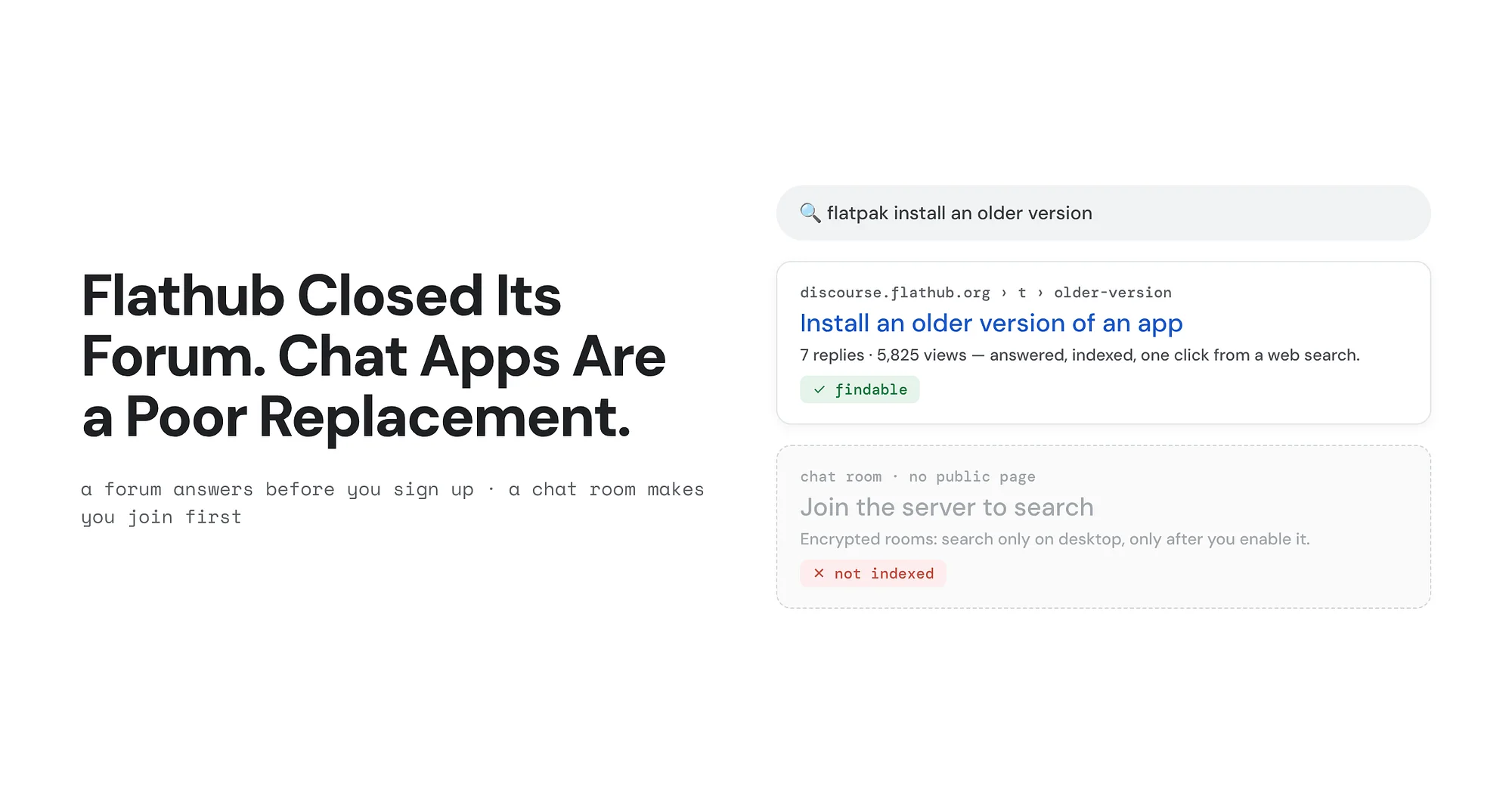
Flathub Closed Its Forum. Chat Apps Are a Poor Replacement.
On October 23, 2026, Flathub made its Discourse forum read only and pointed people to Matrix and issue trackers. Days later, Discord announced it will put public server messages into web search. Together they show what a forum does that a chat room has never done well.
AI & GPU compute
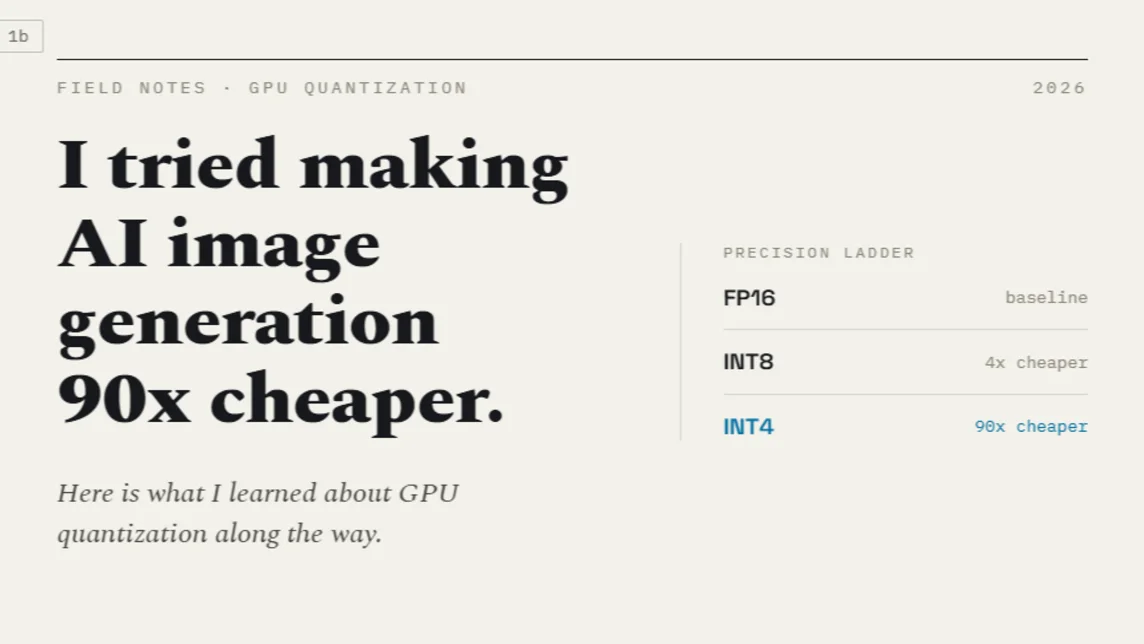
I Tried Making AI Image Generation 90x Cheaper. Here Is What I Learned About GPU Quantization.
The bill had a comma in it.
Developer tools
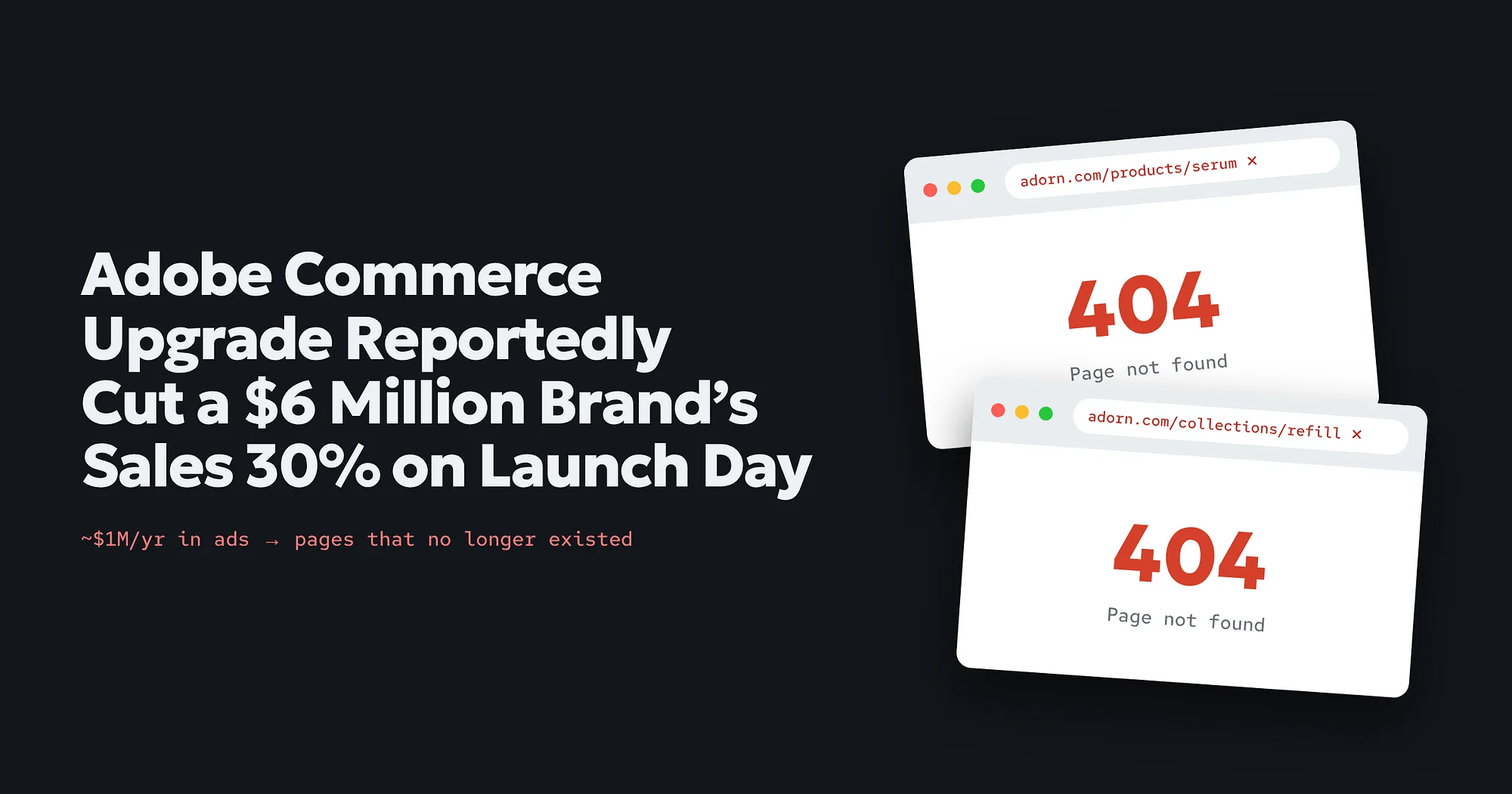
Adobe Commerce Upgrade Reportedly Cut a $6 Million Brand’s Sales 30% on Launch Day
Founder Briony Kennedy says a website migration cut sales by about 30% and broke roughly $1 million a year in ads. Adobe will not comment. The $150 million Adobe settlement in the headlines concerns consumer subscriptions and has no stated link to her contract.