Microsoft Offered 60,000 People the Door. The Real Story Is in the Capex Line.
The headline reads as an AI layoff. Read the spending next to the revenue and a different reason shows up, one that will land at Google and Meta next.
Last verified Also on Medium
On this page
On 26 October 2026, Microsoft told as many as 60,000 of its own employees they could leave voluntarily, with severance, if they wanted to. That is about 27% of a workforce of roughly 223,000. The number got written up as the biggest AI layoff yet, proof that the machines were finally eating the jobs. I think that reading is lazy, and I want to walk through why, because the actual driver is sitting in plain sight on Microsoft’s own earnings statement.
A lot of what got posted about this was people making up numbers to fit a headline. So I am going to stick to figures Microsoft and the reporters covering it actually put on the record, and I will tell you where the number is a company projection versus a hard count.
What Microsoft actually offered
This is a Voluntary Exit Offer, which Microsoft had never run before at this scale. Eligible staff sit at level 70 and below in the US, Canada, the UK, and India. Corporate vice presidents are out. There is no age, tenure, or performance gate. People decide by early December and leave on 31 December. The severance is Microsoft’s standard package, at least 8 weeks of pay in the US, and notably it drops the extended healthcare that a smaller spring program had included, per people familiar with the terms reported by Fortune.
The framing from Microsoft is careful. A spokesperson said, “We don’t expect 60,000 people to walk out the door, and we would never want that.” CFO Amy Hood told staff the company expects very few to accept. Chief People Officer Amy Coleman called the offer “new for us” and said, “We’ll learn from it.”
So the 60,000 is the size of the invitation, not a forecast of departures. That distinction is the whole thing, and most of the coverage blew past it.
The number everyone skipped
Microsoft has run a voluntary program like this once before, this spring. About 2,600 of roughly 8,750 eligible US employees took it, around 30% uptake, per Fortune’s reporting. The company booked an initial charge near $900 million on it.
For this far larger offer, Microsoft is not giving a target. Its spokesperson instead pointed to a 3% to 5% participation range at peer companies, which would work out to somewhere between 1,800 and 3,000 people actually leaving out of the 60,000 invited. One analyst at TIKR, Gian Estrada, ran an illustrative model at 10% uptake, roughly 6,000 departures, and estimated about $1.9 billion in annual savings against a fiscal 2026 research and SG&A base of $70.23 billion.
Sit with those two figures. The headline says 60,000. The realistic exit, on Microsoft’s own benchmark, is a few thousand. That gap is not an accident, and I will come back to why the company wants the big scary number out there anyway.
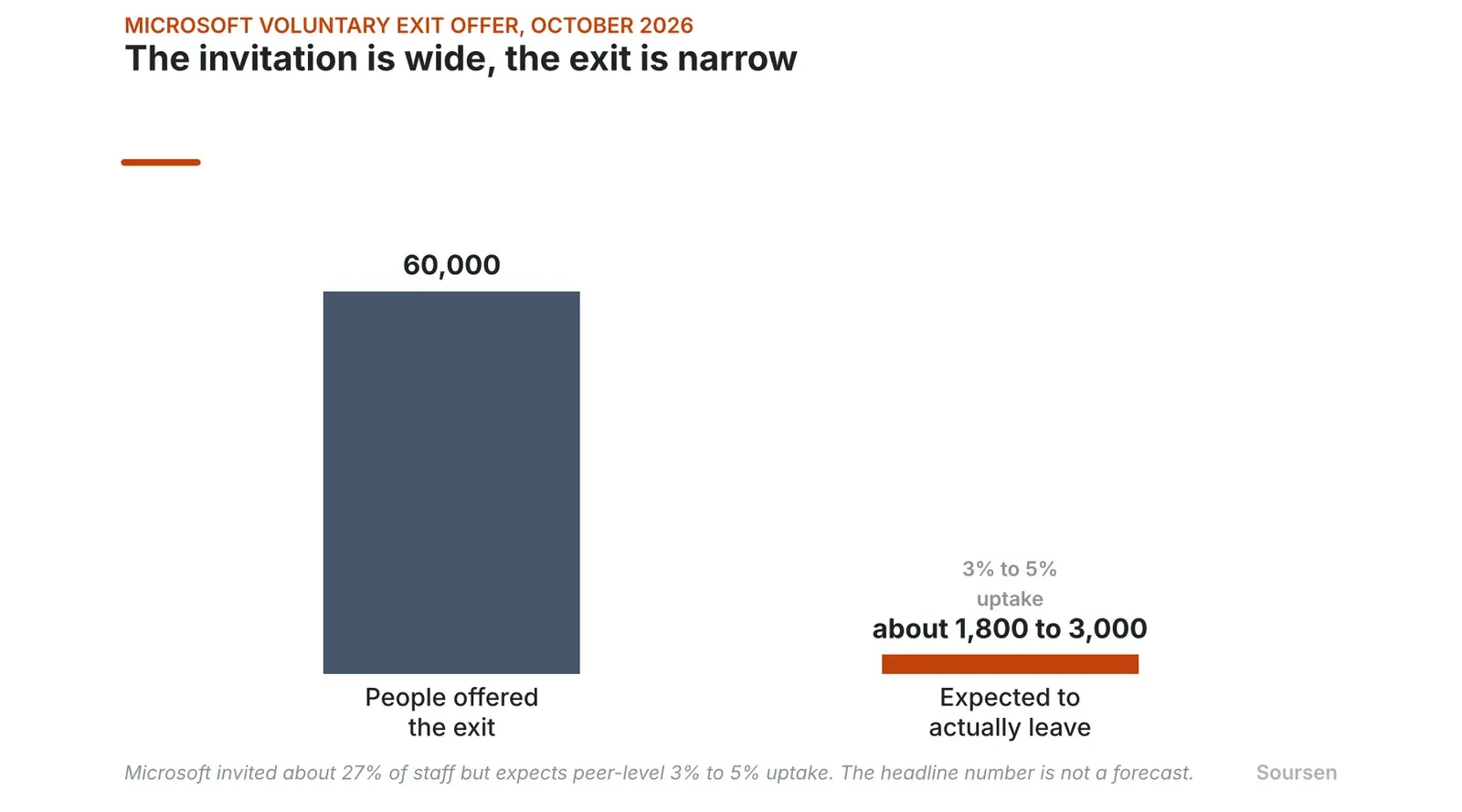
How a 60,000 person offer becomes a few thousand exits. The invitation is wide, the expected uptake is narrow. Source: Fortune
Now look at the spending
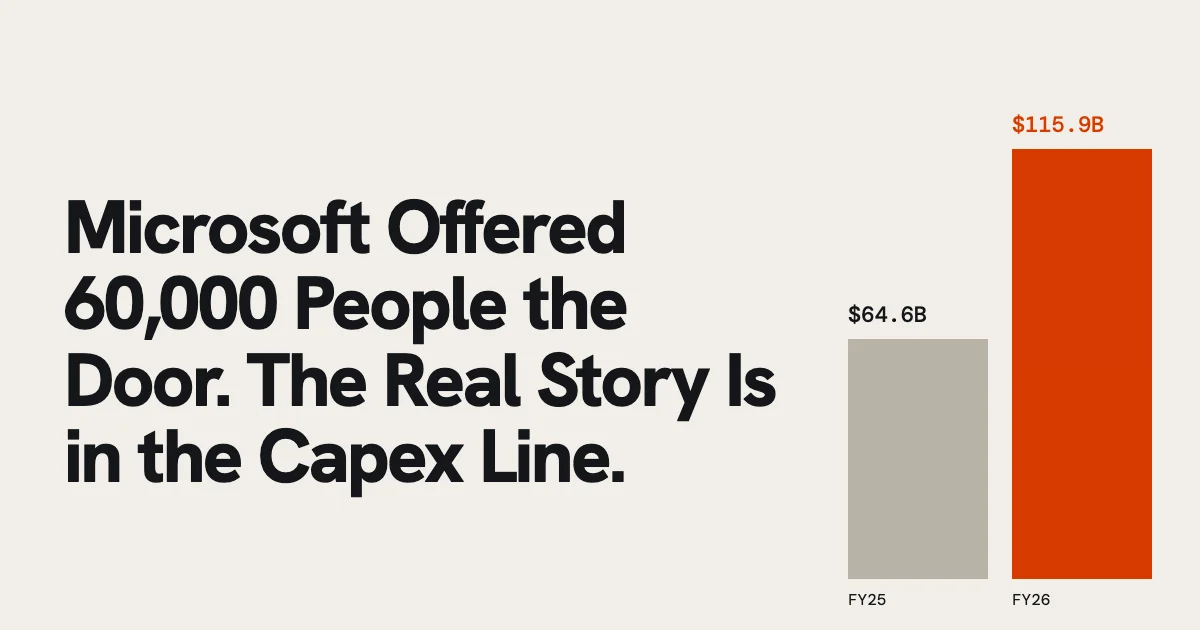
Here is the part the layoff framing misses. Microsoft’s capital expenditure for the fiscal year that ended 30 June 2026 came to $115.9 billion, up from $64.6 billion the year before. That is roughly a 79% jump in one year. Over the same stretch the workforce shrank by about 5,000 people. The company spent almost double on data centers, chips, and networking gear while quietly getting smaller.
The current pace is steeper still. For the quarter ending 30 September 2026, capex rose about 30% to $45.2 billion, and roughly three quarters of that went to short-lived assets such as chips and networking equipment, the kind that depreciate fast. Hood told investors she expects spending to top $50 billion in the following quarter. Put annually, Microsoft is pointing at something near $170 billion of capital spending across calendar 2026, per figures reported by Fortune.
Against that, revenue is growing, but not at the same slope. Microsoft posted $92.3 billion in quarterly revenue, up 19% year over year, with Azure up 48% and net profit of $36.6 billion. Those are strong numbers. The problem is arithmetic. When your spending climbs around 30% and your top line climbs around 19%, the gap between the two lines widens every quarter, and that gap comes straight out of margin.
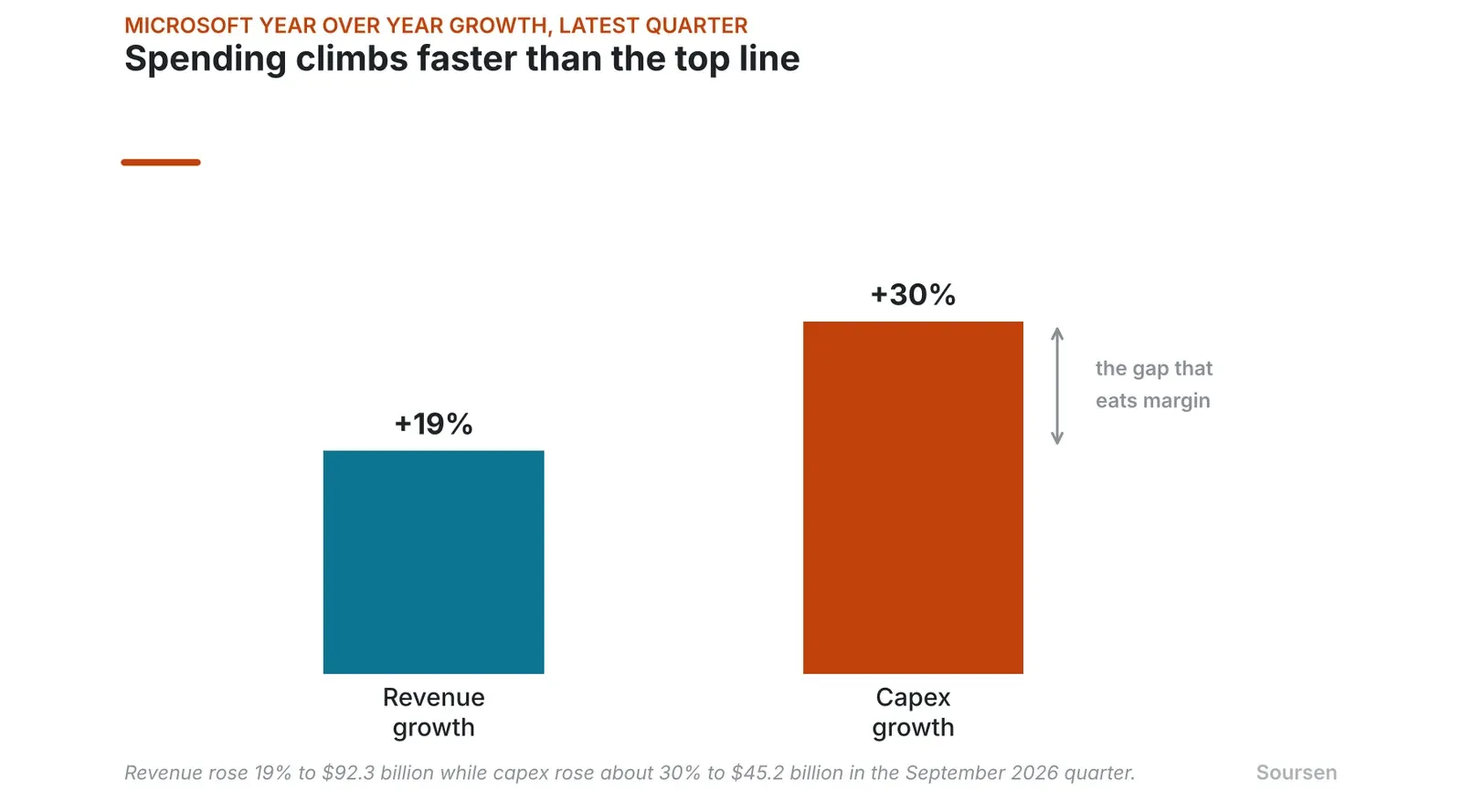
Capex is climbing faster than revenue. The widening gap is the pressure behind the exit offer. Source: Microsoft investor relations
There is a second, slower problem buried in that capex number. Roughly three quarters of the September quarter’s $45.2 billion went to short-lived assets, the chips and networking gear that wear out or go obsolete in a few years, not the concrete and steel of the buildings that last decades. Short-lived assets depreciate fast, and depreciation is a real expense that lands on the income statement quarter after quarter whether or not the AI revenue shows up to cover it. The cash goes out now, and on top of that Microsoft signs up for years of rising depreciation charges that will press on margin long after the construction is done. Cutting payroll is one of the few levers that works on the same timeline.
What all that money actually buys
It helps to be concrete about where $170 billion a year goes. Microsoft said in July it expected to spend about $175 billion on AI infrastructure across 2026, later guided near $170 billion, and the physical form of that is data centers full of Nvidia and increasingly custom silicon, plus the power and cooling to run them. Hood has repeated a line all year, “We still have demand that exceeds supply,” which is the official reason the spending keeps climbing. The company is building capacity it believes it can rent out through Azure, where growth of 48% says the demand is real for now.
The risk is timing. The buildings and chips have to be paid for today, and the return arrives only if enterprise AI demand keeps compounding at something like the current rate for years. If it slows, Microsoft is left carrying the depreciation on a very large pile of fast-aging hardware. That asymmetry, big certain cost now against uncertain return later, is exactly the setup that makes a finance team reach for every flexible cost it can find. Payroll is the most flexible one on the list.
Why a buyout and not a layoff
If the pressure is financial, why offer a voluntary exit instead of just cutting? Because a buyout sorts people for you, at lower legal and morale cost.
Think about who says yes to an offer like this. The person already worried they are on a weak team, already sensing a reorg coming, already half out the door, takes 8 weeks of guaranteed pay over the gamble of being cut later with less. The person who believes they are valuable stays and bets on themselves. So a voluntary program tends to peel off exactly the staff who were least confident of their footing, without the company having to name names, run a formal performance process, or eat the headline of a mass layoff. It is cheaper, it is quieter, and it front-loads the easy departures before any harder decisions.
Microsoft has been candid that layoffs remain on the table depending on business conditions. The spring program, Coleman noted, reduced the scale of the July 2025 layoffs that followed. So the pattern is a soft offer first, then sharper cuts for whatever gap remains. Read that way, the 60,000 figure functions as a signal to the whole org about where things are heading, which is why management is comfortable letting the alarming number circulate even while privately expecting almost no one to take it.
What this says about the AI story
The clean version of this story is that AI made 60,000 workers redundant. Microsoft itself has pushed back on that, saying AI is not driving the buyout programs. I find the capex explanation far more convincing, and it is a subtler point. AI is not replacing these specific people. AI infrastructure is consuming the capital that would otherwise fund headroom in the budget, and payroll is one of the few large, flexible line items a company can pull to defend margin while it pours money into data centers.
The data on attribution backs this up. When analysts tried to tag how many 2026 tech layoffs were actually caused by AI automation, Nikkei Asia put it at 47.9% of first-quarter cuts, while a separate estimate from RationalFX landed at 20.4%. So even on the generous reading, more than half the cuts are something else, and on the stricter reading, four in five are. Sam Altman has acknowledged the “AI washing” at work here, companies pinning ordinary cost cuts on a more flattering story. A Cognizant executive put real AI productivity gains at six months to a year out, meaning a chunk of these cuts run ahead of any actual automation. The timing gives it away. You cut first, then hope the software catches up.
Economist Jay Zagorsky, quoted by Fortune, read the offer as a company that wants fewer workers and more equipment, and expected other large tech firms to follow. He was right, and it is already happening across the industry.
The same math at Amazon, Meta, and the rest
This is not a Microsoft story. The four biggest spenders, Microsoft, Amazon, Meta, and Alphabet, are on track for about $725 billion in combined capital spending in 2026, up roughly 77% from $410 billion in 2025, per reporting compiled by Invezz. Microsoft is pointing at around $190 billion on a calendar basis, Amazon has committed about $200 billion, and Meta raised its full-year guidance to somewhere between $125 billion and $145 billion. Those are not numbers you fund out of petty cash.
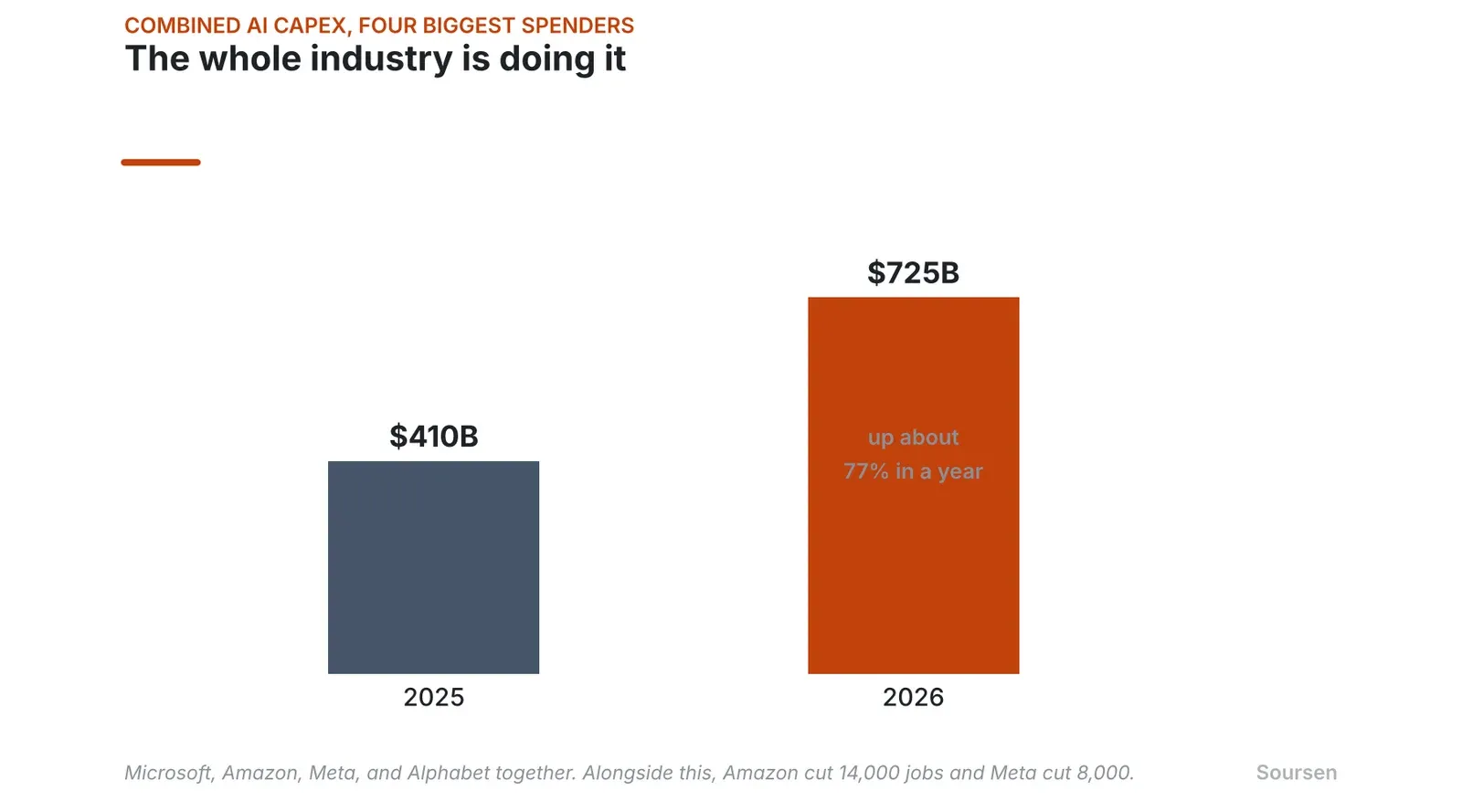
Combined AI capex across the four biggest spenders jumped about 77% in a year, while the same firms cut staff. Source: Invezz
Watch what each of them did to headcount alongside it. Amazon cut about 14,000 corporate jobs in October 2026, the first of a reported roughly 30,000 planned, which would make it the largest layoff in the company’s history, past the 27,000 of 2022. Meta cut about 8,000 roles earlier in the year. Microsoft offered 60,000 the door. In every case the company denied the obvious framing. Amazon CEO Andy Jassy said his cuts were not financially driven or tied to AI, blaming bureaucracy and “a lot more layers.” Microsoft said AI is not driving its buyouts. The denials rhyme because the real cause is the same, and it is not a story either company wants to tell out loud. Enormous, front-loaded AI spending against revenue that grows well but not that fast, with payroll pulled in to hold the margin line. The buyout is less about any one job being automated and more about rebalancing the whole cost structure toward silicon.
Where the cuts are not landing
One detail cuts against the pure doom read, and it tells you what Microsoft actually values. The sales organization is not participating in this offer. Microsoft confirmed that directly. Reporting from Fortune also indicates that some groups in data centers, marketing, cybersecurity, and quantum computing were left out, while Xbox, Windows, Copilot, finance, and AI experiences were fully in.
Look at the pattern. The functions tied most directly to bringing in revenue or protecting it, sales and security, are the ones shielded. That is not sentiment. A sales team that misses its number gets cut on its own schedule, and a security team is what stands between the company and a compliance disaster. The groups asked to thin out are the ones further from the next dollar. If you are deciding where to place yourself inside a company like this, that is the signal worth reading, closer to revenue is safer than cooler to build.
What I would actually do with this
The useful takeaway is not panic. It is that the companies spending the most on AI will keep leaning on their payroll as the shock absorber, and the roles that survive are the ones a finance team can draw a straight line from to money coming in or money being saved. If you are early in your career, that means weighting your time toward work that visibly moves revenue or cuts real cost, and being able to say so plainly, over work that is merely interesting. The demand for engineers is not gone. The demand is narrowing to the engineers a CFO can justify while the capex line keeps climbing.
Sources
- Microsoft’s 60,000 person Voluntary Exit Offer, terms and executive quotes, Fortunefortune.com. Accessed 1 November 2026.
- Microsoft Q1 fiscal 2027 results, revenue, Azure, and capex figures, Fortunefortune.com. Accessed 1 November 2026.
- Microsoft FY2026 Q3 earnings materials, Microsoft Investor Relationsmicrosoft.com. Accessed 1 November 2026.
- Microsoft May 2025 workforce cut of about 3%, CNBCcnbc.com. Accessed 1 November 2026.
- Microsoft July 2025 layoffs across Xbox and the sales division, Fortunefortune.com. Accessed 1 November 2026.
- Analysis of the buyout scope and expected uptake, Implicatorimplicator.ai. Accessed 1 November 2026.
Related stories
AI & GPU compute
Microsoft Filed a Patent to Rewrite What You Say Live and Redraw Your Lips
Application US 2026/0341309 A1 describes swapping words in live video within 1 to 10 seconds, tailored to each viewer’s profile. The main claim says nothing about telling viewers, no patent has been granted, and nearly every piece of the idea already ships somewhere.
Security
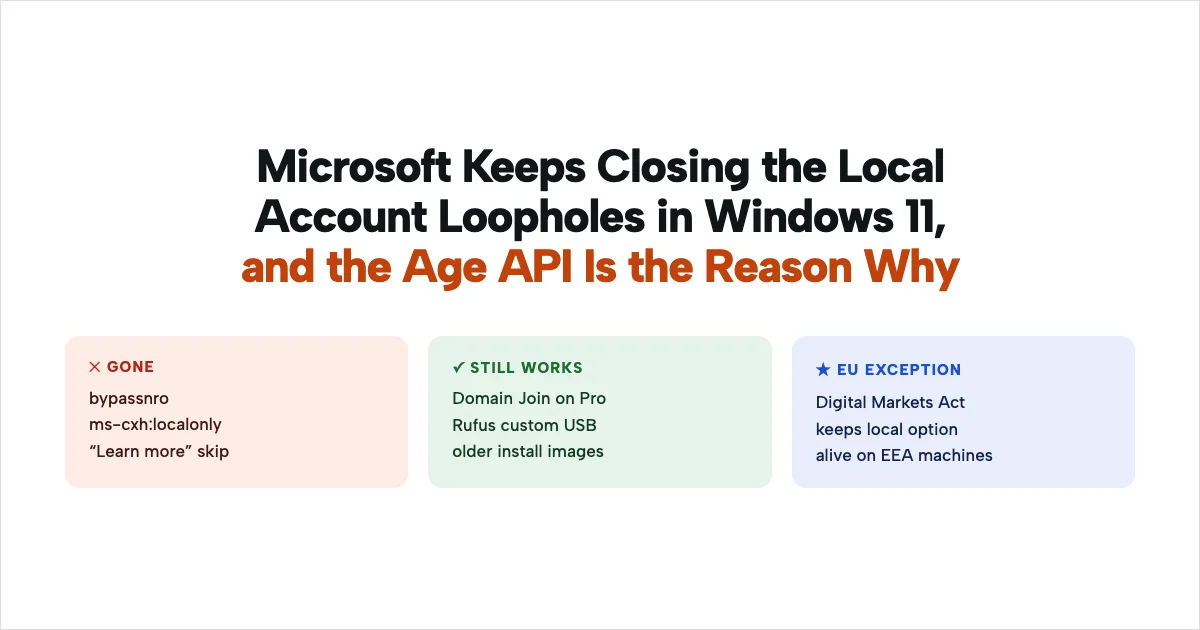
Microsoft Keeps Closing the Local Account Loopholes in Windows 11, and the Age API Is the Reason…
In October 2026 Microsoft quietly killed the last easy way to set up Windows 11 without a Microsoft account, after spending 2025 blocking the rest. I went through exactly which bypasses are gone, what still works, and why a new feature called the Windows age API, that reports whether you are a child, a teen, or an adult, is the piece that ties it all together. None of this requires a conspiracy to explain, the mechanism is on the record.

AI & GPU compute
The AI CEOs Said Humans Were Replaceable. The Winning Hackathon Products Disagree
I want to tell you something that might change how you read every AI press release from this point forward.