Why More Than 50 of the World’s Biggest Banks Are Quietly Building on Chainlink
Note: This article is for informational purposes only and does not constitute financial or investment advice.
Last verified Also on LinkedIn
On this page
- From Simple Price Feed to Financial Plumbing
- Project Pangea: 50 Banks, 16 Countries, One Ambitious Pilot
- DTCC: The Invisible Machine Behind American Markets
- The 2 Projects Already Live: Fidelity and Robinhood
- Does Any of This Adoption Actually Reach the Token?
- The Chainlink Reserve
- Staking and Economics 2.0
- Is Usage Actually Growing? The Data Says Yes.
- The Honest Counterweight
- What the Divergence Actually Means
- 5 Signals Worth Actually Tracking
Note: This article is for informational purposes only and does not constitute financial or investment advice.
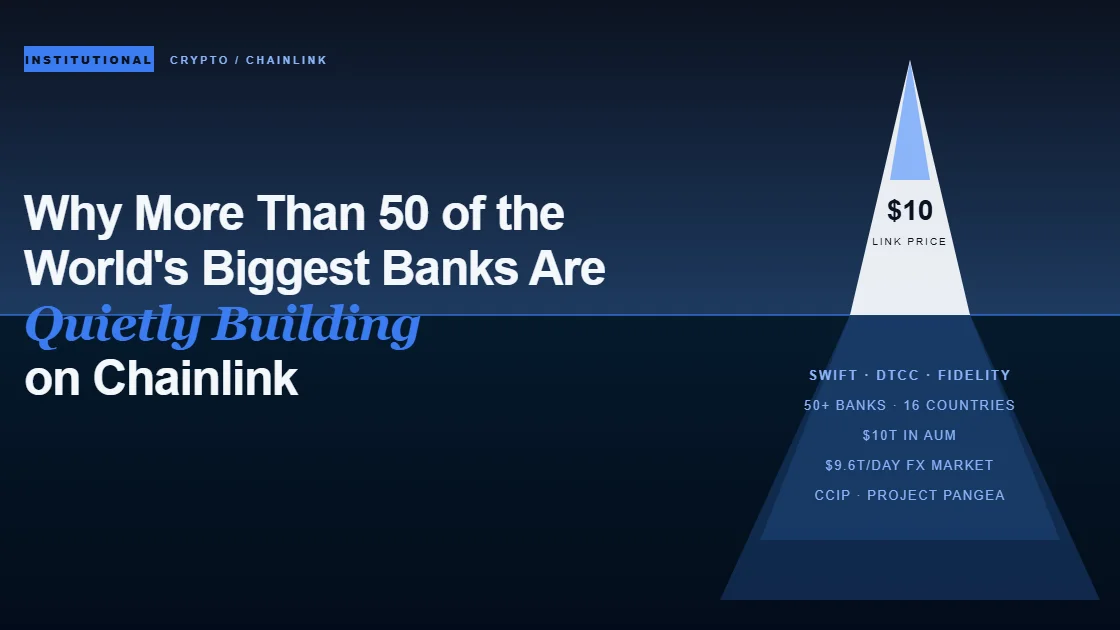
Swift. DTCC. Fidelity. More than 50 of the largest banks on the planet. What do they all have in common right now? Every single one of them is building on a single crypto network, and it is not Bitcoin. It is not even Ethereum. It is Chainlink Labs .
Yet as of mid-2026, the LINK token sits well below $10, down roughly 85% from its all-time high and down sharply over the past year alone. So either the smartest institutions in traditional finance are pouring years of serious engineering into a network that turns out to be worthless, or the market simply has not caught up yet with what is actually being built underneath. Both of those things cannot be true at once, which makes this genuinely worth digging into properly.
From Simple Price Feed to Financial Plumbing
Chainlink started life doing something quite narrow. It was an oracle, which in plain terms is a bridge that feeds real-world data, like an asset price, into a blockchain so a smart contract can actually use that information. Chainlink was, in essence, the thing telling DeFi applications what Bitcoin cost at any given moment. Useful, but hardly something Wall Street would build its future infrastructure around.
Over the past couple of years, that has changed substantially. For a bank to move anything meaningful onchain, it needs 3 things: secure external data, reliable cross-chain messaging, and verifiable settlement. Chainlink has built all 3 of those pieces. Cross-Chain Interoperability Protocol, or CCIP, lets assets and messages move safely between different blockchains, whether public or private. Data Streams pipes low-latency market data, FX rates, prices, and fund valuations directly into smart contracts so settlement can run continuously. Proof of Reserve automatically verifies that a tokenized asset is genuinely backed by what it claims to hold. Put those 3 pieces together and you have the infrastructure a bank actually needs to touch a blockchain without tearing out its existing legacy systems.
Project Pangea: 50 Banks, 16 Countries, One Ambitious Pilot
The biggest and most ambitious of these initiatives is called Project Pangea, launched on June 23, 2026 at the Point Zero Forum in Zurich. It is a consortium of more than 50 banks across 16 countries, together representing more than $10 trillion in combined assets under management. The goal is genuinely ambitious. Enable T+0 atomic FX settlement using regulated stablecoins, starting with a pilot on the euro to Korean won corridor. In simpler terms, the project starts small, but the long-term ambition is to drag the $9.6 trillion-a-day global foreign exchange market from its traditional 2-day settlement cycle down to instant, atomic settlement.
The participants include UniKA, the Unified Korea Alliance, whose steering committee includes Shinhan Bank, JB Bank, Kbank, FairSquareLab, and OBDIA alongside more than 10 additional Korean commercial banks, and Qivalis, a euro stablecoin consortium backed by 37 European banks. The whole system runs on Chainlink’s CCIP and Data Streams sitting between the banks’ existing Swift ISO 20022 messaging and the actual settlement layer, which means banks do not need to rebuild their internal systems to participate.
That all sounds impressive, and it genuinely is, but Project Pangea is explicitly a task force and a pilot at this stage. It is not live settlement volume yet, and it is not a Swift replacement. Chainlink Labs’ President of Capital Markets, Fernando Vazquez, has described the project directly: “Project Pangea upgrades the fragmented foreign exchange model of today with direct, atomic currency swaps using stablecoins. This is a clear example of how the Chainlink standard powers global-scale settlement for the next generation of capital markets.” The task force is targeting real transactions within roughly 12 months, which is a meaningful commitment even for a pilot phase.
DTCC: The Invisible Machine Behind American Markets
If you have never heard of the Depository Trust and Clearing Corporation, that is rather the point. It is the largely invisible infrastructure behind American capital markets, processing roughly $4.7 quadrillion in securities transactions during 2025 alone. DTCC announced on May 12, 2026 that its Collateral AppChain will integrate Chainlink’s Runtime Environment and data standard, targeting 24/7 automated collateral management with real-time pricing, valuation, margining, and settlement, all running on Hyperledger Besu.
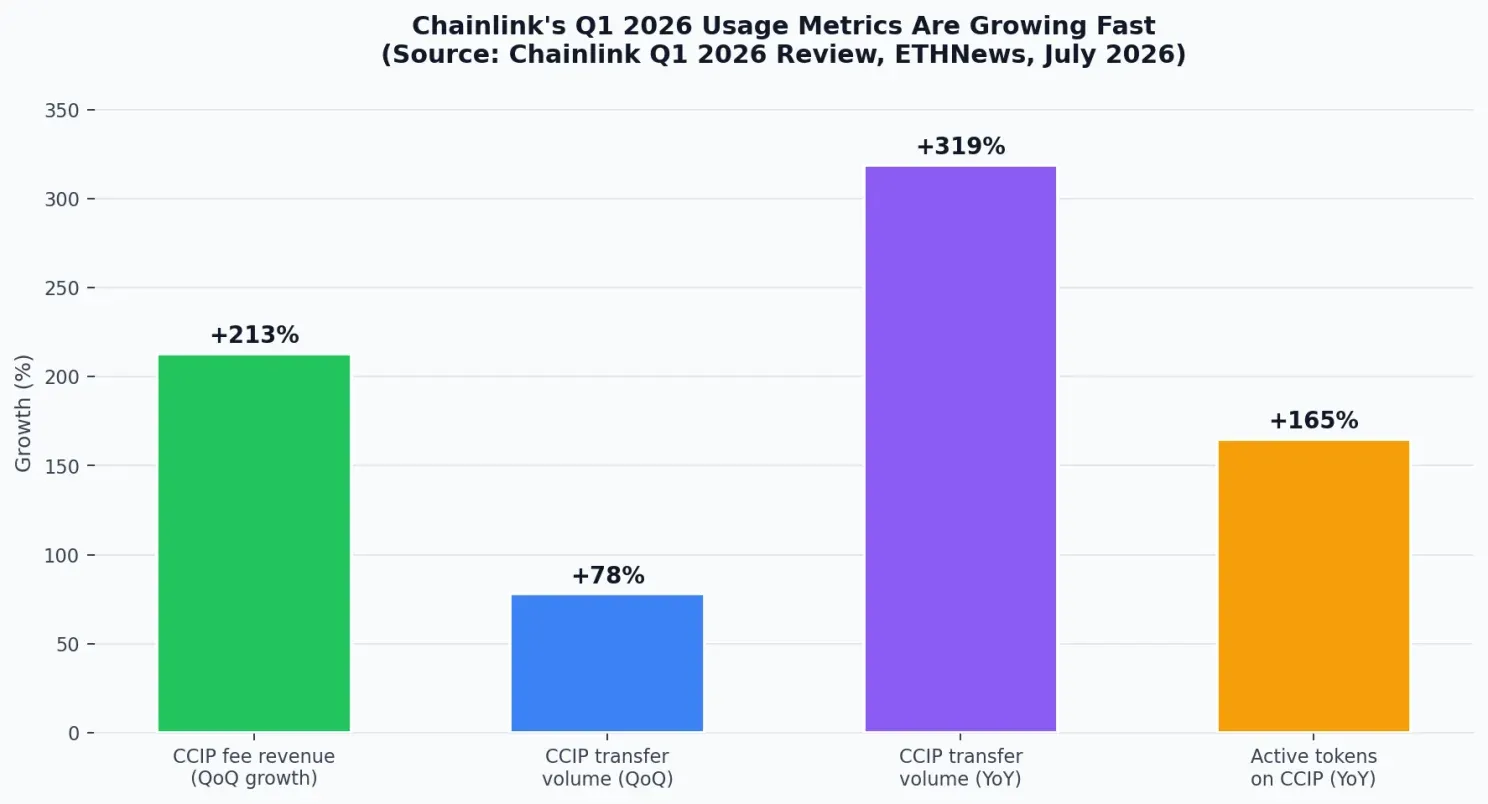
Chainlink’s CCIP usage metrics from its Q1 2026 review. Fee revenue growth of 213% quarter-on-quarter is the single strongest data point in the network’s institutional adoption story. Source: Chainlink Q1 2026 Review, ETHNews, July 2026.
This is still development stage, targeting a Q4 2026 production launch, but it is not unsourced speculation. DTCC’s Managing Director and Global Head of Digital Assets, Nadine Chakar, put it directly: “By leveraging tokenization and distributed ledger technology to modernize collateral mobility, our goal is to enable 24/7, near real-time collateral management across global markets and blockchains.” The Collateral AppChain builds directly on a 2024 Smart NAV pilot that already included JPMorgan, Franklin Templeton, and BNY Mellon, and DTCC has confirmed a separate tokenization service is planned for October 2026, with more than 50 companies already joined to a working group and limited live-transaction testing planned for July.
The 2 Projects Already Live: Fidelity and Robinhood
Unlike Project Pangea and DTCC’s Collateral AppChain, which remain pilots and development-stage projects, 2 other integrations are already live in production. Fidelity International’s tokenized money market fund, the Fidelity USD Digital Liquidity Fund, or FILQ, launched on May 6, 2026 with Chainlink publishing the fund’s net asset value directly onchain. The fund runs on Sygnum Bank’s Desygnate tokenization platform, with JPMorgan supplying the approved daily pricing data that feeds Chainlink’s infrastructure, and Apex Group handling transfer agency services.
FILQ also became one of the first tokenized liquidity funds to receive a top-tier Aaa-mf rating from Moody’s, placing it alongside BlackRock’s comparable tokenized product. Fidelity International head of digital assets distribution Emma Pecenicic framed the launch this way: “There is no tokenized finance without tokenized liquidity. Once markets settle in real time, cash must settle in real time too.” Tokenized money market and Treasury products as a category have grown to more than $15 billion in assets under management, up from roughly $1 billion just 2 years earlier.
The second live integration is Robinhood Chain, which went live on July 1, 2026 as an Ethereum layer 2 network, with Chainlink serving as the official oracle and cross-chain provider from launch, powering tokenized versions of stocks including Nvidia, Google, and Apple. Robinhood’s own stated reasoning for the choice centred on Chainlink’s institutional-grade security and reliability, already trusted by the world’s largest financial institutions.
Does Any of This Adoption Actually Reach the Token?
This is the question every LINK holder has been asking through this entire drawdown, and it deserves an honest, unflinching answer rather than a reassuring one. Owning LINK does not automatically entitle you to a direct slice of network fees. Most oracle and CCIP fees flow to the node operators who actually run the network, not to token holders as anything resembling a dividend. So the bull case for the token specifically rests on 2 distinct mechanisms, and both are worth examining carefully rather than taking on faith.
The Chainlink Reserve
Enterprise clients frequently pay for Chainlink services in stablecoins, ETH, or fiat currency. The protocol then programmatically converts a portion of that revenue into LINK and holds it in a strategic onchain reserve. Critically, as of June 2026, the Chainlink Build Program shifted away from accepting equity or project tokens from partners, meaning commercial partners now pay fees in LINK or liquid assets that feed directly into that same reserve. That creates a genuinely direct pipe from bank usage to LINK accumulation.
How large is that reserve in practice? Honestly, the publicly available figures vary considerably depending on which tracker you consult, ranging from under 2 million LINK to as high as 4.5 million. What every source does agree on is the trend: the reserve is growing, but it remains genuinely small relative to a circulating supply of roughly 730 to 750 million tokens. Bulls would say the mechanism is still early and accelerating. Bears would reasonably point out there is nothing materially large there yet.
Staking and Economics 2.0
The second mechanism is Chainlink’s staking system, described internally as Economics 2.0. The community staking pool is capped at 45 million LINK, roughly 8% of total supply, currently paying a yield somewhere in the 4.3% to 4.75% range. A 28-day cooldown period applies before unstaking, which conveniently softens potential sell pressure. The stated long-term ambition is to shift staking rewards away from token emissions entirely and toward real usage fees generated by CCIP and Data Streams.
That transition is genuinely not finished yet. Right now, staking rewards are still largely funded by emissions from the uncirculated token supply rather than by actual user fees. The roadmap points in the right direction, but the engine is not fully running on real revenue yet, which is an important distinction to hold onto rather than gloss over.
The Chainlink Reserve is buying LINK with one hand while quarterly token unlocks release far more of it with the other. That imbalance, not the adoption story, is the actual crux of the bull-versus-bear debate.
Is Usage Actually Growing? The Data Says Yes.
Whatever the mechanics look like today, the underlying usage trend is unambiguous. CCIP fee revenue rose 213% quarter-on-quarter in Q1 2026. CCIP transfer volume was up 78% quarter-on-quarter and 319% year-on-year. The number of active tokens moving across CCIP grew more than 165% year-on-year. Total value secured across the entire Chainlink network crossed $110 billion by May 2026. Robinhood Chain’s testnet integration of Chainlink Data Streams is specifically built for high-frequency, real-time data feeds, and sign-ups for Chainlink’s Runtime Environment have grown roughly 50% month-on-month, with workflow executions climbing sharply alongside it.
Regulatory clarity has also improved meaningfully in Chainlink’s favour. In Q1 2026, the SEC and CFTC jointly clarified that the LINK token qualifies as a digital commodity, removing a significant piece of regulatory overhang that had lingered over the token for years. Deloitte and Touche also completed a SOC 2 Type 2 audit of Chainlink’s CCIP in April 2026, making Chainlink the only oracle platform to hold that particular certification tier, a detail that matters considerably to risk-averse institutional compliance teams.
The Honest Counterweight
In the interest of genuine balance rather than one-sided cheerleading, several legitimate concerns deserve equal weight.
The dilution picture is real and worth understanding precisely. Circulating supply sits around 730 to 750 million tokens out of a maximum of 1 billion, leaving somewhere between 250 and 270 million tokens uncirculated and held largely by Chainlink Labs. There is, strikingly, no fully public binding long-term vesting schedule for that remaining stash. Chainlink instead follows a quarterly unlock pattern, and in April 2026, 19 million LINK worth roughly $167 million was unlocked in a single event, with more than 14 million of those tokens sent to Binance, which understandably fuelled sell-off concerns at the time.
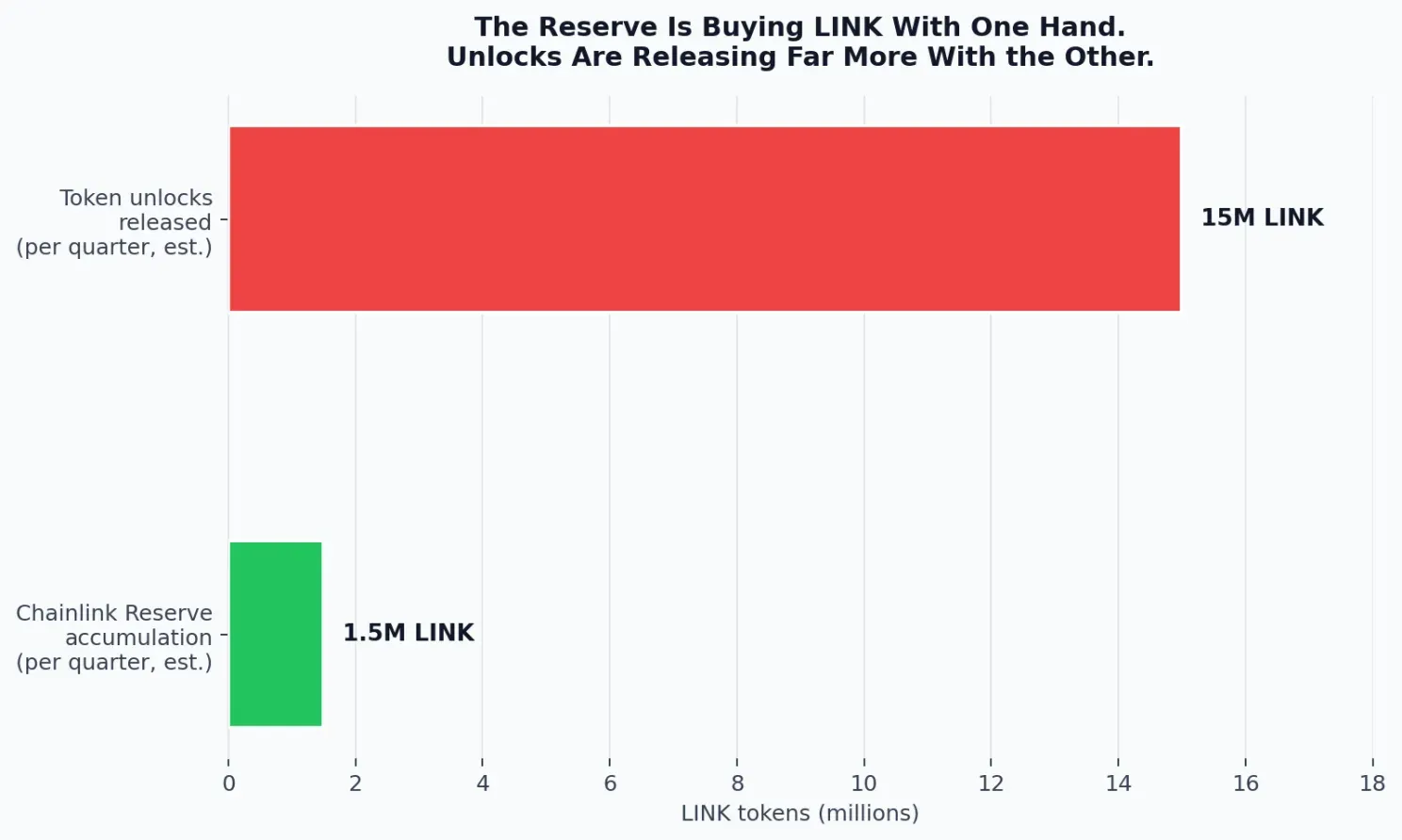
Estimated Chainlink Reserve accumulation against estimated quarterly token unlocks. The reserve mechanism exists and is growing, but current unlock volume appears to substantially outpace it.
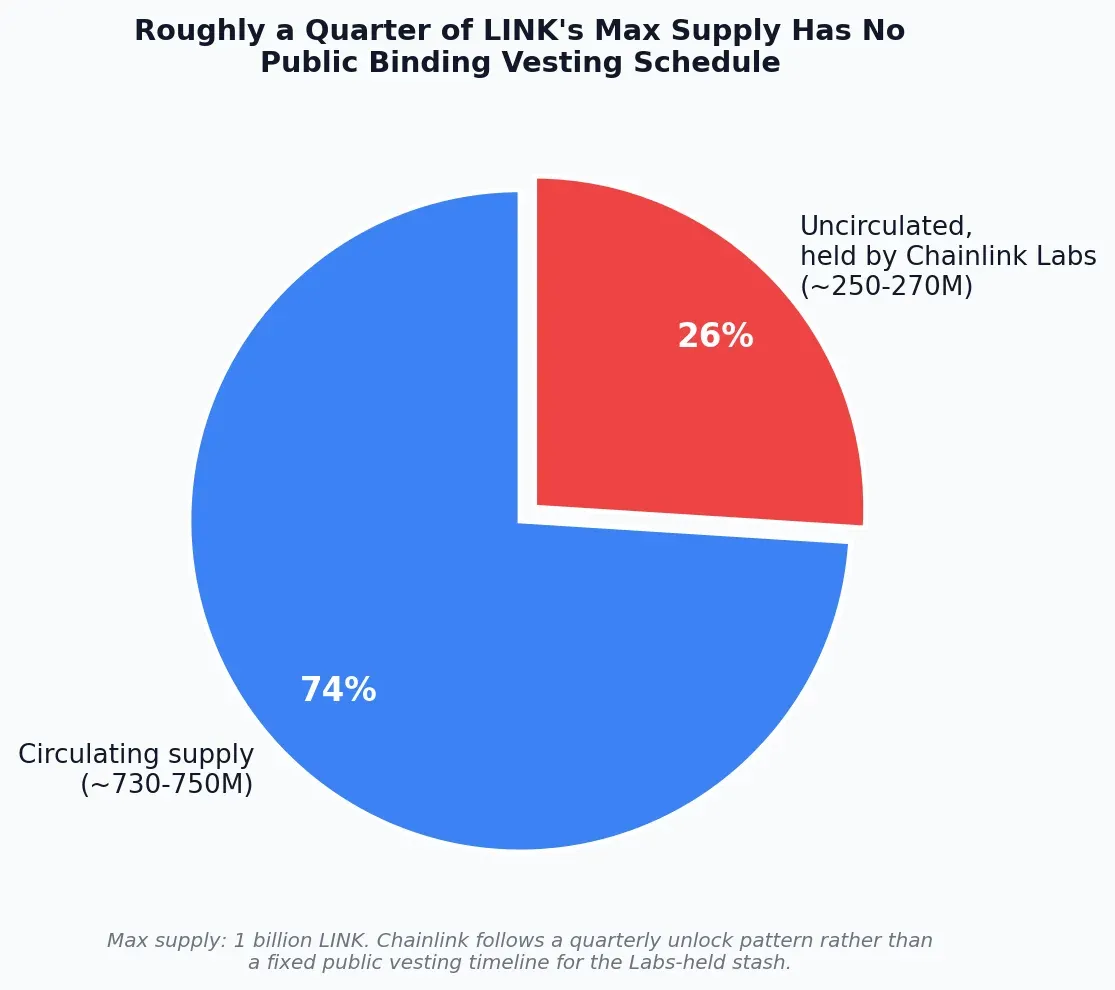
Roughly a quarter of LINK’s maximum supply remains uncirculated and held by Chainlink Labs without a fully public, binding long-term vesting schedule.
There are also legitimate questions about scale that should not be waved away. Network fees are growing quickly in percentage terms, but the absolute numbers remain in the single-digit millions of dollars per month, a genuinely modest figure set against partner banks measured in trillions of dollars in assets under management. Grayscale has reportedly excluded Chainlink from certain revenue-based valuation screens specifically because the mix of onchain and off-chain revenue is difficult to model cleanly with standard methodologies.
There is also what might be called a pilot problem worth naming directly. The 2 flagship banking stories, Project Pangea and DTCC’s Collateral AppChain, remain pilots rather than live production systems. The 2 integrations that are already live, Robinhood Chain and Fidelity’s FILQ, are comparatively smaller in immediate scale. Sceptics have reasonably drawn a comparison here to XRP, where years of institutional partnership announcements have not yet translated into proportional token demand. Sentiment trackers currently show LINK deep in fear territory, with the token stuck in a descending price channel since October 2025.
What the Divergence Actually Means
Chainlink has genuinely built something impressive, and the criticism above is legitimate rather than dismissible. Rising usage does not currently produce a clean, directly observable LINK flow that scales one to one with network volume. Value capture for the token remains indirect rather than automatic.
2 things are simultaneously true here. The network has verifiable institutional traction that almost no other crypto asset can currently claim with a straight face. The token price has largely failed to reflect that traction. That divergence is not necessarily a flaw in the underlying thesis. It may simply be the thesis itself, since nobody serious is currently arguing that Swift-adjacent infrastructure, DTCC, Fidelity, and Robinhood are building on genuine vaporware. The argument against holding LINK right now is mostly about timing: whether pilots convert into real production volume, and whether the value capture mechanics mature meaningfully before continued dilution offsets them.
5 Signals Worth Actually Tracking
Rather than simply hoping the thesis plays out, 5 specific, checkable signals will tell you far more about whether Chainlink’s institutional traction is genuinely translating into value for the token.
- First, watch whether DTCC’s Collateral AppChain actually hits its Q4 2026 production target and generates sustained, measurable onchain fee volume once live. If it ships and produces real flow, the upside case strengthens considerably. If it slips meaningfully, that is a genuine point for the sceptics.
- Second, watch the CCIP fee growth trajectory specifically. The 213% quarter-on-quarter figure from Q1 2026 is the single strongest data point in Chainlink’s entire adoption story. Whether that pace persists into subsequent quarters, or fades toward more modest growth, will tell you a great deal about whether institutional usage is compounding or merely front-loaded.
- Third, watch the reserve accumulation rate against the unlock schedule directly. Reserve accumulation currently runs at an estimated 1.5 million LINK per quarter, while unlocks have released considerably more than that in recent quarters. For the bull case to hold over time, reserve growth needs to accelerate meaningfully and begin genuinely offsetting the supply hitting the open market.
- Fourth, watch the emissions-to-fees transition inside Economics 2.0 specifically. The moment staking rewards genuinely shift from being funded primarily by token emissions to being funded primarily by real CCIP and Data Streams fees is the moment usage growth actually becomes observable cash flow for stakers rather than an inflationary subsidy.
- Fifth, and this may matter more than any other single signal, watch Chainlink Labs’ own wallets directly. Since the uncirculated token supply has no fully public vesting schedule, onchain monitoring of those specific wallets is genuinely your best available early warning system for a potential supply shock.
Whether Chainlink represents one of the most genuinely asymmetric bets remaining in crypto, a network with real Wall Street traction priced as though the market has simply not noticed yet, or another familiar crypto pattern where the partnership announcements pile up while the token bleeds out because the fees never actually reach the people holding it, depends heavily on which of these 5 signals resolves in which direction over the next several quarters.
Sources
- PRNewswire: Chainlink and Multinational Banking Consortia Launch Project Pangea — Official launch announcement, full consortium detail, UniKA and Qivalis structure.prnewswire.com. Accessed 18 July 2026.
- The Defiant: Chainlink Launches Project Pangea With 50+ Banks Across 16 Countries — $9.6 trillion daily FX market context, DTCC’s shared use of Chainlink’s Runtime Environment.thedefiant.io. Accessed 18 July 2026.
- Chainlink Today: Project Pangea Official Coverage — Fernando Vazquez’s full direct quotes, Point Zero Forum context.chainlinktoday.com. Accessed 18 July 2026.
- CoinDesk: DTCC Taps Chainlink for Its Tokenized Collateral Platform Ahead of Q4 Launch — $4.7 quadrillion 2025 transaction volume, Smart NAV pilot history with JPMorgan and BNY Mellon.coindesk.com. Accessed 18 July 2026.
- FFNews: DTCC Collaborates With Chainlink to Advance 24/7 Collateral Management — Nadine Chakar’s direct quote on the Collateral AppChain’s purpose.ffnews.com. Accessed 18 July 2026.
- CoinDesk: Moody’s Awards Top Rating to Fidelity and BlackRock’s Tokenized Money Market Funds — FILQ’s Aaa-mf rating confirmed, May 6, 2026 launch date, JPMorgan and Apex Group roles.coindesk.com. Accessed 18 July 2026.
- ETHNews: Chainlink Integrates Deep Into Wall Street: DTCC Deal and Five New Blockchains — Full Q1 2026 CCIP growth metrics, SEC/CFTC digital commodity classification, Robinhood Chain Data Streams testnet detail.ethnews.com. Accessed 18 July 2026.
Related stories
Crypto & markets
7 Crypto Mistakes That Could Wipe Out Your Portfolio in 2026
Note: This article is for informational purposes only and does not constitute financial or legal advice.

Crypto & markets
Richard Heart Beat the SEC on a Technicality, Then His Own Tax Office Caught Up With Him in…
On 14 October 2026, Turkish police arrested the founder of Hex and PulseChain on an Interpol red notice issued for Finland, which suspects him of gross tax evasion. He had walked away from a $1 billion SEC case 18 months earlier, not because a court cleared him, but because the judge found no US jurisdiction. I went through the whole arc, the sacrifice mechanism, the allegations, the dismissal that was not an acquittal, and a blockchain whose biggest customer was its own founder.
Crypto & markets
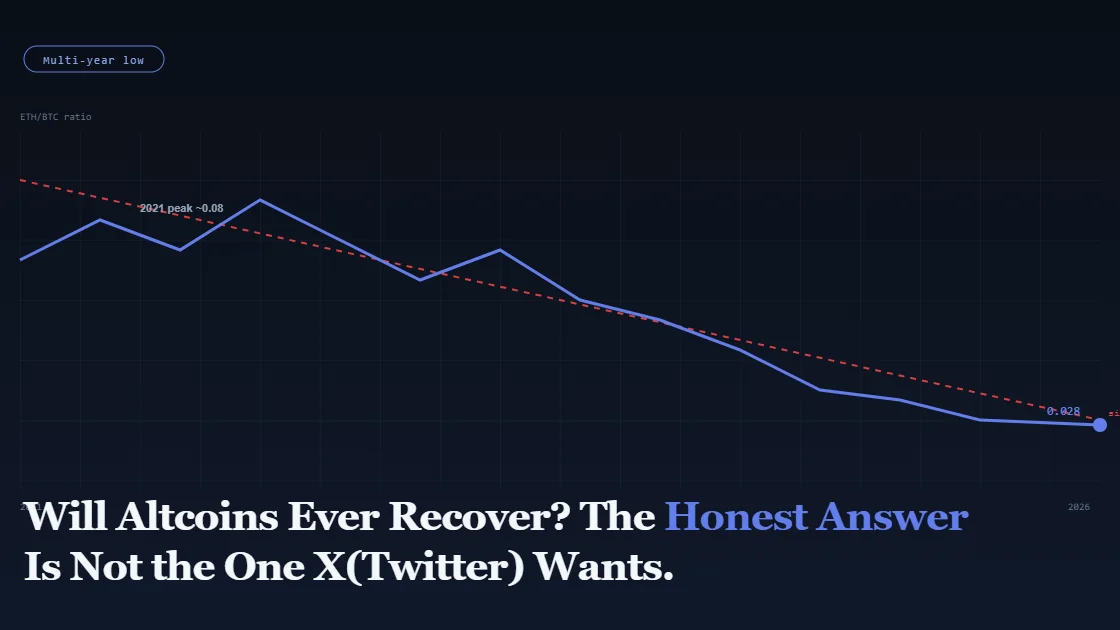
Will Altcoins Ever Recover? The Honest Answer Is Not the One X(Twitter) Wants.
Note: This article is for informational purposes only and does not constitute financial or investment advice.