How China Built the Thing Everyone Else Has to Buy From
China ran a trade surplus of $938 billion in the first 9 months of 2026, installed 59% of the world’s new factory robots, and refines around 90% of the planet’s rare earths. The interesting question is not whether it is ahead in manufacturing, the numbers settle that, but how a few deliberate choices compounded into a lead that tariffs and chip bans have not reversed. I went through the mechanics.
Last verified Also on Medium
On this page
- The number that captures it
- Why the factories move so fast
- Involution, the competition most markets never see
- The 3 bets that built the lead
- The chokepoint hiding inside everything
- Why tariffs and chip bans did not reverse it
- The next race is already running
- The bill that comes with the lead
- What it means for the rest of us
Walk into a car showroom almost anywhere in Europe this year and you will find brands that barely existed there a few years ago. That is the surface of a much larger shift. In the first 9 months of 2026, China’s auto exports rose about 54% by value over the same stretch of 2025, according to its customs agency, driven by demand for electric and hybrid cars. In June, monthly vehicle exports crossed 1 million units for the first time. A growing share of the new cars on the world’s roads now ship from China.
I do not find the fact of the lead very interesting on its own, because the data is not really in dispute. What is worth understanding is the machinery underneath, the specific decisions and physical advantages that let China keep pulling ahead while the countries trying to catch up stay stuck. That is what this is about.
The number that captures it
Start with trade, because it ties everything else together. China ran a goods trade surplus of $938 billion in the first 9 months of 2026, according to customs data reported by the Associated Press. The world bought nearly a trillion dollars more from China than China bought back, and the full year is on track to beat 2025’s record of about $1.2 trillion.
The mix matters more than the size. This is not cheap clothing and plastic toys anymore. In that same stretch, China’s semiconductor exports rose 108% by value, its data processing equipment rose 55%, and its auto exports rose 54%. The things driving the surplus now are chips, batteries, cars, and machinery, which is to say the high value goods that rich countries built their economies on. For much of the world’s manufacturing, the supply chain now starts in China.
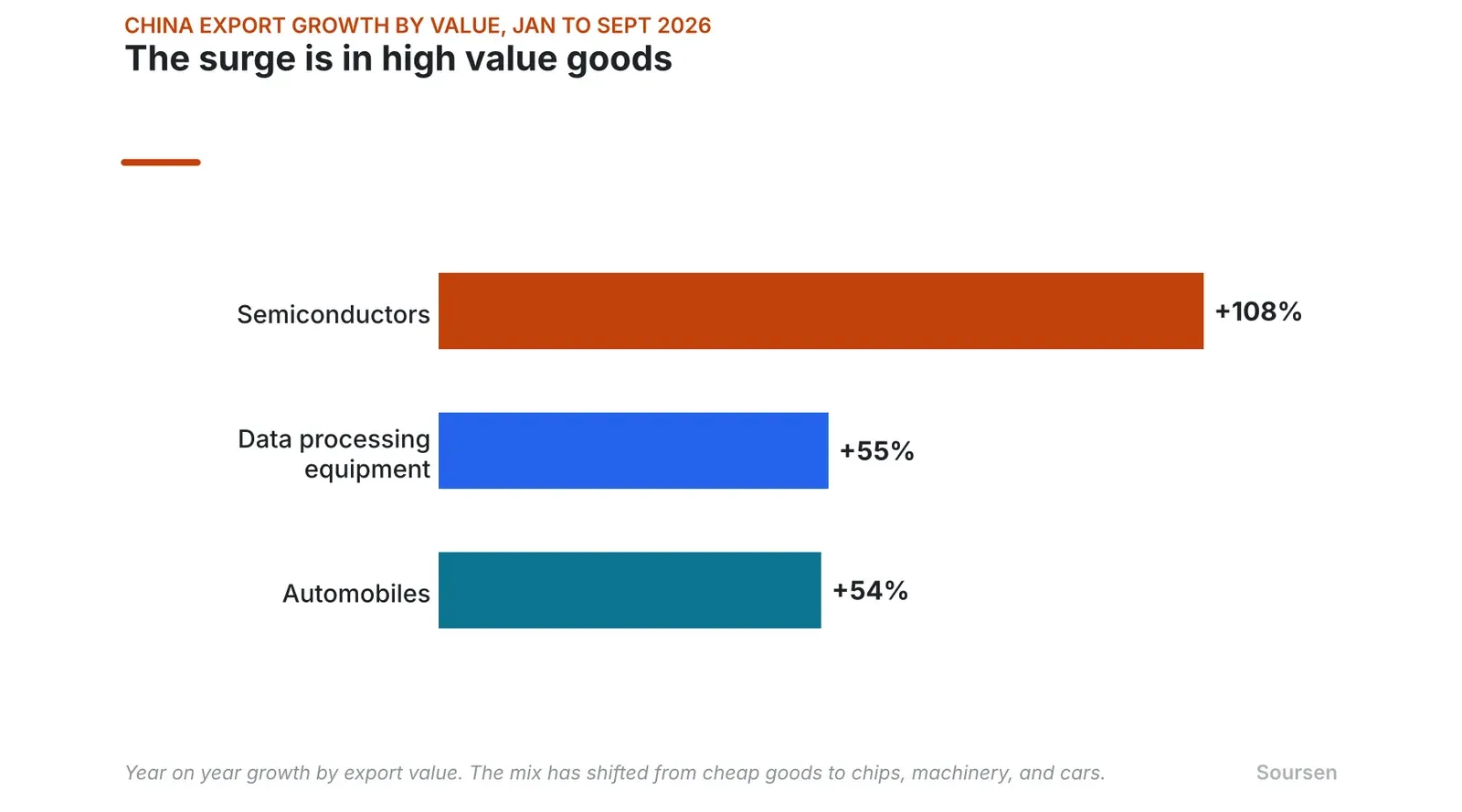
What China’s export surge is actually made of. The growth is in high value goods, not cheap ones. Source: China customs data via AP, Jan to Sept 2026
Why the factories move so fast
The clearest way to see China’s manufacturing advantage is to follow one product from idea to shelf. Picture an engineer in Shenzhen, in the Pearl River Delta, designing a new electric car. Within a short drive of the office are the mold makers who shape the plastic, the factories that print the circuit boards, the plants that make the battery cells, and the software teams that write the code. Midway through testing, the engineer decides the battery housing needs a different shape. She drives to the tooling shop that afternoon, the mold gets recut, the new part gets tested, and the change is locked in within days.
Run the same change at a carmaker whose suppliers are spread across several countries. Drawings go out by email, samples ship by freight, and each round of revisions waits for the last to arrive. A change that takes days in Shenzhen takes months across a scattered supply chain, and a car is thousands of those decisions stacked on top of each other. The same density exists around Shanghai in the Yangtze River Delta. The speed comes from everything a product needs sitting in one region.
Geography is only half of it. For decades China assembled phones, laptops, and appliances for brands worldwide, and every one of those contracts left knowledge behind. Tooling engineers who know which mold will crack. Line managers who can clear a bottleneck before lunch. Inspectors who spot a flaw by feel. That knowledge moves between companies, passes to younger workers, and compounds with every product cycle, so each new product starts from a higher base than the one before it.
Involution, the competition most markets never see
There is a Chinese word for the next piece, involution. It describes competition so intense that everyone has to run faster just to hold their position. The scale of it is hard to overstate. Around 2018 China had more than 500 registered electric vehicle startups. By 2025, roughly 400 of them had ceased operations, leaving about 100 active brands, and McKinsey analysts expect fewer than 50 to survive by 2030. The ones still standing, names like BYD, Geely, NIO, and Xpeng, learned to cut cost, ship updates, and improve at a brutal pace through years of domestic price wars, because the alternative was running out of cash and disappearing, which is what happened to most of them.
So by the time a Chinese car reaches a European showroom, it has already survived the hardest car market on earth. The company exporting it is a survivor of a cull that killed about 4 out of every 5 of its rivals, hardened rather than coddled, which is a different kind of competitor than a legacy automaker that has had a comfortable domestic market for 50 years. That history is a large part of why the imports are hard to price against.
The 3 bets that built the lead
China’s lead did not happen by accident, and it comes down to 3 strategies that each took years to pay off.
The first was picking industries early and staying in them through the lean years. Under Made in China 2025, Beijing named batteries, solar, and electric vehicles as sectors it meant to lead, then kept the money flowing when demand was thin and nobody was making a profit. Western firms did the opposite. The American battery maker A123 Systems went bankrupt in 2012 and was bought by China’s Wanxiang Group. Many early US and European solar manufacturers collapsed or left the business. So when global demand finally arrived, the Chinese companies were the ones that already had the factories, the suppliers, and the trained workers in place.
The second was a bet on battery chemistry. Most Western carmakers built around NMC cells, using nickel, manganese, and cobalt. Chinese makers backed lithium iron phosphate, or LFP, which leaves out the expensive nickel and cobalt. CATL and BYD scaled LFP to enormous volumes, and BYD built its Blade battery around it. The battery is a huge share of what an electric car costs, so a cheaper chemistry at that scale showed up directly as a cheaper car.
The third was a response to being cut off. US export controls blocked Chinese AI labs from the most advanced chips, so instead of waiting for better hardware, labs like DeepSeek and the teams behind Qwen and Kimi squeezed more out of what they had. They leaned on a mixture of experts design, where a model is split into specialized sections and only the ones a given question needs switch on, which saves a large amount of computing power. Then they released the models as open weights, so anyone could download them, run them, and build on top. Chinese AI spread by being efficient and easy to adopt rather than by owning the biggest data centers.
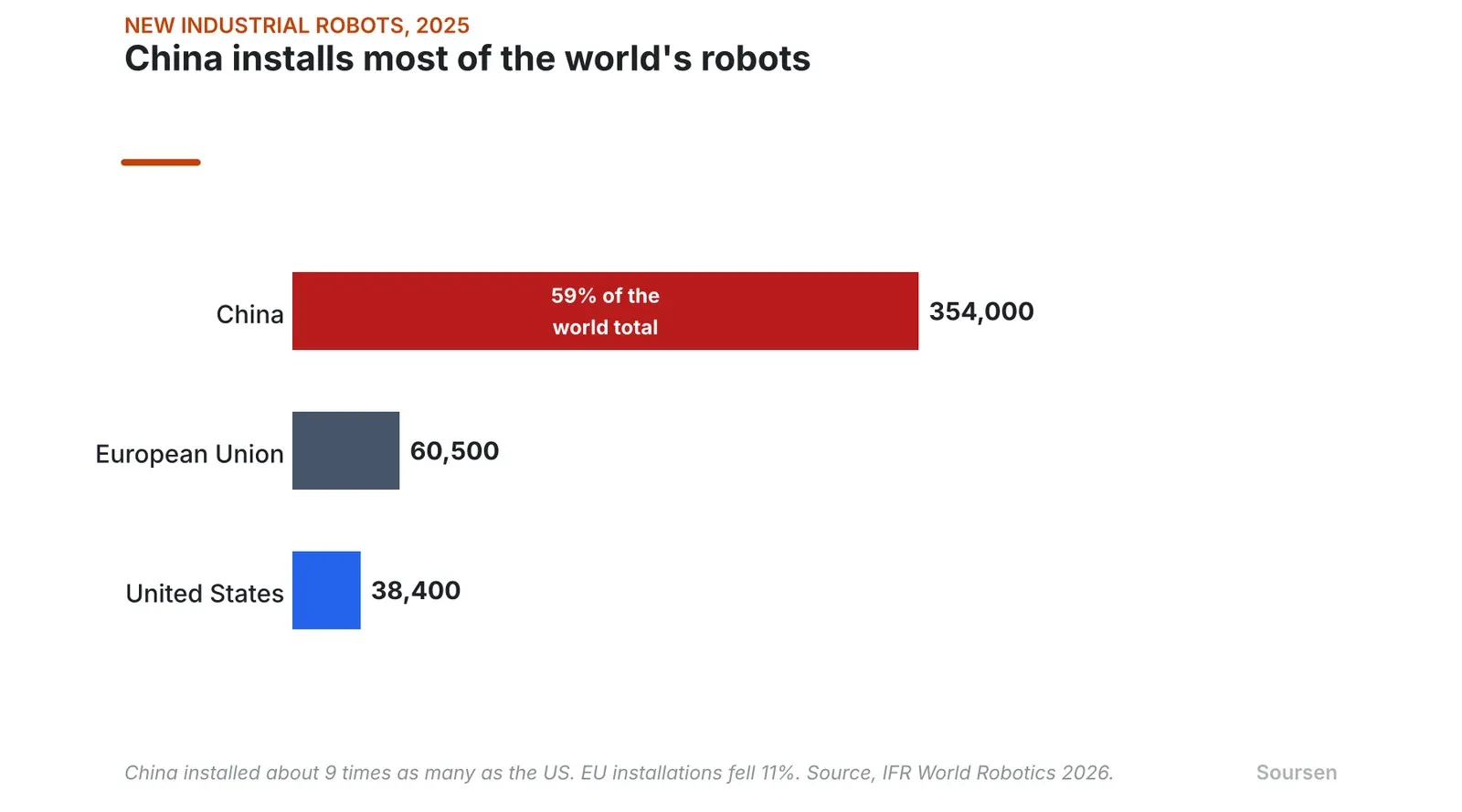
The robot race is the clearest single snapshot. China installed 59% of the world’s new industrial robots in 2025. Source: IFR World Robotics 2026
The chokepoint hiding inside everything
This reaches into products that say they were made somewhere else. Take an electric car assembled in Europe and trace it backward. The motor’s magnets are made from rare earth metals. The battery needs graphite, lithium, and cobalt. The chips rely on gallium and germanium. Those raw materials get dug out of the ground on several continents, but before any factory can use them, they have to be refined, the step where raw ore is purified into something a manufacturer can work with. That step happens overwhelmingly in China.
China handles around 90% of the world’s rare earth refining, plus the bulk of refining for graphite, cobalt, and gallium.
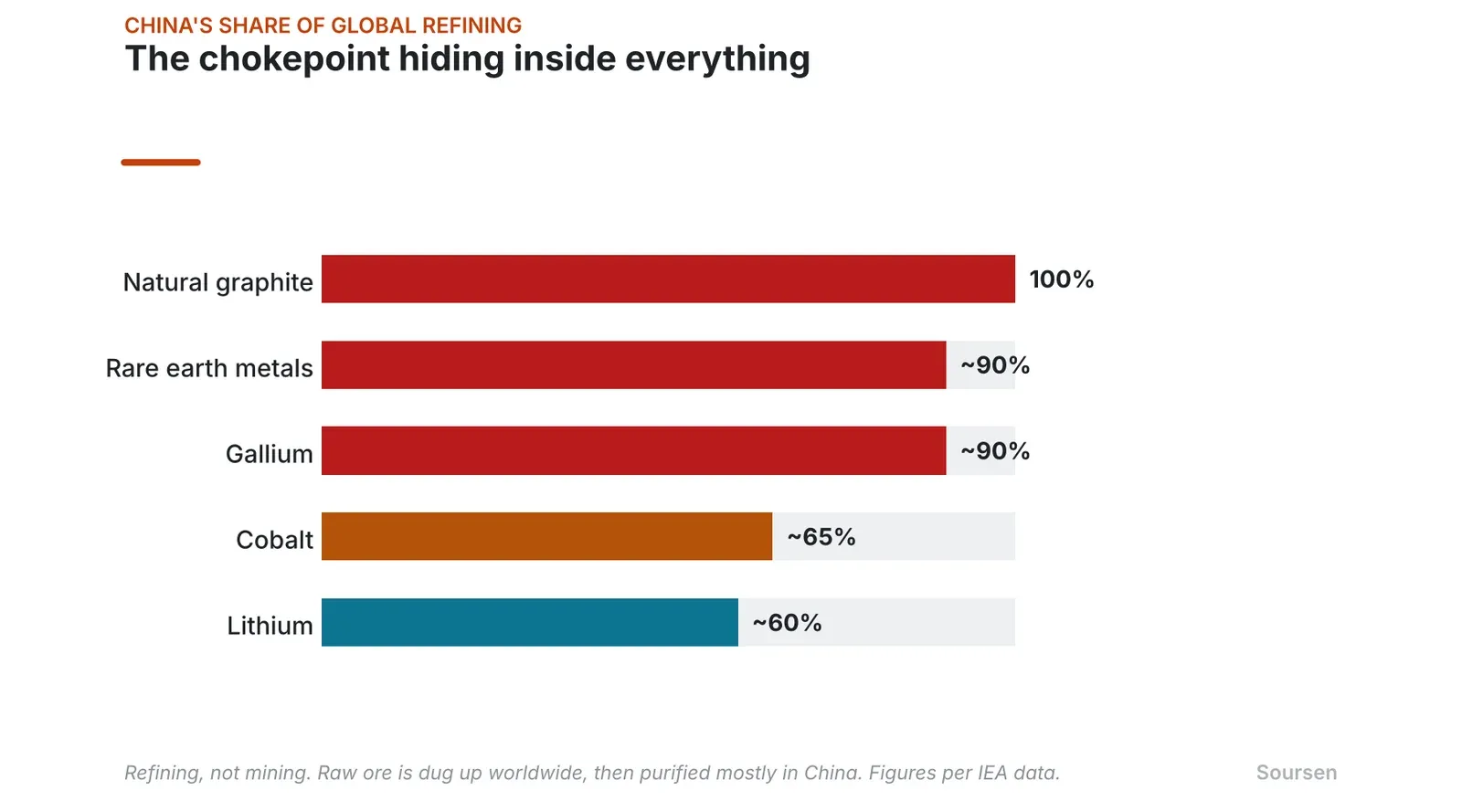
Where the control actually sits. The refining step, not the mining, happens mostly in China. Source: IEA critical minerals data
So a made in label tells you where the final assembly happened, not where the product really started. Beijing understands exactly how much power that gives it. In April 2025 it put licensing requirements on 7 medium and heavy rare earths, including metals used in high performance magnets, and carmakers and electronics firms outside China suddenly waited on paperwork for supplies they used to just order. A broader wave of controls followed later in the year before being paused as part of a truce with the US.
The same pattern showed up in a less obvious place. Tunnel boring machines, the giant rotating drills that carve rail and metro tunnels, are another thing many countries buy from China. In late 2026 Beijing announced export controls on those machines too. India had already seen Chinese made machines held at customs, and its bullet train and metro projects faced fresh delays. A rule written in Beijing can hold up trains on other continents, which is what real control over a supply chain looks like.
Why tariffs and chip bans did not reverse it
The obvious counter to all this was pressure from Washington, tariffs and technology bans. Neither changed the underlying position, and understanding why is the whole point.
Take tariffs. The US put heavy duties on goods shipped from China, so Chinese manufacturers moved final assembly to Vietnam, Mexico, and elsewhere in Southeast Asia. The components still came from Chinese suppliers, got assembled in the new hubs, and shipped to America under a different country of origin. The shipping routes and the customs forms changed, the label on the box changed, and the dependence did not change at all. China’s trade surplus kept climbing the entire time.
The chip bans ran into a similar reversal. The US cut Chinese firms off from the most advanced AI chips and the tools to make them, meaning to freeze China’s chip industry in place. What it did instead was remove the option of buying American, so Chinese firms started building their own. Huawei pushed ahead with its Ascend AI chips, SMIC kept driving toward more advanced manufacturing, and memory makers CXMT and YMTC kept expanding, while Beijing steered its own tech companies toward domestic chips and handed its suppliers a guaranteed home market. Restrictions meant to slow China down pushed it to build its own alternatives sooner. I am not claiming the bans did nothing, they raised costs and bought time, but they did not do the thing they were designed to do.
The next race is already running
The same clusters that won electric cars are now pointed at what comes next. In 2025 China installed 354,000 industrial robots, about 59% of every new industrial robot installed on earth, according to the International Federation of Robotics. The US installed 38,400 and the EU 60,500, with EU installations actually falling 11%. China put in roughly 9 times as many robots as the US, and more than half of its own came from Chinese suppliers.
The pattern repeats across the new frontiers. In drones, DJI is the name most people already know. At IFA in Berlin in September, Chinese firms staged the largest humanoid robot showcase in the event’s history. CATL is developing sodium ion cells and solid state battery designs for the generation after lithium. The factories, engineers, and supply chains that won the car race are being aimed at robots, drones, and the batteries to power them, which means the advantage compounds into the next set of industries rather than resetting.
The bill that comes with the lead
I do not want to write the triumphant version, because the same model that produced the lead is doing real damage inside China. Involution cuts both ways. The price wars that forged world beating companies also pushed the auto industry’s profit margins down to around 1.8%, left most makers losing money on every car, and helped drag the whole economy toward deflation, where falling prices feed on themselves. Bloomberg has described involution and the overcapacity behind it as a core problem for China’s economy, not a feature of it.
Beijing clearly agrees, because it keeps trying to stop it. Regulators have summoned automakers more than once over what they call an irrational price war, and have drafted rules to curb the endless discounting. BYD, the strongest of the survivors, reported a profit slump as the downturn ran on. The honest picture is a country that built a genuine manufacturing lead and is now struggling to control the destructive competition that built it. The lead is real, and so is the hangover.
What it means for the rest of us
Set the geopolitics aside and look at what lands in ordinary life. Across much of the world outside the US, the list of new cars now includes Chinese models that were not there a few years ago, carrying cheaper LFP batteries and costs already squeezed by the price wars back home, and every other brand on the lot has to price against them.
The same trail runs through almost everything else you buy. The phone in your pocket, the charger on your desk, the solar panel on a roof down the street, the parts inside a washing machine. Even when the box names another country, the path usually runs back through Chinese factories and Chinese refineries, and that is a real part of why those products cost what they do. Chinese carmakers are now opening plants in Hungary, Spain, Turkey, Thailand, Indonesia, and Brazil, which brings factory and engineering jobs that revolve around Chinese designs, Chinese processes, and Chinese supply chains. The lead is not an abstract statistic about a faraway country. It is already priced into the things on the shelf in front of you.
Sources
- China’s exports surge as trade surplus hits $938 billion, Associated Press via AJCajc.com. Accessed 1 November 2026.
- China installs 59% of the world’s new industrial robots, The Next Webthenextweb.com. Accessed 1 November 2026.
- China imposes export controls on medium and heavy rare earth materials, Holland & Knighthklaw.com. Accessed 1 November 2026.
- China imposes export controls on tunnel-boring machines, MLexmlex.com. Accessed 1 November 2026.
- Made in China 2025, Wikipediaen.wikipedia.org. Accessed 1 November 2026.
- A123 Systems, Wikipediaen.wikipedia.org. Accessed 1 November 2026.
- Lithium iron phosphate battery, Wikipediaen.wikipedia.org. Accessed 1 November 2026.
- DeepSeek, Wikipediaen.wikipedia.org. Accessed 1 November 2026.
- BYD Auto, Wikipediaen.wikipedia.org. Accessed 1 November 2026.
- 400 Chinese EV companies ceased operations between 2018 and 2025, EV Boostersevboosters.com. Accessed 1 November 2026.
- China’s involution problem, how price wars and overcapacity fuel deflation, Bloombergbloomberg.com. Accessed 1 November 2026.
Related stories
AI & GPU compute
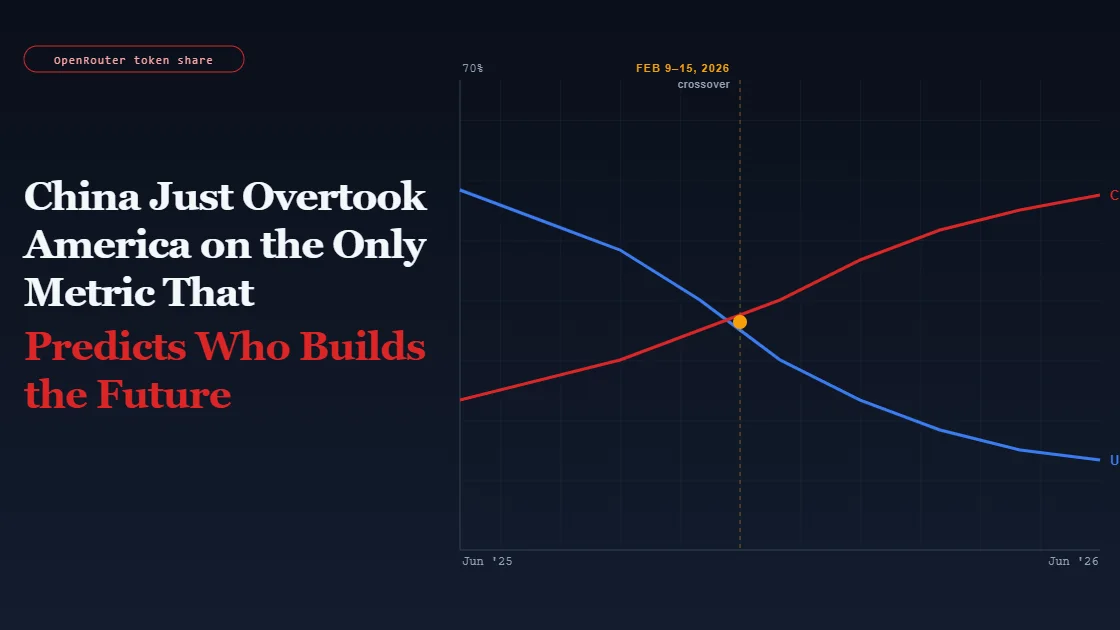
China Just Overtook America on the Only Metric That Predicts Who Builds the Future
Note: This article discusses ongoing industry developments and government policy. It is for informational purposes only.
Infrastructure
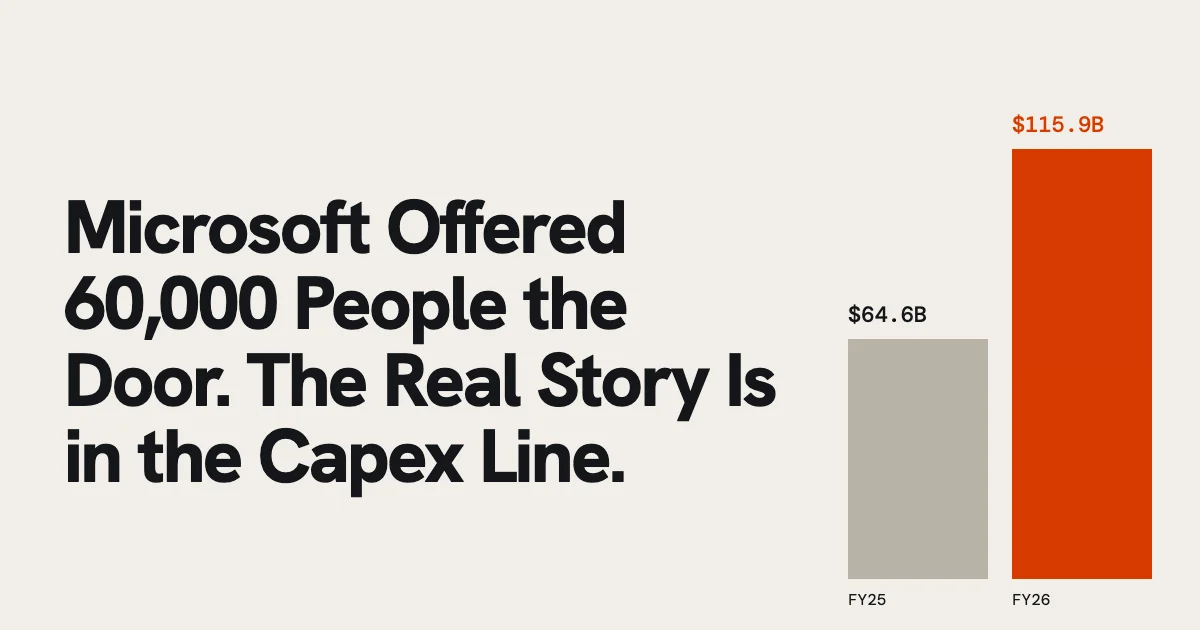
Microsoft Offered 60,000 People the Door. The Real Story Is in the Capex Line.
The headline reads as an AI layoff. Read the spending next to the revenue and a different reason shows up, one that will land at Google and Meta next.

Infrastructure
You Can Build a Serious Home Server for About $1,000, and It Solves a Problem Your Phone Cannot
A used enterprise server that cost a company thousands of dollars new sells for around $250 today, and with a few parts you have a private cloud that runs AI agents, stores your photos, records your cameras, and lets you walk through an airport with a phone that holds almost nothing. I went through the exact parts, the real prices in the current memory shortage, and what to actually run on it.