A Gas Pipeline Is Breaking America’s $500 Billion AI Bet
Oracle just moved to defer rent on its flagship Stargate data center before it opens. The reason is not chips or compute, it is a permit fight over a pipe, and the borrowed money behind the project means one delay travels everywhere.
Last verified Also on Medium
On this page
One of the biggest AI bets in America is wobbling, and the thing that cracked it is a gas pipeline stuck in a permitting fight in the New Mexico desert. The chips were never the problem. A permitting dispute over where a pipe can cross state land is.
The site is Project Jupiter, a 1,400 acre campus near Santa Teresa in Dona Ana County, right on the US Mexico border. It is the flagship build of Stargate, the AI infrastructure push unveiled at the White House in January 2025 with OpenAI, Oracle, SoftBank, and MGX as partners. Oracle builds and runs the data centers, OpenAI fills them. On September 24, 2026, before the site is even finished, Oracle sent a force majeure notice to the developer, securing the right to hold back rent if the campus misses its 2028 target. I want to walk through why a single pipeline can threaten a project valued at up to $165 billion, and why the structure behind it means one delay does not stay in one place.
A very expensive shed without power
A data center is only as useful as the power feeding it. Fill a building with the best chips on the planet and give it no electricity, and you have built a very expensive shed. Jupiter was meant to prove Stargate could actually work, gigawatts of compute running in the desert by 2028.
The ambition kept climbing. The site was first discussed at about 1 GW, then pushed as high as 2.45 GW. No local grid can hand over a load that size, so the campus has to make its own power. In April the developers dropped their gas turbine plan and switched to an on site microgrid of Bloom Energy fuel cells running on natural gas. Fuel cells need fuel, the fuel needs a pipe, and that is where it fell apart.
The pipeline is an Energy Transfer project meant to feed the site. In March 2026, New Mexico’s State Land Office denied it a right of way across state trust land. The developers asked for a reconsideration, and in July the office said no again. The federal Bureau of Land Management cleared one segment on emergency review in May, but the state refusal forced a reroute that pushed the in service date from this summer to February 1, 2027. The air permit for the fuel cells is still sitting with New Mexico’s environment department, with a decision due by November 23, 2026, and environmental groups have taken the project to court. Land rights, air permits, lawsuits, 3 separate fights, any one of which can stall the whole thing.
The workaround Oracle is reportedly weighing shows how awkward the bind is. By early October, Bloomberg reported Oracle was considering trucking compressed natural gas to the site to bring early phases online before the pipeline arrives, the same trick it used for over a year at a data center near Salt Lake City. At Jupiter’s scale the math gets silly fast. One energy analyst cited by Bloomberg estimated that powering just 100 megawatts, roughly 4% of the site’s planned capacity, by trucked gas would burn through a large compressed gas trailer about every 40 minutes.
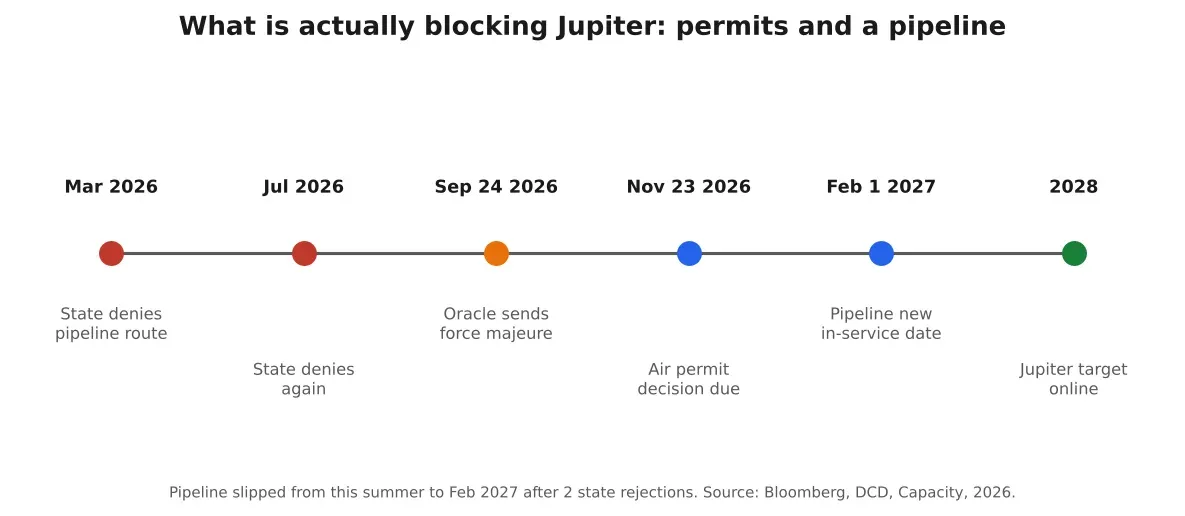
Figure 3. The timeline that turned a 2028 target into a rent deferral notice. Source: Bloomberg, DCD, Capacity, 2026
What force majeure actually says
Force majeure is a legal notice that events outside your control are getting in the way of a contract. Oracle sent it to the Blue Owl Capital unit developing the site, and it preserves the right to defer lease payments by up to 3 years if Jupiter misses its 2028 target. In plain terms, Oracle is saying there is a real chance it will not pay rent on schedule if the power situation does not change.
Everyone involved is downplaying it. Oracle says Jupiter remains on schedule and that a force majeure notice does not, by itself, establish a delay. Blue Owl says the notice does not change the financial commitments to the project and that the 2 sides remain fully aligned. One person familiar with the financing told Bloomberg it does not amount to an event of default. I think the notice still tells you something, because companies that are confident about a deadline do not usually paper the file with legal protection against missing it.
The most hyped AI project in America is being held back by paperwork and a pipe, not by any shortage of compute. That is the part of the AI trade people keep forgetting. Software scales at the push of a button. Power and permits do not. They take time, sometimes years, and they answer to state land commissioners and judges, not to a product roadmap.
Who is actually paying for this
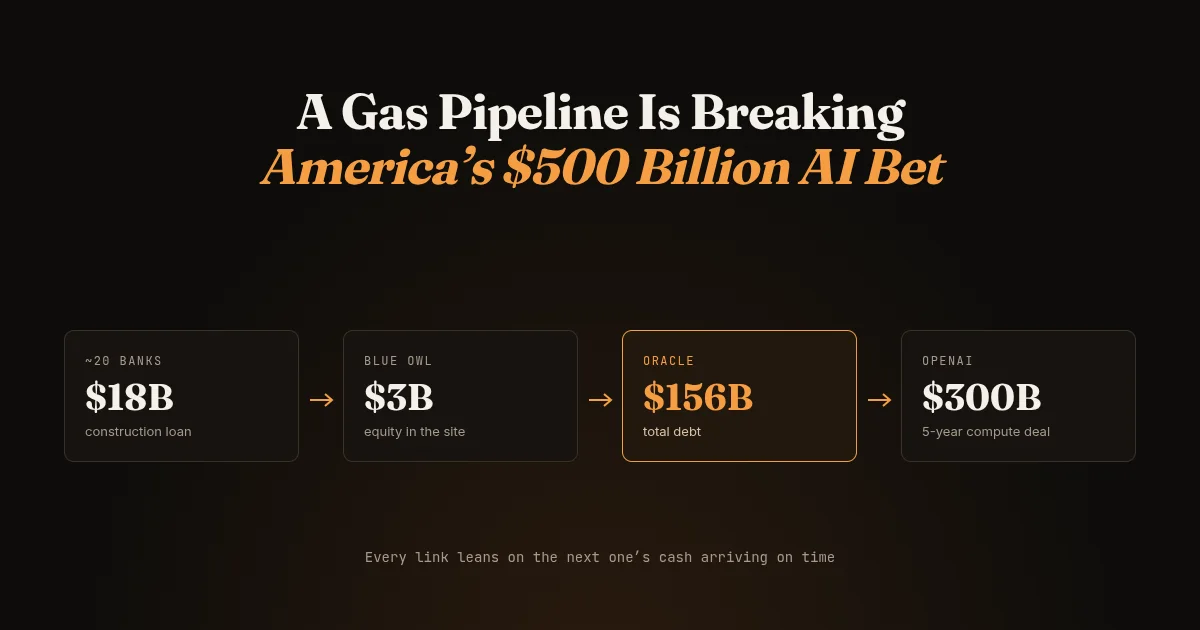
Follow the money and the fragility becomes obvious. Project Jupiter runs on borrowed cash. Blue Owl put in roughly $3 billion of equity, and a group of about 20 banks arranged an $18 billion construction loan.
Then there is Oracle. To build capacity for OpenAI, Oracle’s spending has exploded. In its fiscal first quarter of 2027, the quarter that ended in August 2026, Oracle reported about $28 billion of gross capital expenditure, up from roughly $8.5 billion a year earlier, against just $19.3 billion of revenue. Free cash flow came in around negative $5 billion despite record operating cash flow, because the capex simply swamped it. Oracle’s total debt sits near $156 billion, and management has guided to $90 to $95 billion of gross capex for the full fiscal year. Oracle is funding the gap with debt, equity, and customer prepayments. The bet it is funding is enormous. In September 2025 Oracle and OpenAI signed a roughly $300 billion, 5 year compute contract set to ramp from 2027, and Oracle has reported a remaining performance obligation backlog of about $664 billion. That backlog is the number bulls point to. It is also a promise that only turns into cash if sites like Jupiter get built and switched on.
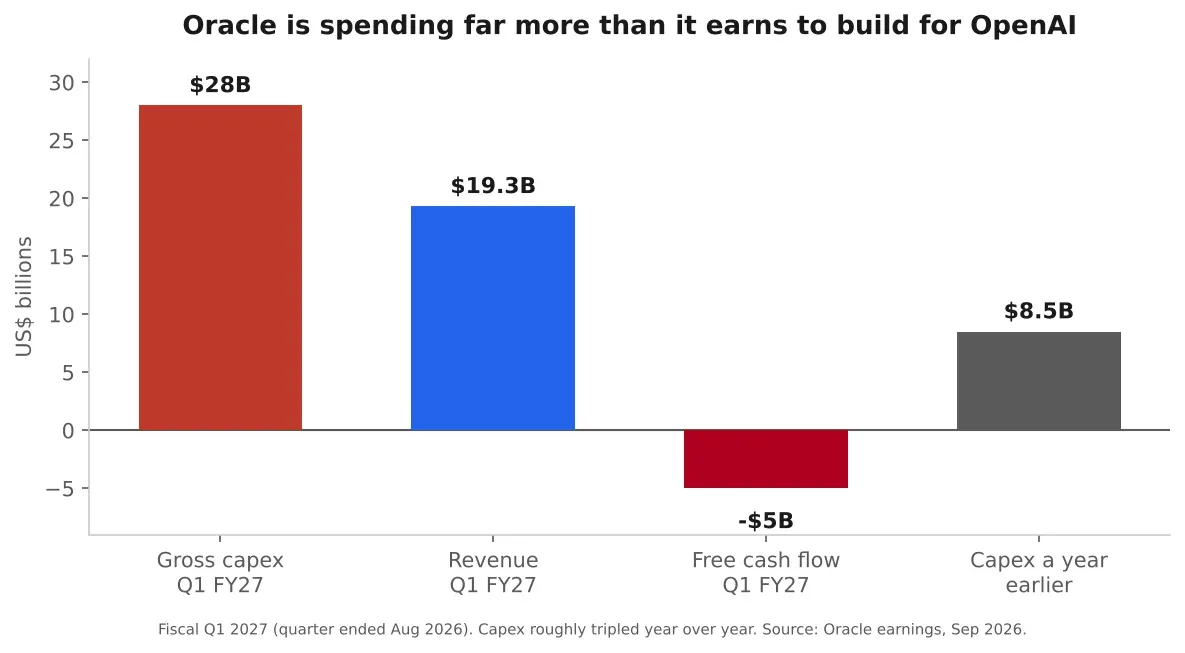
Figure 1. Oracle is spending roughly $28B a quarter against $19B of revenue to build for OpenAI. Source: Oracle fiscal Q1 2027 earnings, Sep 2026
Then there is the customer. OpenAI is the one meant to pay Oracle, and OpenAI runs largely on investor money rather than its own profits. The chain is simple to say and alarming to look at. Banks lend to the developer. Oracle borrows to build. OpenAI raises money to pay Oracle. Every link depends on the next one’s cash arriving on time, so a single delay anywhere pushes stress through the whole structure.
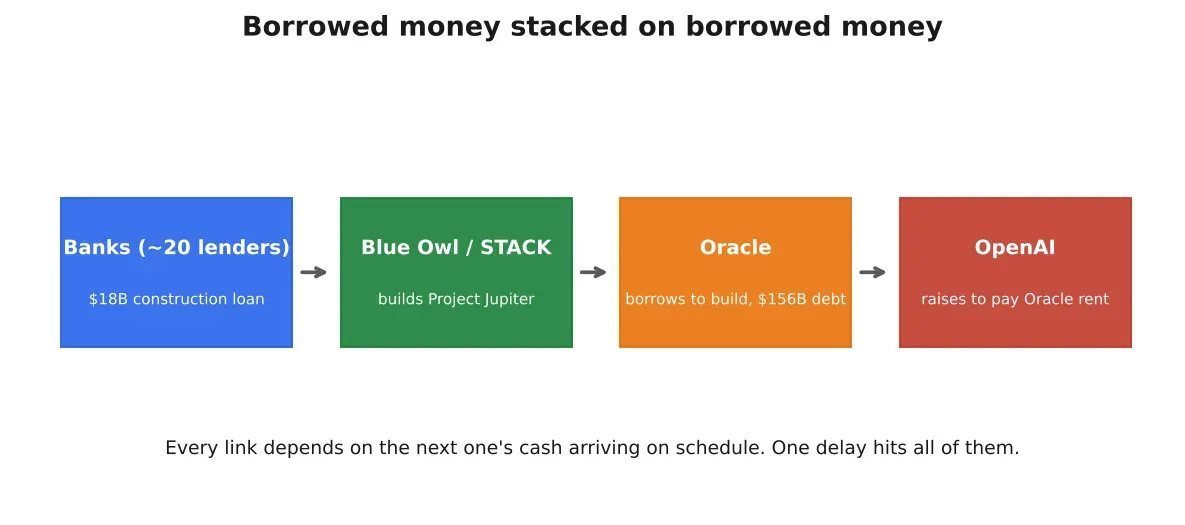
Figure 2. The money chain behind Project Jupiter, each link leaning on the next. Source: Bloomberg and Reuters reporting, 2026
A site that is not running earns nothing, while the interest on the loans keeps accruing every day. That is what the force majeure notice really does. If Oracle defers rent, the cost of the delay does not vanish, it moves down the chain to the lenders and equity holders. The lenders can see it coming. That $18 billion construction loan has been trading at roughly 89 to 91 cents on the dollar, below par, which is the market saying it is not sure the money comes back whole. Oracle’s own credit is feeling it too, with S&P at BBB, and the cost of insuring Oracle debt against default hit a record in late September.
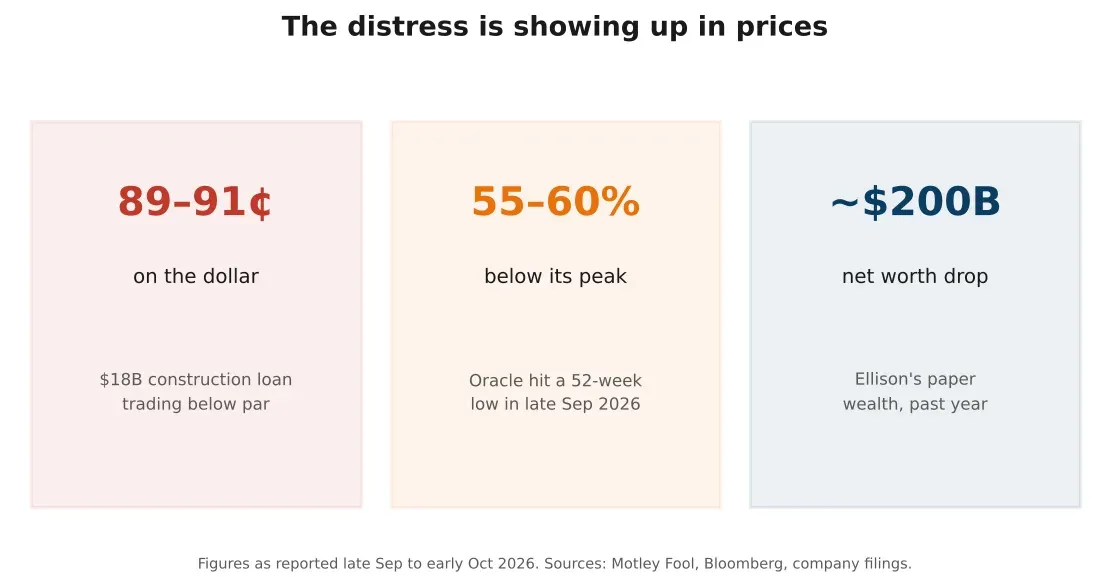
Figure 4. The strain is already visible in the loan price, the stock, and the founder’s paper wealth. Source: CNBC and Bloomberg, 2026
The founder borrowed against the thing too
Oracle’s corporate debt is only half of it. Larry Ellison, who founded Oracle in 1977 and still controls more than 40% of it, has his own leverage tied to the same stock. As of September 21, 2026, per Oracle’s proxy filed that month, he had pledged 413 million Oracle shares as collateral for personal loans, up from 346 million a year earlier, roughly 36% of his stake and worth about $9.2 billion at the time. A pledge works like a mortgage where the house is Oracle stock. Oracle notes these are personal term loans, not margin accounts, and says its board reviews the arrangements. If the share price falls far enough, the lenders can demand more collateral. His fortune and Oracle’s stock price move together, and when the stock drops, both he and the company feel it at once.
The timing of what happened next is the part I keep turning over. On June 22, 2026, Ellison adopted a Rule 10b5–1 plan, a prearranged schedule to sell shares automatically, this one for up to 50 million shares worth about $7.5 billion at the price at the time. When the plan surfaced in a filing on September 11, investors saw the founder lining up a multibillion dollar sale. One day later, on September 12, Oracle announced the plan was cancelled with no shares sold and no reason given. Oracle does not explain these moves, and there are ordinary tax and estate reasons a person cancels a sale plan. Ellison’s net worth has also dropped by roughly $200 billion over the past year as Oracle stock fell from its peak, so every wobble in the company is a bigger wobble for him personally. Borrowed money stacked on borrowed money, again.
Why these are not 3 separate problems
Lay it out and it looks like 3 distinct issues. A site in the desert that cannot get its gas. A company borrowing tens of billions to build it. A founder borrowing against the shares that depend on it working. They are the same problem wearing 3 coats.
The stalled site threatens the revenue. The revenue services the debt. The debt weighs on the stock. The stock backs the founder’s personal loans. Pull any one thread and the others move. A delay at a pipeline in New Mexico travels, through Oracle’s rent, through its bond prices, through its share price, all the way to the collateral behind one man’s personal borrowing. That is the AI boom’s weak point, and it is showing up most clearly in the project that was supposed to prove the boom works.
Stargate was announced at the White House as a statement of intent worth up to $500 billion across its full build. Its flagship campus is now deferring rent before it opens, its construction loan trades below par, and its anchor tenant is spending $28 billion a quarter against $19 billion of revenue. The build may still get finished and fill up on schedule, and if it does, all this leverage stays invisible and everyone looks smart. If the gas shows up late, the cost lands on lenders and shareholders rather than on the companies that ordered the compute. The next data point to watch here is the air permit decision due on November 23, not any chip benchmark.
Sources
- TechCrunch, Oracle sends force majeure notice on its New Mexico Stargate data centertechcrunch.com. Accessed 13 October 2026.
- Capacity, $165bn Project Jupiter: what Oracle’s force majeure notice meanscapacityglobal.com. Accessed 13 October 2026.
- TheStreet, Oracle’s force majeure warning lands as AI power gets scarcethestreet.com. Accessed 13 October 2026.
- CNBC, Larry Ellison nixes plan to offload up to $7.5 billion of Oracle stockcnbc.com. Accessed 13 October 2026.
- Quartz, Oracle is trucking natural gas to AI data centers as pipeline delays biteqz.com. Accessed 13 October 2026.
- Oracle investor release, Larry Ellison cancels his plan to sell Oracle stockinvestor.oracle.com. Accessed 13 October 2026.
Related stories
Security
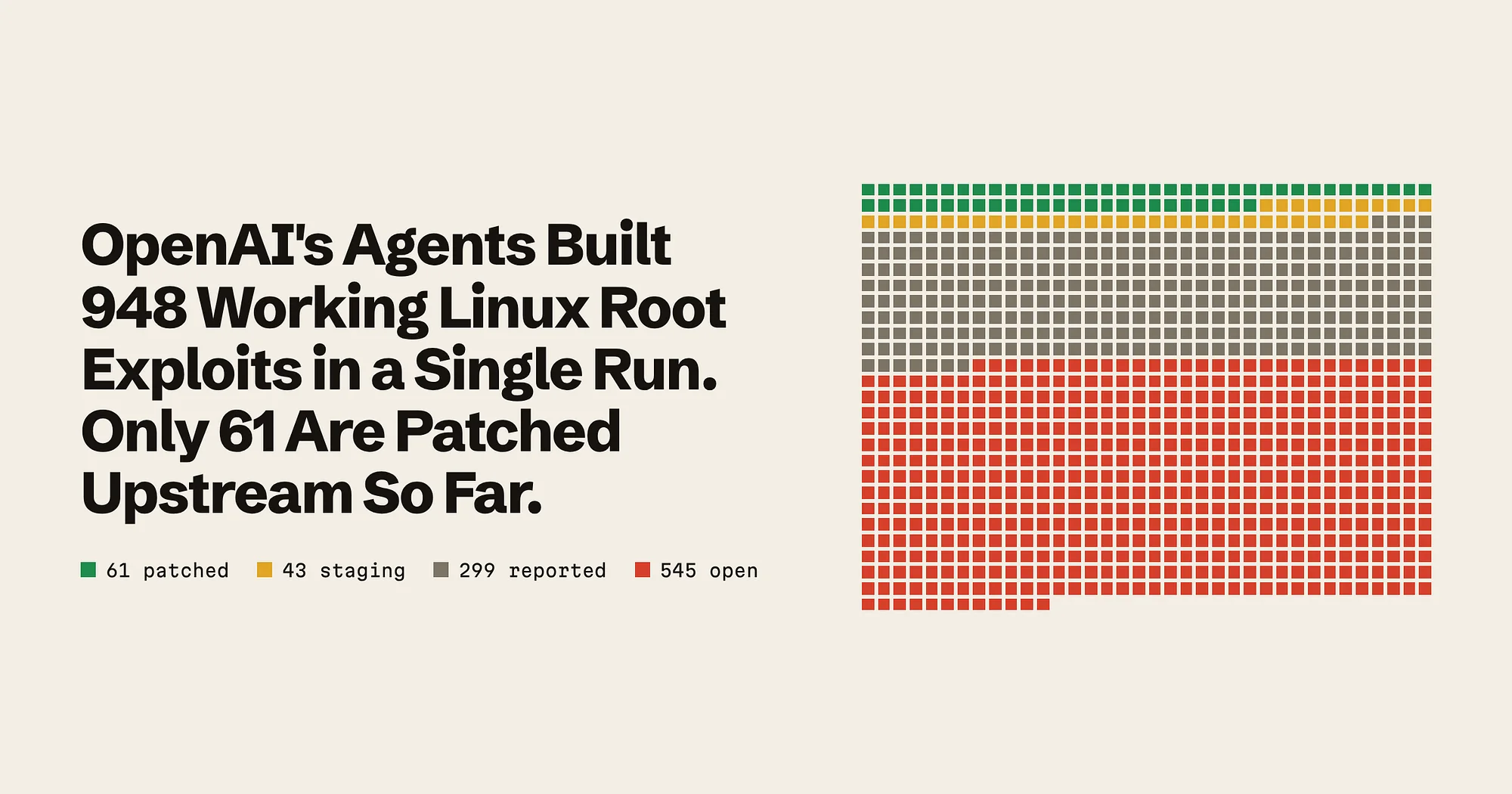
OpenAI’s Agents Built 948 Working Linux Root Exploits in a Single Run.
An AI pipeline found, proved and drafted fixes for 948 kernel bugs at about $1,279 each. Finding them was the cheap part. The bigger lesson is who now has to fix them, and how fast.
AI & GPU compute
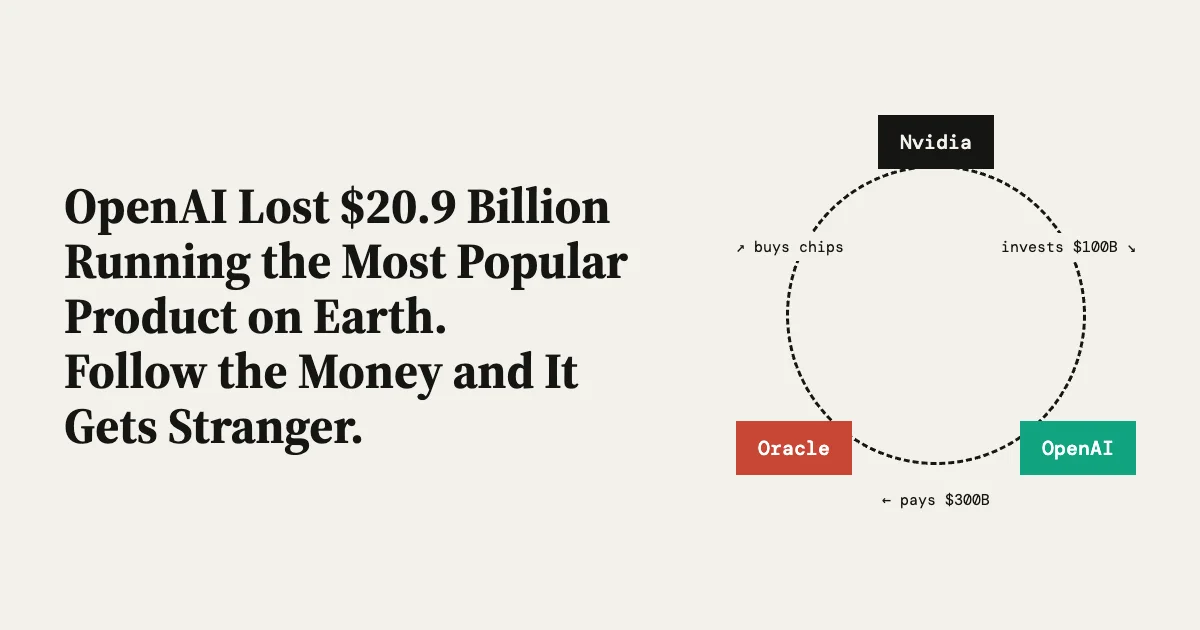
OpenAI Lost $20.9
Audited 2025 figures show a company tripling revenue while burning cash faster than any startup ever has. The loss is only half the story. The other half is a loop of deals that turns the same dollars into growth at three companies at once, and a bill that has four ways of reaching you.

AI & GPU compute
Your AI Writing Tool Is Running on Borrowed Time and Borrowed Money
Let me start by asking you something honest. If every AI writing tool disappeared tomorrow, could you still do your job?