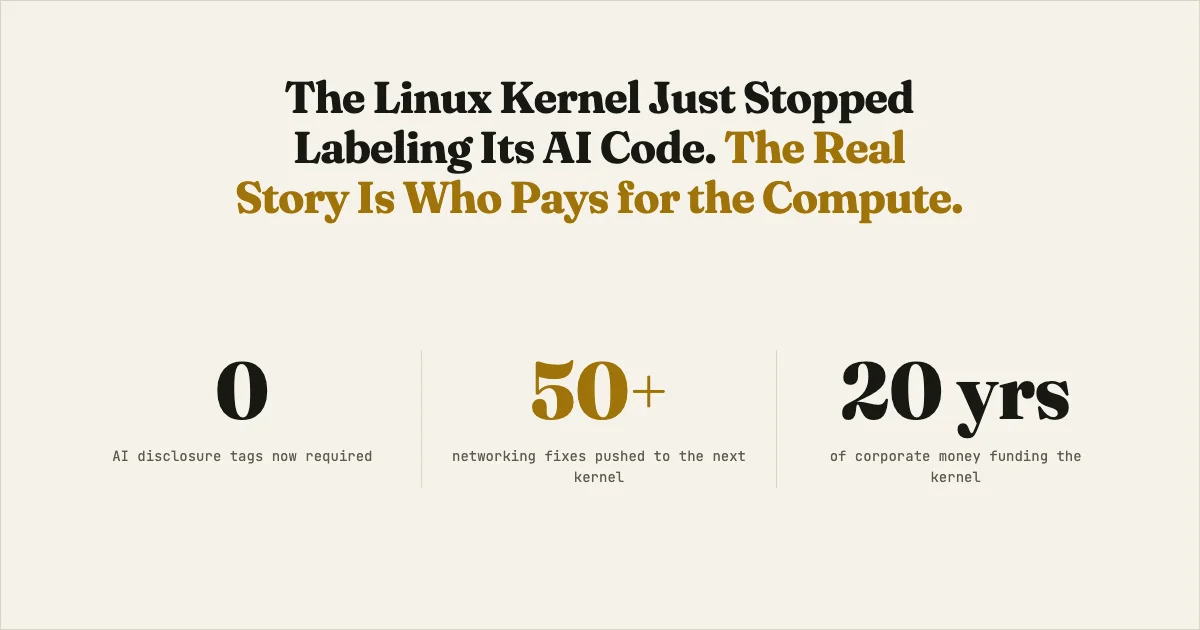
The Linux Kernel Just Stopped Labeling Its AI Code. The Real Story Is Who Pays for the Compute.
At the October 2026 maintainers summit, the Linux project dropped its requirement to tag AI assisted patches. The maintainers had reasonable reasons. The harder question is what it means that the compute reviewing and writing kernel code is donated by the same companies betting everything on AI.
Last verified Also on Medium
On this page
In October 2026, at the kernel maintainers summit in Prague, the Linux project decided to stop asking contributors to disclose when they used an AI tool to write code. The Assisted-by tag, introduced earlier in the year so that AI generated patches would be labeled, is being removed. I think that decision, and the fight around it, says more about where open source is heading than any benchmark does.
I want to walk through what actually changed, the real reasons the maintainers gave, where the serious disagreement is, and the structural question underneath all of it, which is whether a project that leans on corporate funded AI compute can still call itself free.
What actually got decided
The facts first, because this story has been told in a lot of heated ways. In April 2026 the kernel began allowing AI assisted contributions on the condition that you tagged them, with something like Assisted-by, so the provenance was visible. At the Prague summit in October, reported by LWN and Phoronix, the maintainers reached consensus to drop that requirement, and a patch removing it from the documentation went to the mailing list.
The reasons the maintainers actually gave are mundane, not sinister. Jeff Layton, a Red Hat kernel developer, laid out 3. Plenty of contributors ignored the tag anyway. The tag doubled as free advertising for proprietary LLM vendors, and it was never clear why the project needed to collect the information in the first place. Linus Torvalds, for his part, put the emphasis on judgment. He said he expects people to do their best and to understand what they are submitting, and that understanding has very little to do with which tools they used. That is a narrower position than the headlines suggest.
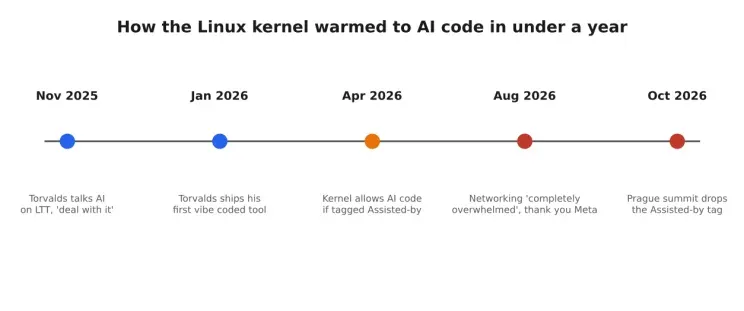
Figure 1. The kernel went from tagging AI code to dropping the tag in under a year. Source: LWN, Phoronix, The Register, 2026
The disagreement is real, and it is not settled
Not everyone agreed, and the dissent is the interesting part. Laurent Pinchart argued against removing the tag without some other disclosure mechanism, on the grounds that rules like this set expectations even when some people ignore them. Take away the only signal of how much AI is in the code, and you lose the ability to audit provenance later, which matters for a codebase that runs on billions of devices.
There is a licensing angle underneath that worry too. AI models are trained on large bodies of code under various licenses, and the kernel is GPL. If a model reproduces something it learned from incompatible code, a labeled patch at least gives you a thread to pull. Remove the label and that thread is gone. I do not think anyone has a clean answer here, which is exactly why some maintainers wanted to keep the signal.
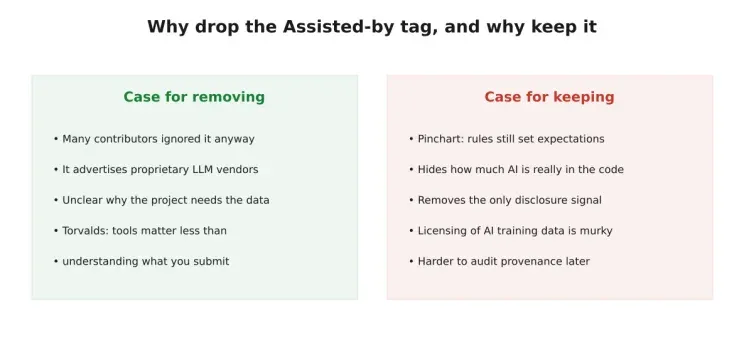
Figure 2. The 2 sides of the tag debate, both with real points. Source: LWN summit coverage, 2026
The networking subsystem is the canary
The clearest picture of the strain is in networking, and it comes straight from a maintainer’s own words. In the Linux 7.3 networking pull request in August 2026, subsystem maintainer Jakub Kicinski wrote that the team was “completely overwhelmed, of course,” by the flood of patches. His stated fix was more automation, not less. The message thanks Meta for securing enough LLM budget and access to run reviews with multiple frontier models on each patch, which he said helps eliminate some hallucinations, and floats letting the models handle more of the busy work, including applying patches that already carry trusted reviewers’ tags.
Sit with that for a second. A core Linux subsystem is being flooded with machine generated patches, and the maintainers’ answer is to point more machines at the problem, paid for by one of the largest AI companies in the world. In a later cycle the networking tree diverted more than 50 fixes to the next kernel while still being swamped by AI fueled churn. Whatever you think of AI coding, the volume problem is real and documented.
The structural question underneath it
Here is the part that actually worries me, and it has nothing to do with any one person’s opinion of chatbots. The Linux Foundation is funded overwhelmingly by large corporations. Platinum members, which include Google, Meta, and Microsoft among others, pay around $500,000 a year each, and the Foundation’s annual revenue crossed $300 million in 2026. Those same companies have enormous commercial stakes in AI being everywhere.
When the compute that reviews and increasingly writes kernel code is donated by Meta, and the organization stewarding the project is funded by the companies with the most to gain from AI adoption, the word free starts to strain. Big corporate backers fund the Foundation, those backers have a vested interest in AI, and a major project that stayed AI skeptical would be a problem for them. That is just how the incentives line up, no conspiracy required, and it is worth saying out loud.
There is a counterweight worth stating fairly. Corporate money has funded Linux kernel development for 2 decades, and the kernel got better, not worse, over that time. Paid developers from Red Hat, Intel, Google, and others do a large share of the serious work. Corporate funding is not new, and it is not automatically capture. The new thing is that the funding now buys compute that produces code directly, which shortens the distance between a sponsor’s interest and what lands in the tree.
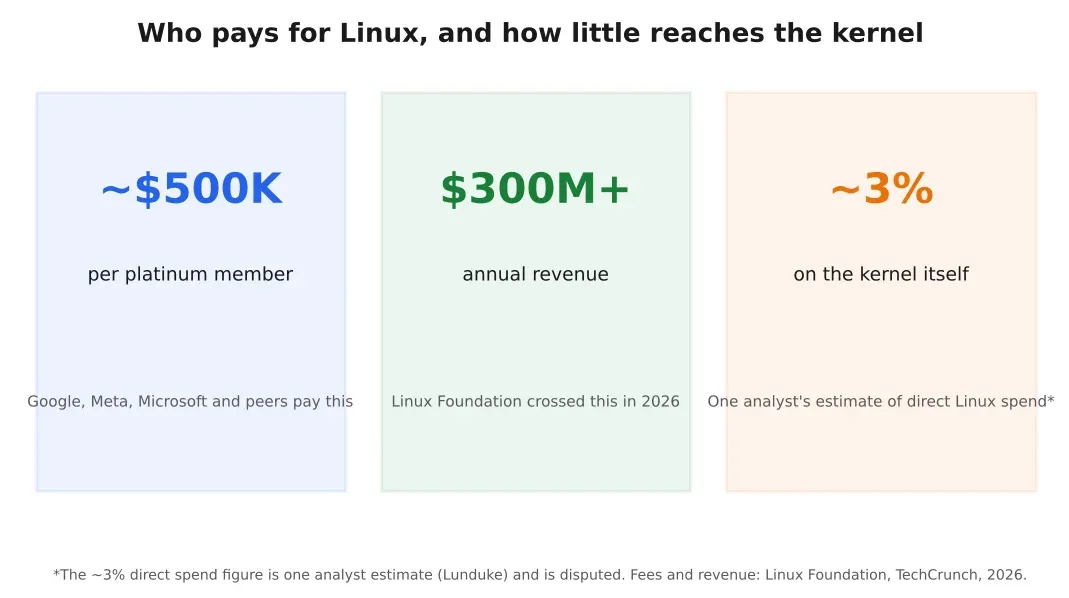
Figure 3. Who funds the Linux Foundation, and the disputed question of how much reaches the kernel. Source: Linux Foundation, TechCrunch, 2026
The exits, and why none of them are clean
So where do you go if you do not like this? The honest answer is nowhere comfortable. You can freeze on a long term support kernel and buy a few years, which is the easiest move and what a lot of people are doing. You can switch to the BSDs. NetBSD has a reputation for rejecting AI slop, but it supports far less hardware, gaming through Wine is hit and miss, and the Nvidia drivers are rough, roughly where Linux was around the year 2000. FreeBSD is friendlier day to day but more open to AI assisted contribution than NetBSD.
Forking the kernel sounds clean and is not. Copying the code is the easy 1%. The hard 99% is rebuilding the institutions around it, the maintainers, the review process, the testing infrastructure, the trust. Anyone who says just fork it is skipping the part that actually matters. Distributions already carry their own patch sets and lag mainline for stability, so in practice the pressure valve is more likely to be big distros quietly diverging than a clean community fork.
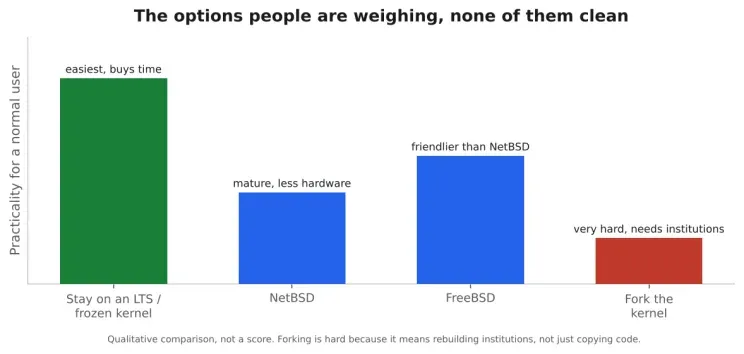
Figure 4. The options people are weighing, none of them clean. Source: Author summary of community discussion, 2026
What I would actually watch
Strip away the heat and a few concrete things will tell you how this goes. Watch whether the share of AI assisted commits keeps climbing and whether anyone outside the project can still measure it now that the tag is gone. Watch whether a serious kernel regression gets traced back to a machine written patch that no human fully understood, which is the failure mode the skeptics keep naming. Watch whether a major distribution forks or freezes in protest, because that is the signal that the disagreement moved from the mailing list to the shipping product.
Linux is still the least bad way off Windows for most people, and the kernel is not going to fall apart next week. My concern is slower than that. A project defined for decades by humans understanding every corner of their code is handing more of that understanding to tools funded by companies with their own agenda, and it just removed the one label that let outsiders see how much. None of this is a reason to panic. It is a reason to pay attention, and to keep asking who pays for the compute.
Sources
- The Register, Linux kernel devs drop obligatory confession of AI tool usagetheregister.com. Accessed 15 October 2026.
- Phoronix, Linux kernel developers plan to remove Assisted-By tag requirementphoronix.com. Accessed 15 October 2026.
- LWN.net, the 2026 Maintainers Summitlwn.net. Accessed 15 October 2026.
- Phoronix, Linux 7.3 networking merged but developers completely overwhelmed by AI/LLMsphoronix.com. Accessed 15 October 2026.
- Phoronix, networking diverts 50+ fixes, still bombarded by AI churnphoronix.com. Accessed 15 October 2026.
- Linux Foundation, Google renews platinum membershiplinuxfoundation.org. Accessed 15 October 2026.
Related stories
Linux & open source
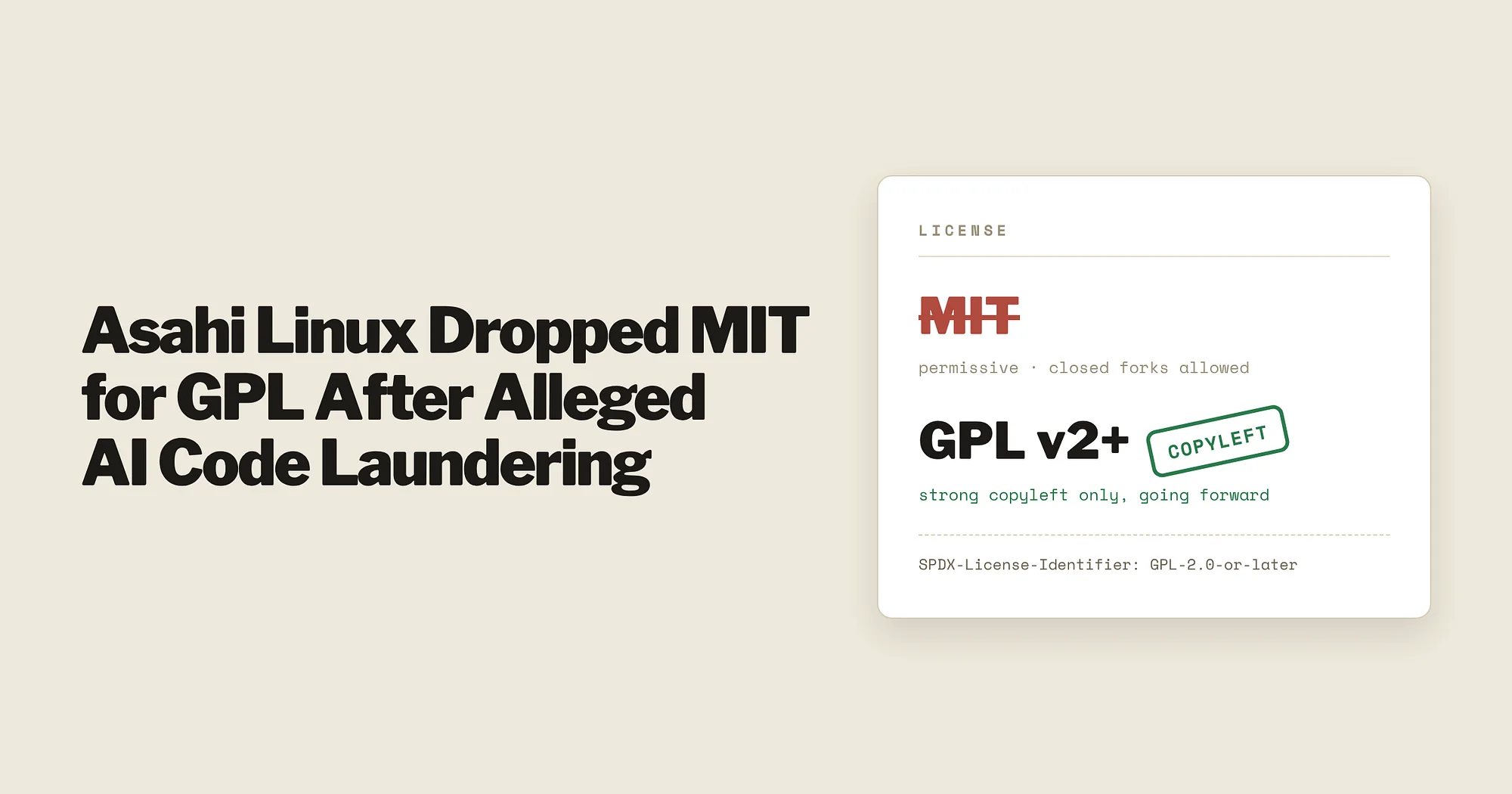
Asahi Linux Dropped MIT for GPL After Alleged AI Code Laundering
On November 7, 2026, Asahi Linux said it is moving every repository to GPL v2 or later. Asahi alleges that unreleased code was lifted from personal forks and that some of it was rewritten with LLM help to hide its origin. The report names no one, and the legal and community questions are still open.
Linux & open source
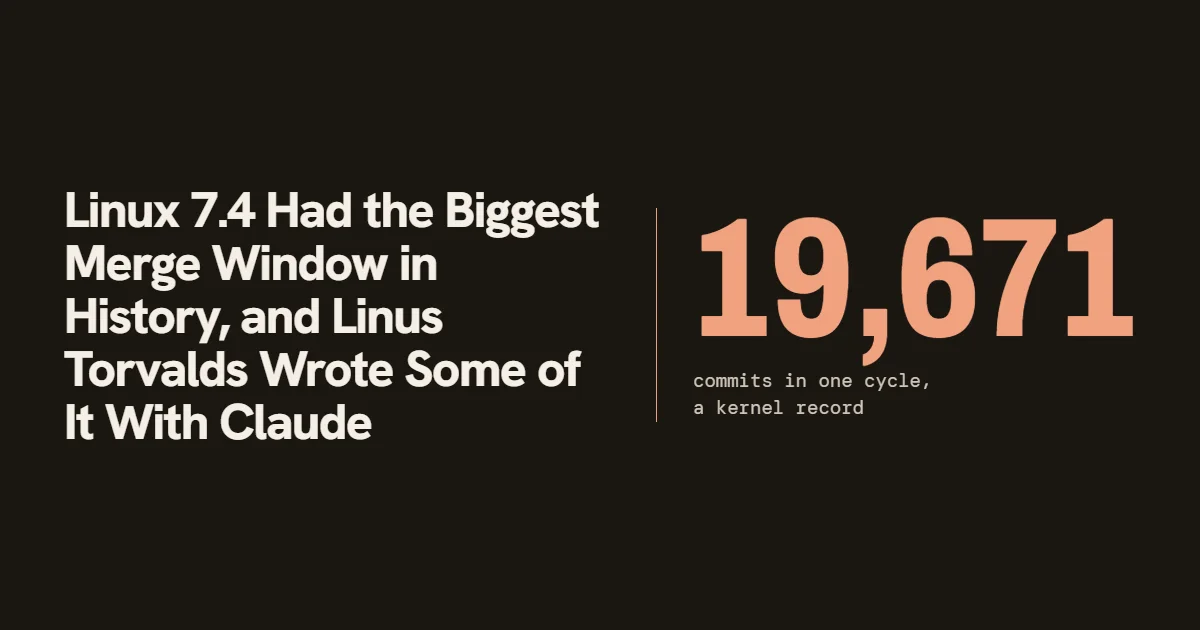
Linux 7.4 Had the Biggest Merge Window in History, and Linus Torvalds Wrote Some of It With Claude
The kernel just took in nearly 20,000 commits in one cycle, a record. The reason is the same force straining its maintainers, AI. The release is the clearest look yet at what that help gives and what it costs.
Linux & open source
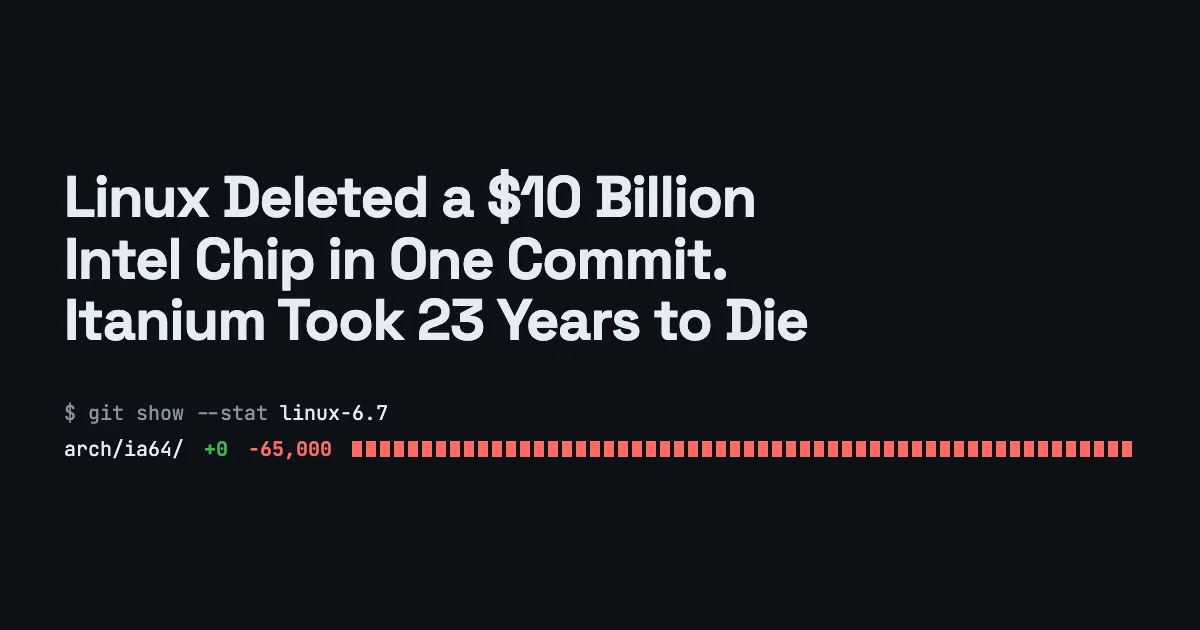
Linux Deleted a $10 Billion Intel Chip in One Commit. Itanium Took 23 Years to Die
Intel and HP spent roughly $10 billion building Itanium, the chip that was supposed to replace x86 forever. Analysts projected $38 billion in sales by 2001. In Linux 6.7, released in January 2024, the kernel deleted about 65,000 lines of Itanium support in one go, because nobody was left to maintain it. I went through why the most expensive bet in CPU history ended as a pile of deletions, and what it taught Linus Torvalds about anyone who promises the future needs a clean break.