4 of the World’s Biggest Markets Are Being Propped Up With Your Money
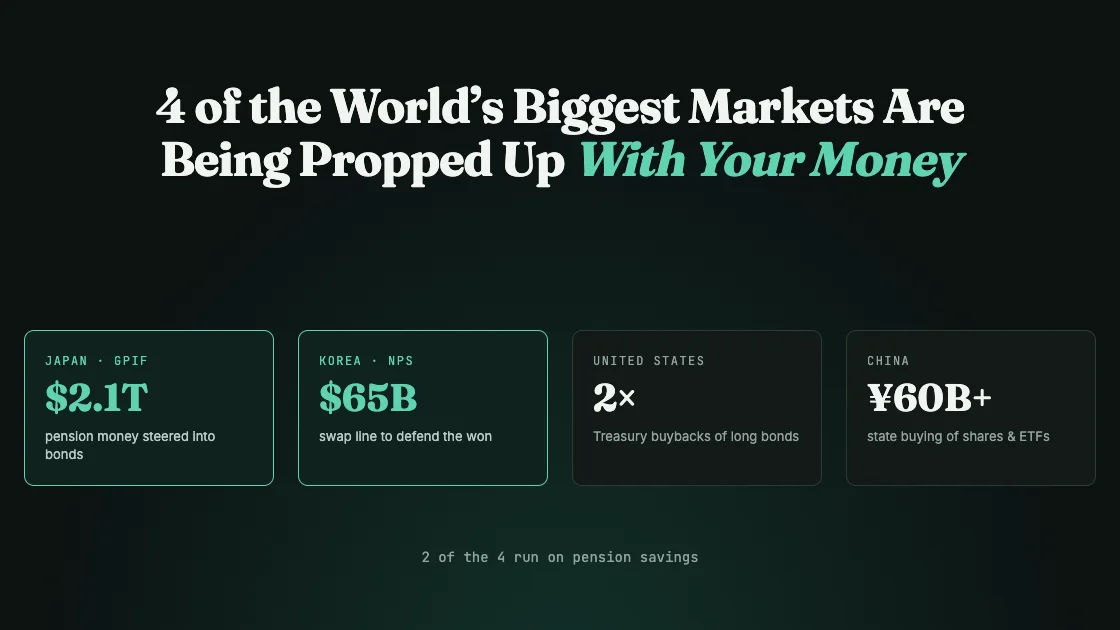
Japan, South Korea, the United States, and China have each turned an emergency intervention into a standing feature of the market. 2 of the 4 run on pension savings. Here is how each one works, and what happens when the backstop gets tested.
Last verified Also on Medium
On this page
4 of the biggest markets on earth are being held up by hand right now. Japan is leaning on a $2.1 trillion pension fund to steady its bonds and its currency. South Korea turned its national pension fund into a currency defense unit. The United States quietly rewrote a post 2008 bank rule to make room for more government debt, and China just buys its own stock market when prices fall.
The strange part is that every one of these would be called an emergency measure in normal times. Right now they are standing features of the system, and the fuel for all of them is ordinary people’s money. I want to walk through what each government reached for, why these emergency fixes keep hardening into permanent ones, and what actually happens if the tools stop working.
What a market is supposed to do
In theory a market is simple. Buyers and sellers meet, and the price is whatever they agree on. A risky bond has to pay more interest. A weak currency gets cheaper. An overpriced stock falls. The price sets itself, and the government’s job is to write the rules and then stay out of the way.
The 4 markets here matter more than most because between them they set the price of money, savings, and risk for much of the planet. US Treasuries are the benchmark for borrowing costs almost everywhere. Japan and South Korea run 2 of the largest pension funds in the world. China’s stock market is the clearest test anywhere of how far a state will go to manage prices. When these stop setting their own prices, the effect does not stay local.
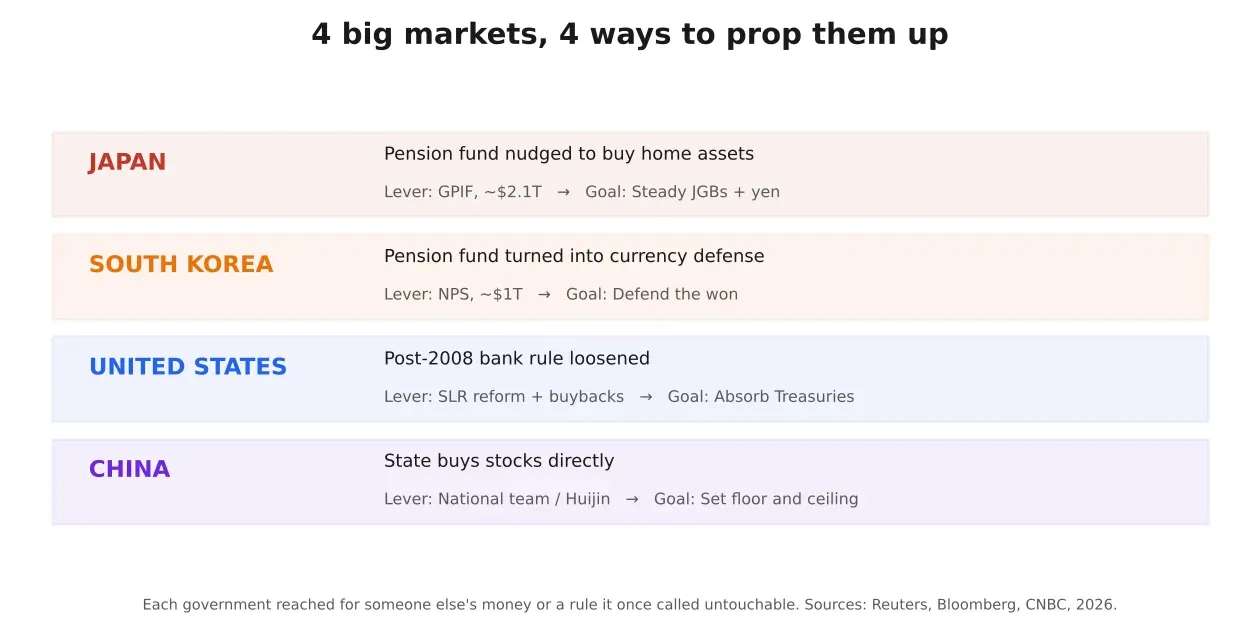
Figure 1. The 4 biggest markets, and the 4 different ways of propping them up. Source: Reuters, Bloomberg, CNBC, 2026
Japan talks its market up with pension money
For years the Bank of Japan was the biggest buyer of Japanese government bonds, the safety net soaking up whatever nobody else wanted. Then it started scaling that buying back, just as the government kept spending more and issuing more debt. More bonds, fewer hands to hold them. When buyers thin out, yields rise, and JGB yields have been climbing hard while the yen kept sliding. 2 problems at once, a bond market losing its biggest buyer and a currency losing its value.
What did the state reach for? It skipped the central bank and skipped a new tax, and leaned on a pension fund instead. In July 2026, Finance Minister Satsuki Katayama told a press conference that the government wanted state pension funds like the GPIF to substantially increase their investment in domestic assets. The GPIF is Japan’s Government Pension Investment Fund, and it manages around 318 trillion yen, roughly $2.1 trillion, for tens of millions of people. Prime Minister Sanae Takaichi backed the message, urging pension funds and households to bring their money home.
The market moved within minutes. The yen firmed and 10 year bond yields fell, without the fund placing a single trade. The GPIF said in late July it would act solely in the long term interest of its beneficiaries. Then in August its management committee held an unusual off schedule meeting that fueled speculation about an allocation change, though the fund then skipped the asset mix discussion in September, cooling the buzz. The fund splits its money into 4 roughly equal buckets, domestic bonds, domestic stocks, foreign bonds, and foreign stocks, so even a small tilt toward home means pension money buying Japanese government debt and pulling cash back from abroad, which happens to support the yen.
It is not working especially well so far. The 30 year JGB yield has pushed to record highs around 4.2%. If a strategy that steers retirement money into a falling bond market keeps failing, the damage goes well past a trading loss. It becomes a pension scandal for the ages.
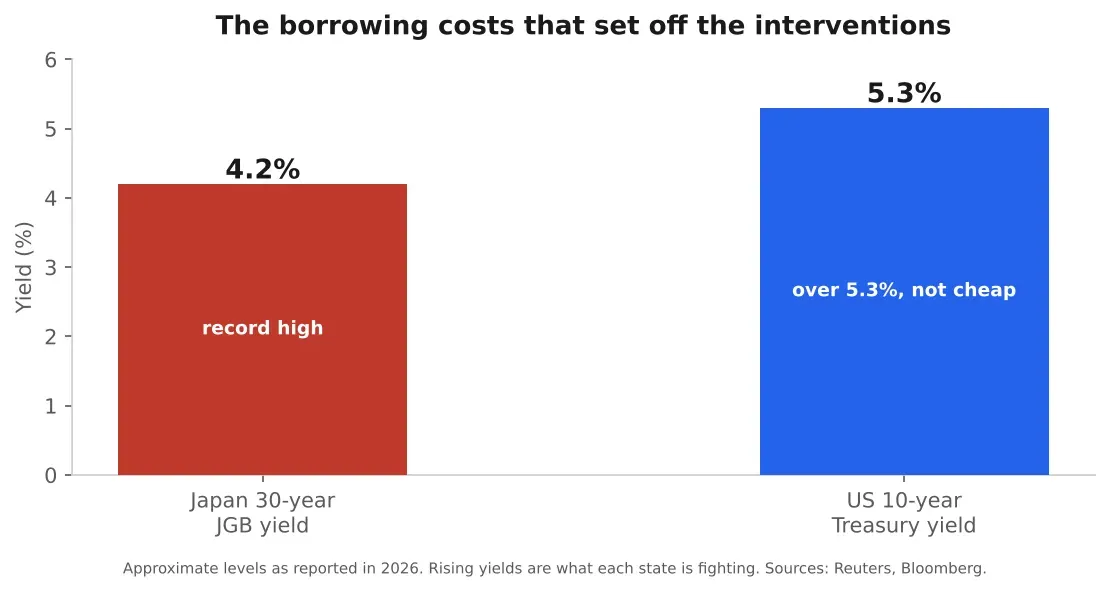
Figure 2. The borrowing costs that set off the interventions, both near records. Source: Reuters and Bloomberg, 2026
South Korea aims its pension fund at the currency
Korea watched Japan and borrowed the idea, then pointed it at a different target. Japan used its pension fund to steady bonds. Korea used its to defend the won. Earlier this year the won crossed 1,500 to the dollar, its weakest in about 17 years, and one of the biggest sources of dollar demand inside Korea was the National Pension Service itself. The NPS manages roughly $1 trillion and is the third largest public pension fund on earth. In 2025 it bought $40.7 billion of foreign stocks, and every one of those purchases meant selling won to buy dollars. The fund saving for Korea’s retirement was helping push the currency down.
So in November 2025 the Finance Ministry, the Health Ministry, the Bank of Korea, and the NPS formed a 4 party consultation body, 3 arms of the state plus a pension fund, meeting to talk about the exchange rate. The Bank of Korea and the NPS then extended a $65 billion currency swap through the end of 2026, which lets the NPS get its dollars straight from the central bank rather than buying them on the open market, so it stops pushing up dollar demand. Then came the hedging. The NPS agreed to sell dollars forward at a fixed price, which effectively meant the pension fund betting against the dollar on the state’s behalf. It was switched on in December 2025, again in March 2026, and again in June, and policymakers kept the timing unpredictable so traders could not front run it.
By September the won had recovered to near a 2 year high and the NPS suspended the hedging. So it worked. It worked by turning the retirement fund of nearly the entire working population of South Korea into a currency tool. Lawmakers and local media in Seoul argue this compromises the one job the fund actually has, earning returns for pensioners.
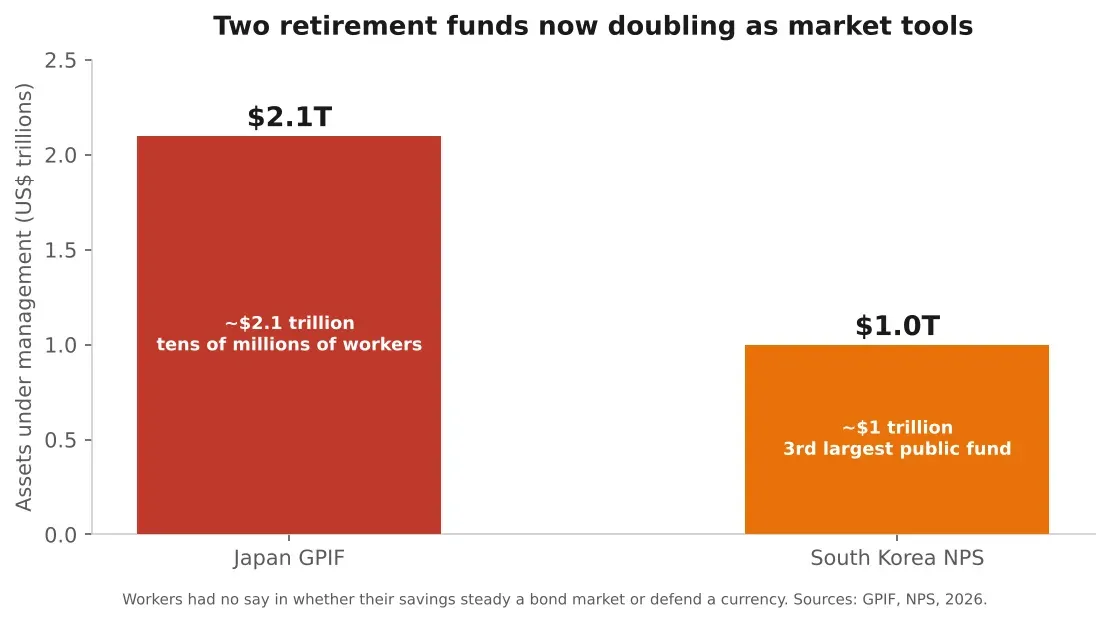
Figure 3. The 2 retirement funds now doing double duty as market tools. Source: GPIF and NPS disclosures, 2026
The United States rewrites the rulebook
Japan and Korea at least used money that already existed. The US went its own way and changed the rules, for the most important market there is, Treasuries. The Treasury market sets the baseline cost of borrowing for nearly everything, mortgages, corporate loans, government budgets. As of this writing the 10 year yield sits above 5.3%, which is not cheap.
After 2008, regulators imposed a rule they treated as untouchable, the supplementary leverage ratio. It made the biggest banks hold a fixed amount of their own capital against everything they owned, no matter how safe it looked, Treasuries included. The bluntness was deliberate, because in 2008 the clever models that sorted safe from risky had failed. It had a side effect though. The more Treasuries a bank holds, the closer it gets to its limit, and a bank at its limit stops buying. A rule meant to make banks safer also capped how much government debt they could absorb.
Late in 2025, the Fed, the FDIC, and the OCC moved to loosen it, swapping the fixed buffer for a smaller one tied to how systemically important each bank is, and the big banks moved to adopt it early. The rule written to stop the last crisis was rewritten to make room for more Treasury buying. That was not the only tool. The Fed said it would stop shrinking its balance sheet and started what it calls reserve management purchases of short term Treasury bills, which is central bank language for buying government debt again. Then in August 2026, Treasury Secretary Scott Bessent moved to at least double the Treasury’s buybacks of long dated bonds, paid for by issuing short term debt. Critics call this fiscal dominance, the Treasury itself acting as the market’s buyer of last resort. A loosened leverage rule, a central bank buying again, and a Treasury buying back its own bonds. Not the moves of a state that feels secure about its finances.
China just becomes the buyer
In Japan and Korea the state steered pension money indirectly. In the US it changed the rulebook. In China the state simply becomes the buyer. The main vehicle is Central Huijin, part of a group of state linked investors known as the national team, and the tool of choice is the humble ETF. When prices fall, the national team steps in and buys. In mid July 2026, state capital platforms like China Reform Holdings and China Chengtong committed more than 60 billion yuan to share purchases, buybacks, and ETFs. Behind them, the People’s Bank of China runs swap and relending facilities that let institutions borrow specifically to buy stocks. Regulators have pushed insurers and pension funds to hold more domestic shares, and at times restricted short selling and large shareholder sales. It runs the other way too, with Huijin trimming ETF holdings when a rally runs too hot.
The state sets both the floor and the ceiling. Over the past year, while Japanese and Korean stocks surged, the Shanghai Composite ended roughly 1% lower than it started. Calm, flat, and supervised.
Why the emergency keeps becoming the norm
Each intervention works just long enough to make the next one necessary. Take that US leverage rule. In spring 2020, after Treasuries were dumped in a panicked dash for cash, the Fed temporarily exempted Treasuries and reserves from the ratio to keep the market working. An emergency patch. 6 years later the loosening is basically permanent. Korea’s swap line started as a backstop and now gets extended, with the hedging switched on 3 times in 7 months. Japan’s pension fund was supposed to sit safely outside politics, and now a finance minister moves markets just by naming it. China’s national team stepped in during the 2015 crash and never really left.
The mechanism is simple. When a market learns the state will step in, it starts pricing in that support. Private buyers no longer need to take the risk at the bottom, because someone bigger always will, so they step back, the state steps further in, and the market grows a little more dependent each time. The pension call comes before the crisis. The rule change comes before the breakdown. The buying comes before the fall.
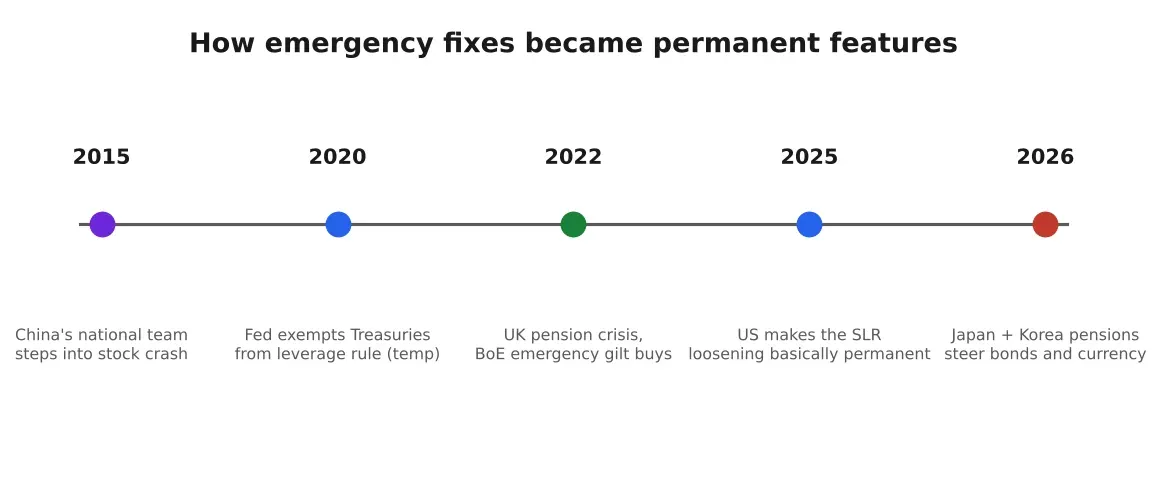
Figure 4. The pattern repeating: each emergency fix hardens into a standing feature. Source: Fed, BoE, Bloomberg, 2026
What happens when it stops working
The answer is built into how it works. All these supports run on one fuel, confidence that the state has enough firepower to keep going. That confidence is also the weak point, because once the backstop becomes the market, prices hold only as long as people believe the backstop is bigger than the selling coming at it. China learned that in 2015, when the crash came anyway despite state buying and short selling curbs. Britain saw a version in 2022, when leveraged pension strategies hit margin calls as gilt yields surged and the Bank of England had to step in with emergency gilt purchases. The thing holding prices up and the thing that fails when confidence goes are the same thing.
That is why the cost does not stay with governments. 2 of these 4 examples literally run on retirement money. The GPIF holds the pensions of tens of millions of Japanese workers, the NPS holds the savings of nearly the entire Korean workforce, and none of those people were asked whether their pension should steady a bond market or defend an exchange rate. In China, insurers and pension funds are told what to hold. In the US, the rules being loosened are the ones written after 2008 to protect the banks ordinary people depend on. Markets used to put the risk on whoever chose to take it. Now the risk sits with whoever’s money happens to be within reach, and when a government decides the system needs steadying, the money it reaches for is rarely its own. It is your pension and your savings on the line, and the next time one of these backstops is tested, that is whose money finds out first.
Sources
- Nikkei Asia, Japan finance chief’s push for pension funds to buy JGBs draws skepticismasia.nikkei.com. Accessed 15 October 2026.
- Reuters via Investing.com, Japan signals pension shift to domestic assets, sparking rally in yen and bondsinvesting.com. Accessed 15 October 2026.
- Korea Times, FX authorities and NPS agree to extend $65bn currency swapkoreatimes.co.kr. Accessed 15 October 2026.
- Bloomberg, Korea’s pension fund NPS expands currency hedging to bolster wonbloomberg.com. Accessed 15 October 2026.
- CNBC, Treasury doubles debt buybacks as Bessent moves to steady bond marketcnbc.com. Accessed 15 October 2026.
- Mayer Brown, US banking regulators propose enhanced supplementary leverage ratio reformmayerbrown.com. Accessed 15 October 2026.
- Bloomberg, China’s national team cut ETF stakes below disclosure markbloomberg.com. Accessed 15 October 2026.
Related stories
Crypto & markets
The US Housing Market Is Frozen Solid. The People Paying for It Are the Ones Who Cannot Wait
A 30 year mortgage went from under 3% to 7.4% in 4 years, and the whole system seized up. I went through the Freddie Mac, NAR, Redfin, and FHFA numbers to show exactly how buyers and owners got locked in from both ends, and why the people who can least afford to wait are the ones paying for it.
Crypto & markets
If the Democrats Win the Midterms, Here Is What Actually Changes, and What Does Not
The question gets asked every cycle, and the answer usually arrives wrapped in either panic or celebration. The real mechanics are narrower and more interesting than either. I went through what a House majority can actually do, what adding the Senate changes, and where the hard constitutional walls sit that no election moves, using the 2016 to 2021 record as the clearest recent example. This is a civics explainer, not a prediction and not advice on who to vote for.

Crypto & markets
Richard Heart Beat the SEC on a Technicality, Then His Own Tax Office Caught Up With Him in…
On 14 October 2026, Turkish police arrested the founder of Hex and PulseChain on an Interpol red notice issued for Finland, which suspects him of gross tax evasion. He had walked away from a $1 billion SEC case 18 months earlier, not because a court cleared him, but because the judge found no US jurisdiction. I went through the whole arc, the sacrifice mechanism, the allegations, the dismissal that was not an acquittal, and a blockchain whose biggest customer was its own founder.