If the Democrats Win the Midterms, Here Is What Actually Changes, and What Does Not
The question gets asked every cycle, and the answer usually arrives wrapped in either panic or celebration. The real mechanics are narrower and more interesting than either. I went through what a House majority can actually do, what adding the Senate changes, and where the hard constitutional walls sit that no election moves, using the 2016 to 2021 record as the clearest recent example. This is a civics explainer, not a prediction and not advice on who to vote for.
Last verified Also on Medium

On this page
A US midterm runs halfway through a president’s four year term. All 435 seats in the House of Representatives are up, along with about a third of the 100 Senate seats, plus governor races and a long list of state offices. The reason the whole country watches is that Congress writes the laws, controls the money, confirms the officials, and runs the investigations, and a midterm is the first chance voters get to change who controls Congress after a presidential election. So when people ask what happens if the Democrats win, the honest answer depends entirely on which chamber they win, and by how much. I want to walk through that, because the gap between what a majority can actually do and what the coverage implies is wide.
Start with the baseline going into the 2026 cycle. Republicans hold the House by a thin margin, roughly 220 seats to the Democrats’ 213, and the Senate 53 to 47 once you count the two independents who caucus with the Democrats. A majority in the House is 218. In the Senate it is 51, or 50 with the Vice President breaking the tie, since the VP serves as president of the Senate and votes only to snap a deadlock. The margins are thin, and thin margins are what make a midterm consequential. A net swing of a handful of seats flips who sets the agenda.
History says the president’s party usually loses ground
There is a strong, measurable pattern worth stating plainly, because it frames the whole question. The party holding the White House almost always loses House seats in the president’s first midterm. Across the last century the average loss for the president’s party sits in the range of 25 to 30 House seats, and Ballotpedia’s review of wave elections found that 6 of the 11 biggest House swings since 1918 landed in a president’s first midterm. The 2018 cycle under Trump fit the pattern, with Democrats picking up 40 seats and taking the chamber. The 2022 cycle under Biden broke it, with Republicans gaining only a single digit number of seats despite wide expectations of a red wave.
So the pattern is real but not a law of nature. It tells you the wind usually blows against the president’s party, not how hard it blows in any given year. Turnout, the economy, the candidates in individual districts, and how the lines were drawn all decide the size of the move. A party can be favored and still fall short, which is exactly what happened in 2022.
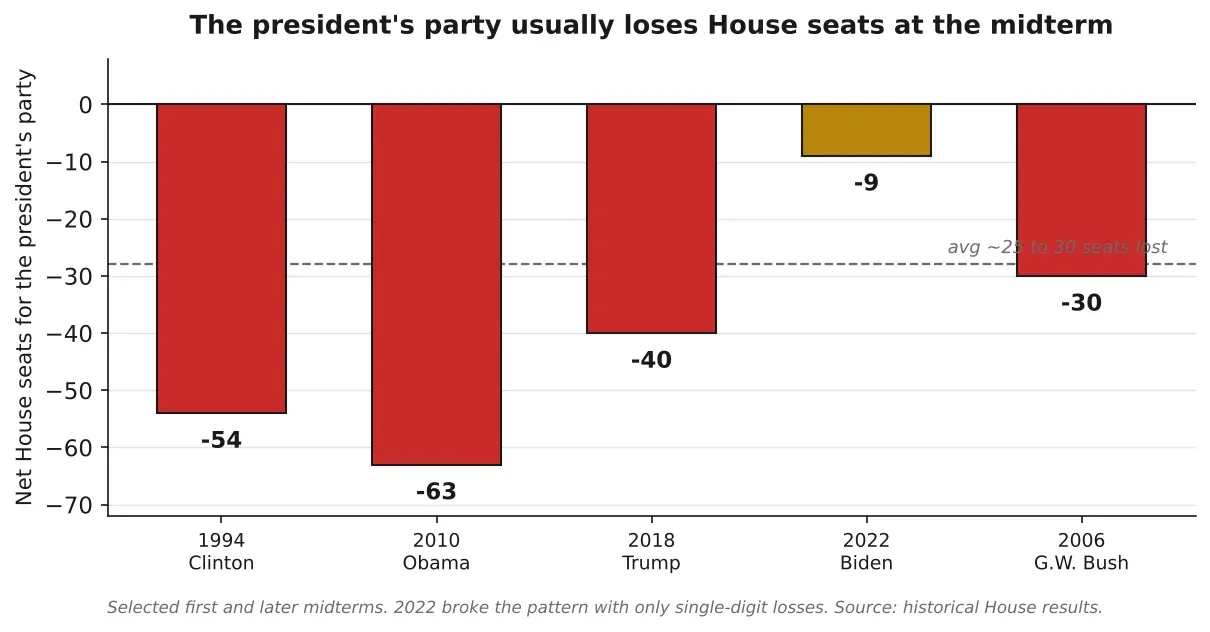
Figure 1. The president’s party has lost House seats in almost every first midterm of the last century, averaging roughly 25 to 30 seats, though 2022 showed the pattern can break. The bars show net House seat change for the president’s party in selected midterms. Source: Author chart based on historical House election results
What winning the House actually gets you
This is where most of the real power sits, and most of it is not about passing new laws. A House majority gets four concrete things.
The first is the committee gavels. Whoever holds the majority chairs every committee, and the chair decides what gets investigated, who gets subpoenaed, and which hearings happen. In January 2019, after the 2018 win, Democrats took over the House committees and the oversight machinery came on fast. Jerry Nadler ran Judiciary, Adam Schiff ran Intelligence, Elijah Cummings ran Oversight. They opened investigations, issued subpoenas, and went to court to enforce them. The fight over Trump’s financial records, the Mazars and Deutsche Bank subpoenas, ran all the way to the Supreme Court, which in July 2020 sent the question back down to the lower courts rather than handing Congress a clean win. The point is that a majority turns the investigative power on, and the White House then fights it through the courts, which is slow and often inconclusive. Oversight is real power, and it is also power with limits.
The second is the power of the purse. The Constitution gives Congress control over federal spending, and in practice no money goes out that the House has not agreed to. A House controlled by the opposition can refuse to fund things, attach conditions to spending bills, and use the budget as a bargaining chip. This is the mechanism behind the ugliest standoffs in Washington, the government shutdowns, which happen when the House and the rest of the government cannot agree on a spending bill before the money runs out. The debt ceiling is the same lever in a different form. Congress sets a legal limit on how much the Treasury can borrow, and raising it requires a vote. In July 2025 the limit was raised by about $5 trillion as part of a larger bill, and whoever controls the House has a say in whether and how that happens next time.
The third is control of the floor agenda. The Speaker of the House and the majority decide which bills get a vote and which die without one. A new majority can pass its own priorities through the House on a simple majority, message bills, investigations authorized, budgets written its way. Whether any of that becomes law is a separate question, and the answer is usually no, for reasons I will get to.
The fourth is that the House can impeach. Impeachment in the House takes only a simple majority, 218 votes if everyone is present. That is the accusation stage, the rough equivalent of an indictment, and it does not remove anyone from office. Trump was impeached twice by the House, in December 2019 on two articles, abuse of power and obstruction of Congress, and again in January 2021 for incitement after the Capitol riot. Both times the House had the votes. Both times that was only half the process.
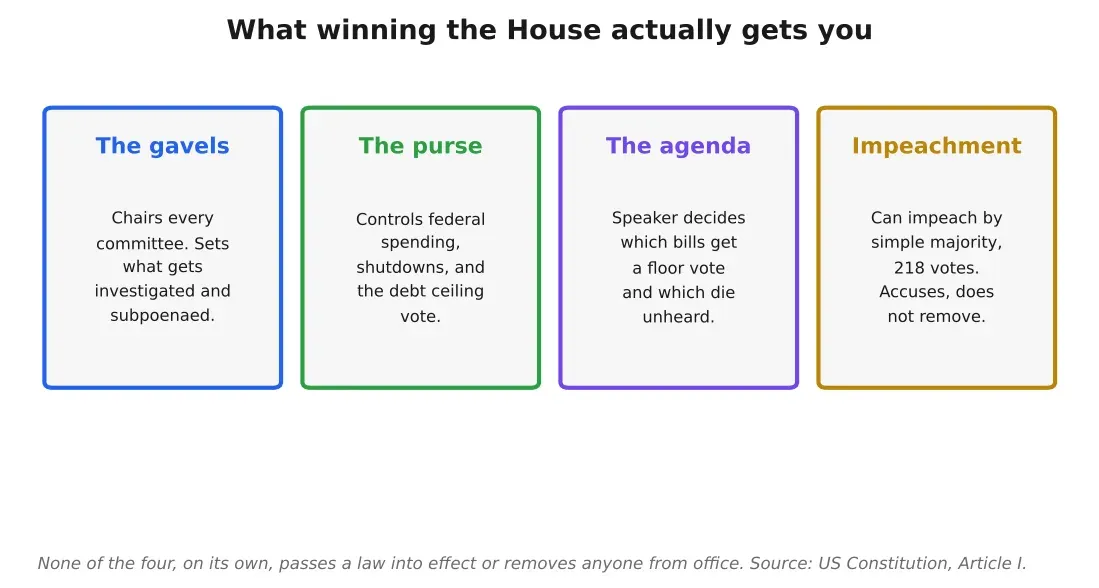
Figure 2. What a House majority controls. The committee gavels and the subpoena power that comes with them, the power of the purse over federal spending and the debt ceiling, the floor agenda, and the ability to impeach by simple majority. None of the four, on its own, passes a law into effect or removes anyone from office. Source: Author chart summarizing the constitutional powers of the House majority
Why winning just the House does not let a party pass its program
Here is the part that surprises people. Taking the House does not let a party enact its agenda, and the reason is structural. A bill has to pass both chambers in identical form and then get signed by the president. A House majority on its own clears only the first of those three hurdles.
Even with both chambers, there is a wall inside the Senate called the filibuster. Most legislation needs 60 votes to cut off debate and move to a final vote, not a simple 51. Since neither party is anywhere near 60 seats, that means almost nothing of consequence passes on party lines alone. The main exception is budget reconciliation, a special process for tax and spending bills that cannot be filibustered and passes with 51 votes. That is how the big tax and spending packages of recent years moved, and it is narrow by design, limited to budget related provisions. So a party that wins both chambers can still only force through the slice of its agenda that fits inside reconciliation, and everything else needs 60 votes it does not have.
Then there is the veto. Anything that does clear both chambers can be vetoed by the president, and overriding a veto takes two thirds of both the House and the Senate, which no normal majority holds. So if the Democrats win Congress while a Republican sits in the White House, the realistic legislative outcome is not a wave of new laws. It is gridlock, each side able to block the other, neither able to impose its program. Divided government mostly stops things rather than starts them.
What adding the Senate changes
Winning the Senate too does not fix the filibuster problem, but it unlocks two things the House cannot touch.
The first is confirmations. The Senate alone confirms the president’s nominees, Cabinet secretaries, agency heads, ambassadors, and federal judges including the Supreme Court. Since the nomination rules were changed, these clear on a simple majority, no filibuster, so the Senate majority effectively controls who gets confirmed. An opposition Senate can slow or block a president’s picks, and the sharpest example is 2016, when the Republican Senate refused for about 10 months, 293 days, to hold a hearing or vote on Merrick Garland, President Obama’s Supreme Court nominee, leaving the seat open until after the election. The majority sets the Senate calendar, and the calendar is the weapon. A president whose party loses the Senate finds it far harder to fill judgeships and senior posts for the rest of the term.
The second is the back half of impeachment, and this is the hard wall. The House impeaches, but only the Senate holds the trial, and removing someone requires a two thirds vote, 67 of 100 senators. That number is the whole story. In February 2020, after the first impeachment, the Senate acquitted Trump, 52 to 48 on abuse of power with Mitt Romney the single Republican voting to convict, and 53 to 47 on obstruction, both nowhere near 67. In February 2021, after the second impeachment, 57 senators voted to convict, including 7 Republicans, the most bipartisan impeachment vote in US history, and still 10 short of removal. So in the modern era, with the parties as polarized as they are, the 67 vote threshold has worked as a near guarantee that impeachment does not end in removal. A party would need a landslide plus heavy defections from the other side, well beyond a simple majority.
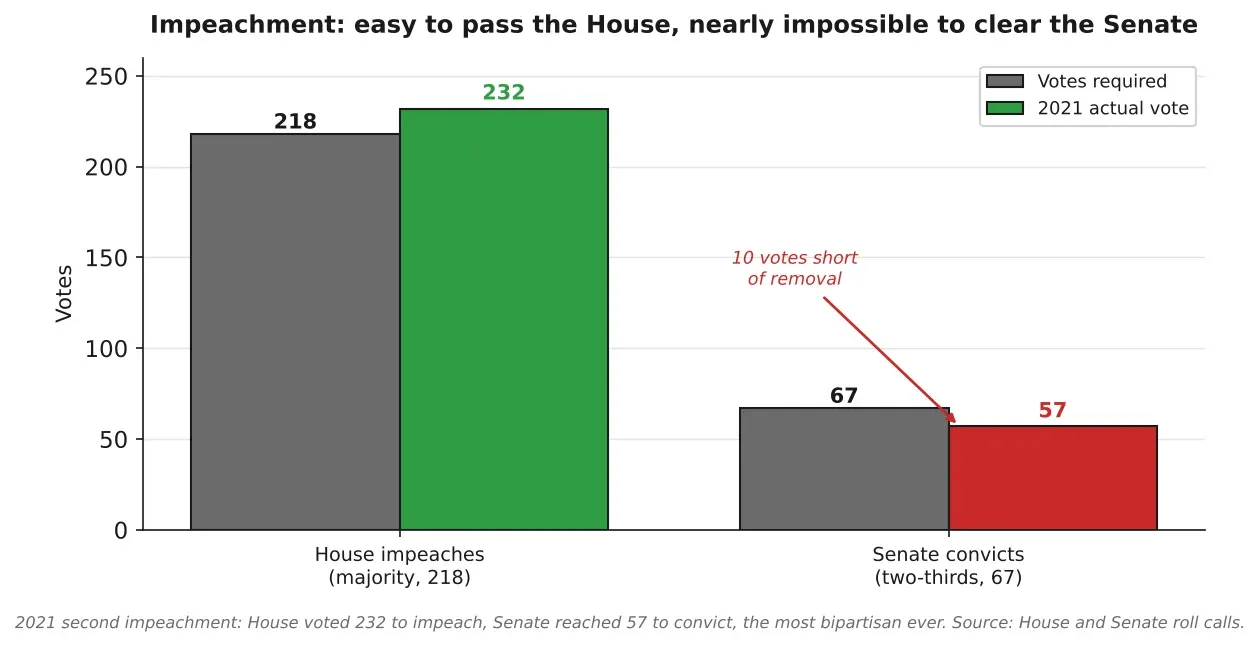
Figure 3. Impeachment is a two step process with very different bars. The House impeaches by simple majority, which it did against Trump in 2019 and 2021. The Senate convicts only by a two thirds supermajority, 67 votes. The 2021 trial reached 57, the most bipartisan impeachment vote ever and still 10 short. Source: Author chart based on the House and Senate impeachment votes of 2019 to 2021
The walls that no midterm moves
A few things do not change no matter who wins, and keeping them in view is what separates a civics read from the overheated version.
The president keeps the veto, so a hostile Congress cannot force major legislation past a president of the other party. The 60 vote filibuster keeps either party from passing most of its program on a narrow majority. The president cannot be removed without 67 Senate votes, which the modern era has never produced. The 22nd Amendment limits a president to two terms, and a midterm does not touch that. The courts remain a separate branch, so a congressional subpoena or a spending condition can still be challenged and narrowed by judges, as the financial records fight showed. The president also retains broad executive authority, the power to issue executive orders, direct the agencies, and act abroad, much of which Congress cannot block directly even when it controls both chambers.
Put those walls together and the realistic menu becomes clear. If the Democrats win only the House, they get oversight, subpoenas, and a veto over spending, which turns the next two years into a negotiation and forces the president to govern more by executive action because legislation stalls. If they also win the Senate, they add control over confirmations, which can freeze a president’s judicial and Cabinet picks, and they gain the power to run an impeachment trial, though removal stays out of reach without a supermajority. In none of these scenarios does a Democratic Congress get to enact its agenda over a Republican president, because of the filibuster and the veto. That is a far narrower outcome than a referendum on the direction of the whole country, which is how the election usually gets sold.
How to read the forecasts without getting played
In the run up to any midterm there is a flood of polls and prediction market odds, and they are useful as long as you remember what they measure. A generic ballot poll asking whether people would rather vote for a Democrat or a Republican for Congress is a snapshot of national mood, not a seat count, and the translation from vote share to seats depends heavily on how districts are drawn. Prediction markets like Kalshi price the odds of each party controlling each chamber, and they move with the news, but a 60% chance is not a certainty, and markets have been wrong before, the 2022 red wave that never arrived being the recent lesson. Treat all of it as probability, not prophecy. The only count that is final is the one on election night, and even then the thinnest majorities can take days to resolve as the last races are called.
The honest summary is that a midterm is a control switch, not a reset button. If the Democrats win, they decide who holds the gavels, who controls the money, whether the president’s nominees get confirmed, and whether the next two years run as cooperation or trench warfare. They do not rewrite the Constitution, remove the veto, erase the filibuster unless they choose to and have the votes, or lower the 67 vote bar for removal. Knowing which of those is actually in play, and which is not, is most of what it takes to read an election year without getting swept up in it.
Sources
- Membership of the 119th Congress, a profile, Congressional Research Serviceeverycrsreport.com. Accessed 25 October 2026.
- Six of 11 wave elections took place in a president’s first midterm, Ballotpedianews.ballotpedia.org. Accessed 25 October 2026.
- 2018 United States elections, Wikipediaen.wikipedia.org. Accessed 25 October 2026.
- The filibuster explained, Brennan Center for Justicebrennancenter.org. Accessed 25 October 2026.
- Trump v Mazars USA, Supreme Court opinion, July 2020supremecourt.gov. Accessed 25 October 2026.
- Merrick Garland Supreme Court nomination, Wikipediaen.wikipedia.org. Accessed 25 October 2026.
- First impeachment of Donald Trump, Wikipediaen.wikipedia.org. Accessed 25 October 2026.
- US Senate GOP debt limit increase of $5 trillion, States Newsroomnewsfromthestates.com. Accessed 25 October 2026.
- 2026 House control odds, Kalshikalshi.com. Accessed 25 October 2026.
- The 119th Congress, what to know about the House and Senate, PolitiFactpolitifact.com. Accessed 25 October 2026.
Related stories

Crypto & markets
Richard Heart Beat the SEC on a Technicality, Then His Own Tax Office Caught Up With Him in…
On 14 October 2026, Turkish police arrested the founder of Hex and PulseChain on an Interpol red notice issued for Finland, which suspects him of gross tax evasion. He had walked away from a $1 billion SEC case 18 months earlier, not because a court cleared him, but because the judge found no US jurisdiction. I went through the whole arc, the sacrifice mechanism, the allegations, the dismissal that was not an acquittal, and a blockchain whose biggest customer was its own founder.

Crypto & markets
The US Housing Market Is Frozen Solid. The People Paying for It Are the Ones Who Cannot Wait
A 30 year mortgage went from under 3% to 7.4% in 4 years, and the whole system seized up. I went through the Freddie Mac, NAR, Redfin, and FHFA numbers to show exactly how buyers and owners got locked in from both ends, and why the people who can least afford to wait are the ones paying for it.

Crypto & markets
4 of the World’s Biggest Markets Are Being Propped Up With Your Money
Japan, South Korea, the United States, and China have each turned an emergency intervention into a standing feature of the market. 2 of the 4 run on pension savings. Here is how each one works, and what happens when the backstop gets tested.