Wall Street Filed an Automatic Bitcoin Buyer. It Runs on Stock Dividends.
On June 18, 2026, Franklin Templeton, a $1.5 trillion asset manager founded in 1947, filed registration statements with the SEC for 2 exchange-traded funds built around one of the oldest and most boring ideas in finance. A dividend reinvestment plan. The twist is where the dividends go.
Last verified Also on Medium

On this page
- The Backdrop Makes the Timing Strange
- How the Franklin DRIP Machine Actually Works
- The Regulatory Switch That Made This a Conveyor Belt
- BlackRock Built the Income Version
- The Structural Argument For Why This Matters
- The Counterarguments Are Equally Strong
- The fees on fees problem
- The valuation blind buying problem
- The historical top signal problem
- The Uncomfortable Question at the Centre of All of This
- What to Actually Watch From Here
On June 18, 2026, Franklin Templeton, a $1.5 trillion asset manager founded in 1947, filed registration statements with the SEC for 2 exchange-traded funds built around one of the oldest and most boring ideas in finance. A dividend reinvestment plan. The twist is where the dividends go. Instead of buying more stock, they buy Bitcoin.
No wallet. No exchange account. No moment where you have to decide to buy a volatile asset. You own a basket of dividend-paying US companies, and in the background, a machine accumulates Bitcoin automatically on a fixed calendar, every quarter, forever.
This is not a one-off filing. 2 days before Franklin’s submission, BlackRock launched a Bitcoin income ETF. Bitwise has projected over 100 crypto ETFs and ETPs rolling out across 2026. The biggest names in asset management have stopped simply offering Bitcoin and started repackaging it into every investment flavor imaginable. Understanding what they are building, why they built it now, and whether it actually benefits the investor holding it is worth taking seriously.
The Backdrop Makes the Timing Strange
Bitcoin was sitting around $59,500 when Franklin filed. It is down approximately 52% from its October 2025 all-time high of $124,720. The 14-day RSI had just printed 31, right at the edge of technically oversold territory. The Fear and Greed Index was at 13, deep in extreme fear. US spot Bitcoin ETFs had bled approximately $6.35 billion across 7 consecutive weeks, with a single day in late June seeing nearly $692 million in redemptions. Total spot ETF assets had collapsed from roughly $170 billion at the peak to around $73 billion at the time of writing.
This is not a bull market product launch. This is product infrastructure being built during one of the most painful stretches in Bitcoin’s recent price history. That contrast is the first thing worth sitting with.
How the Franklin DRIP Machine Actually Works
DRIP stands for Dividend Reinvestment Plan. The concept itself is about as old as the stock market. When a company pays a dividend, instead of receiving cash, the plan automatically reinvests that payment into more shares of the same company. Do that across a diversified portfolio for 20 or 30 years and the compounding quietly builds a meaningful position without any active decision-making from the investor. It is reliable, mechanical, and almost completely uninteresting to read about.
Franklin’s version breaks the loop at the reinvestment step. The 2 funds, the Franklin US Equity Bitcoin DRIP Index ETF and the Franklin US Innovation Bitcoin DRIP Index ETF, hold a standard basket of US stocks. The equity fund tracks a VettaFi index of approximately 498 large-cap US companies spanning a market cap range from $7.5 billion to $4.9 trillion as of April 30, 2026. The innovation fund tracks the 100 largest non-financial companies on the Nasdaq. Both funds begin with allocations of 95% US equities and 5% Bitcoin. Per the SEC filings, when dividends are paid by the underlying equity holdings, the cash is redirected into Bitcoin-linked instruments rather than additional shares. Those instruments can include spot Bitcoin ETFs such as Franklin’s own EZBC, CME futures, or listed options embedded directly inside the fund.
The structure has 3 deliberate limits built in. The Bitcoin sleeve is capped at a hard maximum of 20% of fund assets. When dividend income pushes the Bitcoin allocation above 5%, the fund rebalances back toward 4.5% on a quarterly schedule. The September 1, 2026 target launch date is not arbitrary. It is driven by the 75-day review window created by a regulatory change that took effect in September 2025.
The genius of the structure, if you want to call it that, is what it removes. It strips out every friction point that has historically stopped a conventional investor from touching crypto. There is no exchange to sign up for. There is no seed phrase to lose. There is no moment where the investor has to consciously decide to buy an asset they find intimidating. The Bitcoin accumulation happens as a byproduct of owning companies they already understand.
The Regulatory Switch That Made This a Conveyor Belt
One question worth asking is why this wave of filings is happening now rather than two years ago. The answer is a specific regulatory change made by the SEC on September 17, 2025. On that date, the Commission approved generic listing standards for commodity-based trust shares, including digital assets. The practical consequence was transformative. Before the change, every new crypto ETP required its own bespoke rule change filing, a process that could take up to 240 days and often felt more like a political gauntlet than a regulatory review. After it, qualifying products slot into a streamlined review of approximately 60 to 75 days.
To understand how significant this shift is, consider Bitcoin’s history. A Bitcoin ETF took the better part of a decade from first filing to first approval. Repeated submissions, repeated rejections, years of comment letters before the SEC finally approved spot Bitcoin products in January 2024. Each approval was its own campaign. As Bitnomial’s analysis of the new framework describes it, that era is over. The SEC has moved from a one-off battle model to a rules-based conveyor belt. Bitwise analyst Matt Hougan has forecast over 100 new crypto ETFs and ETPs across 2026 as a direct consequence. Franklin’s September 1 target date is the 75-day clock ticking from its June 18 filing.
BlackRock Built the Income Version
2 days before Franklin’s filing, on June 16, BlackRock launched the iShares Bitcoin Premium Income ETF under the ticker BITA. This fund takes a completely different approach to the same underlying asset. Rather than accumulating Bitcoin automatically through dividends, it generates yield from Bitcoin by selling covered call options on roughly 25 to 35% of its holdings. It targets an annualised yield of 15 to 25%, aims to retain approximately 70% of Bitcoin’s price appreciation, and charges a fee of 0.65%.
The side-by-side picture of these 2 products is instructive. Franklin built a tool for the investor who wants to accumulate Bitcoin without thinking about it. BlackRock built one for the investor who wants income rather than upside. These are not competing products. They are targeting entirely different investor profiles with the same underlying asset, which is exactly how a mature product category gets built.
The establishment has stopped simply blessing Bitcoin and started segmenting it. Growth investors, income investors, dividend investors, the cautious retiree who will never in their life open a crypto exchange account. Each now has a tailored wrapper aimed directly at their existing investment behaviour.
The Structural Argument For Why This Matters
The most important feature of DRIP-style products is not what they do to Bitcoin’s price in the short term. It is the character of the demand they create. Vetifi’s Ryan Scholer described the Franklin structure as a programmatic dollar-cost averaging tool. Dividends are paid on a fixed calendar, and the broad fund’s underlying index yields approximately 1.05% per year. That means the fund mechanically converts roughly 1% of its total assets into Bitcoin exposure annually, completely on autopilot, regardless of what the Fear and Greed Index reads, regardless of whether Bitcoin is at $124,000 or $59,000, regardless of whether retail investors are panicking.
This is the opposite of what the current ETF flows represent. The hot money that poured into spot Bitcoin ETFs in 2024 treated them as high-beta risk-on exposure, something to sell the moment macro conditions turned hostile. That is a discretionary, reactive buyer. A DRIP buyer cannot be turned off by a frightened investor because the buying is written into the fund’s mandate.
Now scale the potential demand. Total US retirement assets sit at approximately $47.6 trillion. Roughly $7.5 trillion of that is in equity-focused IRAs and 401(k)s. Those are exactly the pools of dividend-paying stock exposure these products are designed to plug into. BlackRock itself has discussed a modest 1 to 2% Bitcoin allocation as a portfolio diversifier. Even 1% of the total US retirement pool is approximately $476 billion. A 5% sleeve gets you to $2.4 trillion. That is a buyer that simply did not exist 2 years ago.
The Counterarguments Are Equally Strong
Leaving the bull case without the honest counterweight would be incomplete. The skeptical reading of this product wave is not a fringe position.
The fees on fees problem
A Franklin DRIP investor pays the fund’s management fee, then pays the embedded cost of whatever Bitcoin instrument it purchases underneath, then absorbs the trading and options overhead stacked on top of that. For context, Franklin’s own spot Bitcoin ETF EZBC charges 0.19%. A plain S&P 500 index fund costs around 0.03%. Stack 3 layers of cost on a 30-year retirement horizon and the drag compounds into a significant performance gap. The fund is being built for a customer who values simplicity over cost optimisation, which is a defensible product decision, but the person buying it should understand what simplicity costs.
The valuation blind buying problem
A classic DRIP has a built-in stabiliser. When a stock falls, the reinvested dividend buys more shares at a cheaper price, automatically improving the investor’s cost basis. The Franklin structure breaks this relationship. The dividend income buys Bitcoin not because Bitcoin got cheaper. It buys Bitcoin because some unrelated US company happened to pay a dividend on its scheduled date. There is no valuation filter whatsoever. The identical mechanism that looks disciplined at $59,000 would have been buying Bitcoin at the $124,720 peak with exactly the same mechanical enthusiasm.
The historical top signal problem
Historically, a flood of new crypto-linked financial products has tended to mark cycle peaks rather than cycle bottoms. ProShares’ Bitcoin Futures ETF BITO launched on October 19, 2021, approximately 3 weeks before that cycle’s peak of around $69,000 on November 10, 2021. 100 new filings can look a great deal like Wall Street productizing a hot asset right before it cools.
The counter to this specific concern is that these products are launching with Bitcoin down 52% from its high, not pressed against it. Bloomberg ETF analyst Eric Balchunas has argued that most current ETF holders have ridden through the drawdown, and that the outflows represent portfolio rebalancing rather than a fundamental loss of conviction. The 2021 analogy may not hold when the product wave is occurring at the opposite point in the price cycle.
The Uncomfortable Question at the Centre of All of This
Franklin’s CEO Jenny Johnson has argued publicly that traditional finance resists open blockchains because they threaten fee-based transaction models. That is a pointed observation. It is also slightly ironic coming from a firm building its own fee layer on top of Bitcoin. As SpottedCrypto’s analysis of the filing notes, tickers, fee rates, and listing exchange were all blank in the preliminary prospectus. The actual cost structure of the fund will determine whether it is a genuine accumulation vehicle or a fee extraction machine in a familiar wrapper.
The structural question underneath this entire product wave is whether the distribution channel carries real adoption or extraction. The answer is probably both, and the proportion depends on details that are not yet public.
Wall Street has turned Bitcoin from a speculative asset into a financial ingredient. It has been sliced into income flavors, growth flavors, and dividend flavors, and sold to every investor archetype. Whether that is validation or domestication depends on whether the investor at the end of the pipe is building genuine wealth or simply paying multiple fee layers for the privilege of mechanical exposure to an asset they were too intimidated to buy directly.
What to Actually Watch From Here
The filing is not the product. The AUM is. These DRIP and income products mean nothing until they actually gather assets after their September 2026 launch. Track inflows across all US spot Bitcoin ETFs on SoSoValue from September onward. The number that appears in the first 3 months, not the filing itself, is the real test of whether Bitcoin for every investor actually works.
Watch the 7-week ETF outflow streak for signs of stabilisation. The Coinbase premium index, which had run negative for 46 consecutive days at the time of this writing, flipping positive would signal that US institutions are stepping back into the market rather than sitting on the sidelines.
Watch the macro lever. With the Fed funds rate at 3.63%, the 10-year Treasury at 4.38%, and PCE inflation running at 4.1%, capital has a genuine risk-free reason to sit in bonds rather than Bitcoin. Any signal of rate cuts materially changes that competition overnight.
Watch whether the broader product line fills out the way Bitwise projected. 100 ETF wrappers landing into a bear market is either the deepest accumulation infrastructure of the cycle or the loudest top signal on record. Which story is winning will become visible in the AUM data from autumn 2026 onward.
Sources
- Bitcoin Magazine: Franklin Templeton Files 2 ETFs That Route Stock Dividends Into Bitcoin, June 2026 — Official description of both fund names and 95/5 equity-to-Bitcoin split. September 1, 2026 effective date target.bitcoinmagazine.com. Accessed 8 July 2026.
- MEXC: What If Stock Dividends Built Your Bitcoin Position? The Franklin Templeton Bitcoin DRIP ETF Explained — $1.5 trillion AUM confirmed from June 2026 SEC filing. 20% hard cap and 4.5% rebalancing target explained.mexc.com. Accessed 8 July 2026.
- SpottedCrypto: Franklin Templeton Bitcoin DRIP ETF SEC Filing June 2026 — VettaFi index of 498 securities, market cap range $7.5B to $4.9T. 1.05% annual dividend yield calculation. September 1 target driven by 75-day clock.spotedcrypto.com. Accessed 8 July 2026.
- Spaziocrypto: Franklin Templeton Files Bitcoin DRIP ETF, June 2026 –3 Bitcoin exposure mechanisms: spot ETFs, CME futures, listed options. Both fund names confirmed from SEC filings.en.spaziocrypto.com. Accessed 8 July 2026.
- Bitcoin Foundation: DRIP ETF Franklin Templeton Turns Dividends Into Bitcoin — June 18, 2026 filing date confirmed. Franklin EZBC spot BTC fund fee of 0.19%.bitcoinfoundation.org. Accessed 8 July 2026.
- SEC.gov : Press Release on Generic Listing Standards, September 17, 2025 — Official approval of generic listing standards. SEC Chairman Paul S. Atkins quote on maximising investor choice.sec.gov. Accessed 8 July 2026.
- Bitnomial: The ETF Approval Fast Lane, March 2026 — Approval timeline compressed from 240 days to 75 days. Explained as end of bespoke rule-change era.bitnomial.com. Accessed 8 July 2026.
- Katten: Generic Listing Standards for Crypto and Commodity ETPs, September 2025 –60 to 75-day timeline confirmed. Eligibility criteria including ISG membership and 6-month CFTC futures requirement.quickreads.ext.katten.com. Accessed 8 July 2026.
- Investing.com : Covered Call Bitcoin ETFs Test Demand Beyond Pure Spot Exposure — BITA 15 to 25% annualised yield target, 70% price participation, 25 to 35% overwrite range, 0.65% fee.investing.com. Accessed 8 July 2026.
- TFTC: Bitcoin ETFs Shed $7.2 Billion Across 2 Record Outflow Streaks in 2026 — $6.35 billion across 7 consecutive weeks of outflows confirmed. $692 million single-day peak outflow.tftc.io. Accessed 8 July 2026.
- SoSoValue: US Spot Bitcoin ETF Daily Flow Tracker — Live daily ETF flow data. Total ETF assets collapse from $170B to $73B tracked here.sosovalue.com. Accessed 8 July 2026.
- CryptoQuant: Coinbase Premium Index — 46-day negative streak at time of writing. US institutional demand signal.cryptoquant.com. Accessed 8 July 2026.
Related stories
Crypto & markets
Bitcoin Is Down 53% From Its Peak With Every Macro Reason to Rally.
Bitcoin dipped to an intraday low of $59,100 on June 5, 2026, its lowest level since September 2024, marking a 53% collapse from the $126,272 all-time high it set in October 2025. The Block confirmed Bitcoin trading near $60,750 on June 28, down more than half from its October peak.

Crypto & markets
Richard Heart Beat the SEC on a Technicality, Then His Own Tax Office Caught Up With Him in…
On 14 October 2026, Turkish police arrested the founder of Hex and PulseChain on an Interpol red notice issued for Finland, which suspects him of gross tax evasion. He had walked away from a $1 billion SEC case 18 months earlier, not because a court cleared him, but because the judge found no US jurisdiction. I went through the whole arc, the sacrifice mechanism, the allegations, the dismissal that was not an acquittal, and a blockchain whose biggest customer was its own founder.
Crypto & markets
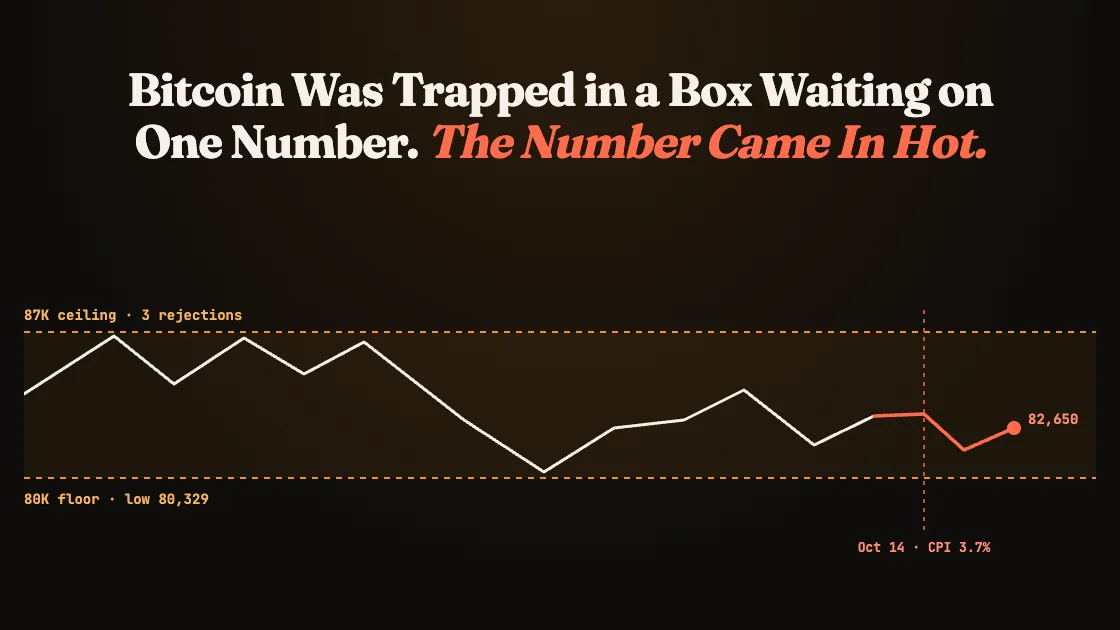
Bitcoin Was Trapped in a Box Waiting on One Number. The Number Came In Hot
A ceiling near 87K, a floor near 80K, and $800 million of liquidations in between. Then the September CPI ran hot, yields jumped, and Bitcoin slid under 82K. Here is how the range was built and how it broke. None of this is financial advice. Prices and levels in this piece are as of October 14, 2026. Bitcoin and bond yields move daily.