BlackRock Just Launched the Product Michael Saylor Spent 6 Years Saying Was Impossible
On June 16, 2026, BlackRock launched a Bitcoin product that pays you to hold it. The iShares Bitcoin Premium Income ETF, ticker BITA, began trading on Nasdaq after the SEC granted effectiveness the evening before.
Last verified Also on Medium

On this page
- The Backdrop Makes the Timing Brutal
- What BlackRock Actually Built
- Goldman Is the Aggressive Version
- What Strategy’s Moat Actually Was
- The Premium Did Not Die By Accident. It Was Attacked Twice.
- The Cracks Are Not a Forecast
- STRC Fell Below Par
- They Sold Bitcoin for the First Time Since 2022
- The Honest Counterweight
- What These Products Actually Take From You
- The Synthesis: Validation or Domestication
- What to Watch From Here
On June 16, 2026, BlackRock launched a Bitcoin product that pays you to hold it. The iShares Bitcoin Premium Income ETF, ticker BITA, began trading on Nasdaq after the SEC granted effectiveness the evening before. Goldman Sachs is roughly two weeks behind with a version that is structurally far more aggressive.
Most of the coverage of this launch is reading it as Wall Street finally blessing Bitcoin. The asset class has matured, the thinking goes, and now everybody wins. That framing misses what is actually happening here. These products are built to compete directly against the one feature that made Strategy, the company formerly known as MicroStrategy, worth paying a premium for in the first place. The cracks in that premium are already visible in the company’s own filings.
This piece walks through exactly how the new income products work, why they represent a genuine structural threat to Strategy’s business model, and the deeper question about what happens to Bitcoin’s character when the largest institutions in finance start packaging it as a yield product.
The Backdrop Makes the Timing Brutal
Bitcoin has fallen sharply from its all-time high of $126,198 set in October 2025, trading well below $65,000 through most of June 2026. Strategy’s stock fell alongside it, dropping toward the low $100s from levels well above that earlier in the year, per the analyst rating updates referenced later in this piece. This is not a celebratory backdrop. It is a cold, risk-off market, and it is against exactly this environment that the two most powerful names in asset management decided to plant their flags in the territory Strategy spent six years building.
What BlackRock Actually Built
The product is officially the iShares Bitcoin Premium Income ETF, trading under the ticker BITA. It is actively managed and holds a mix of spot Bitcoin and shares of BlackRock’s own flagship spot Bitcoin ETF, IBIT. The fund then writes call options on roughly 25 to 35% of those holdings each month.
For anyone unfamiliar with how a covered call actually functions, here is the plain version. Picture you own a house in a neighbourhood that might be about to boom. Selling a covered call is agreeing today to sell that house at a fixed price down the line, and collecting a cash payment right now in exchange for making that promise. If the neighbourhood triples in value, your buyer captures that gain, not you. But you already cashed your check regardless of what happens next. That is BITA in essence. It rents out a portion of Bitcoin’s future upside to options buyers for cash today, then distributes that cash to shareholders as monthly income.
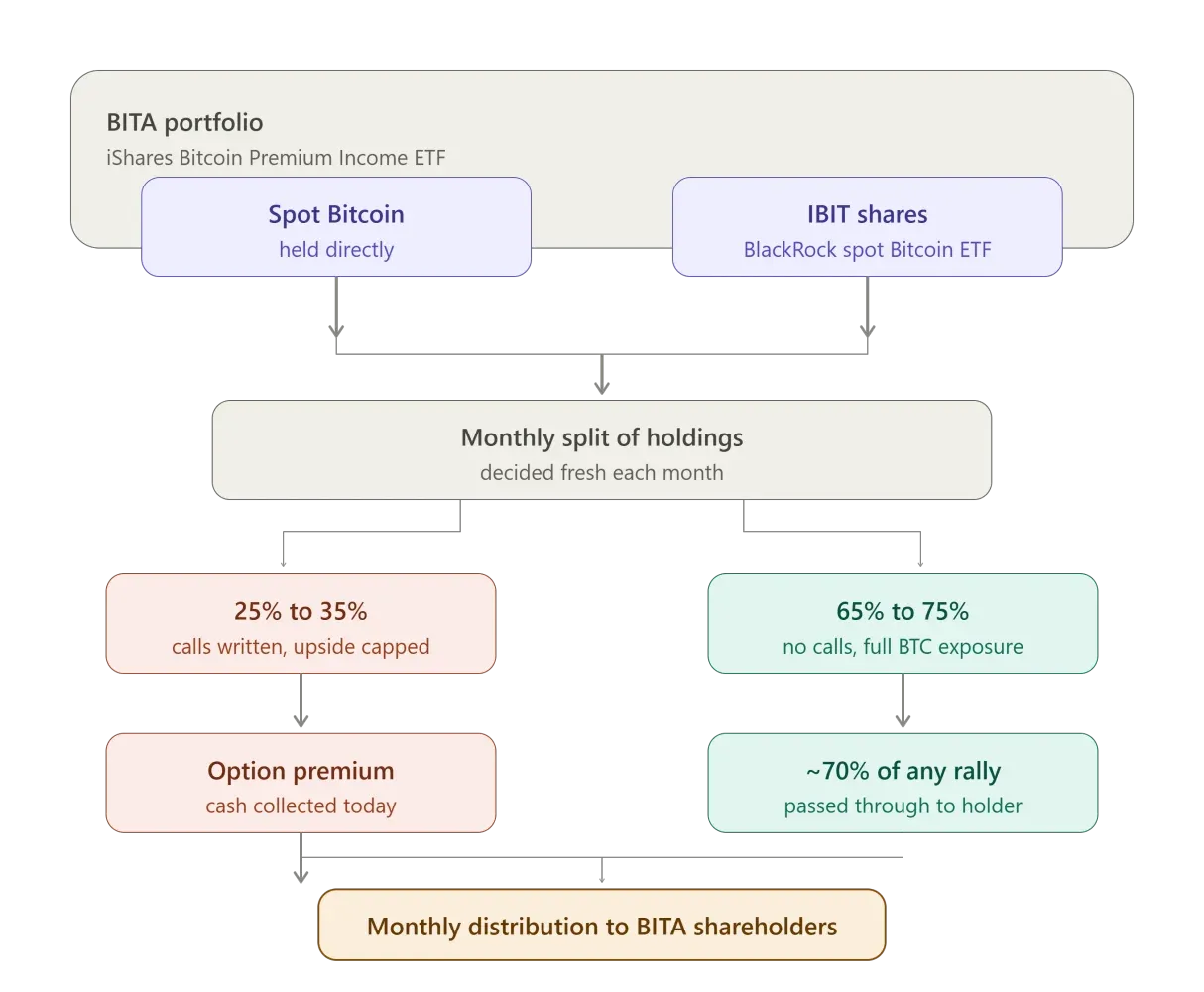
The fund targets an annualised yield of 15 to 25%, aiming to retain at least 70% participation in Bitcoin’s price appreciation. The management fee is 0.65%, a number that is deliberately positioned. Existing Bitcoin covered call funds like Roundhill’s YBTC charge approximately 0.95%, and Neos’s BTCI charges 0.99%. Grayscale’s comparable product sits around 0.66%. BlackRock walked in and undercut nearly every existing competitor in the category. This is the identical playbook that let IBIT capture dominant market share in the spot Bitcoin ETF race: lower the fee, lean on the brand, squeeze the incumbents.
BlackRock’s Chief Investment Officer of Global Fixed Income, Rick Rieder, appeared on Bloomberg the day of launch and said directly, “I think bitcoin is ultimately going considerably higher.” The product’s design and the executive’s framing both point in the same direction: this is BlackRock positioning Bitcoin as a standard, yield-bearing component of institutional portfolio construction rather than a purely speculative bet.
Goldman Is the Aggressive Version
If BlackRock’s product is Bitcoin with training wheels, Goldman Sachs is building Bitcoin in a straitjacket. Goldman filed for its own Bitcoin income ETF on April 14, 2026, and Bloomberg’s ETF analyst Eric Balchunas has projected a launch around July 1. The fund’s actual prospectus language, confirmed independently by The Block and several other outlets, states the overwrite level will typically run between 40% and 100% of the fund’s Bitcoin exposure, compared to BlackRock’s 25 to 35%. Unlike BlackRock’s BITA, Goldman’s fund will not hold Bitcoin or IBIT directly. It invests in spot Bitcoin ETPs and sells call options against those holdings.
Think carefully about what 100% means in practice. At full overwrite, the entire position has its upside sold away. The fund stops functioning as a Bitcoin exposure vehicle and becomes a pure income instrument, optimised for maximum yield with essentially no participation in the next major rally. Goldman is targeting a different client base entirely, high-net-worth private wealth clients who want the label of Bitcoin exposure combined with the predictable behaviour of a bond.
Two of the most powerful institutions in finance are now selling versions of the same fundamental pitch. Bitcoin pays you. Neither of them needs Strategy to make that happen.
What Strategy’s Moat Actually Was
To understand why these products represent a genuine threat rather than a neutral development, you need to understand what made Strategy valuable in the first place.
Before spot Bitcoin ETFs existed, Strategy was the most practical way to get Bitcoin exposure inside a standard brokerage account or retirement vehicle. It traded on major exchanges, received standard equity analyst coverage, and offered leveraged exposure through convertible debt and preferred stock issuance. Investors paid a substantial premium for that convenience and leverage. This premium is measured by a ratio called MNAV, the company’s market value divided by the value of the Bitcoin it actually holds. Multiple market trackers confirm that MNAV peaked at approximately 3.89 times in late 2024, meaning investors were paying nearly $4 for every $1 of Bitcoin the company held.
That premium funded an entire mechanism known as the flywheel. Strategy traded at a substantial premium, the company issued new shares at that inflated price, used the proceeds to buy more Bitcoin than the new shares represented in underlying value, and Bitcoin per share rose for every existing shareholder. The premium justified more share issuance. More issuance funded more Bitcoin purchases. The cycle repeated.
This mechanism only works above a specific threshold, roughly where MNAV equals 1.0. Above that line, issuing new shares to buy more Bitcoin is accretive, meaning it adds Bitcoin-per-share value for existing holders. Below it, every new share issued actively destroys Bitcoin-per-share value for the people who already hold the stock, because the company is selling equity worth less than the Bitcoin backing it.
Where Strategy trades today depends on which date and which calculation method you use, and the live trackers do not fully agree with each other. FinanceFeeds reported an mNAV of 0.70x in mid-June 2026, meaning the stock traded at a discount to its Bitcoin holdings at that moment. bitcointreasuries.net showed a basic mNAV of 0.66x and a diluted mNAV of 0.71x as of June 22, 2026, alongside an enterprise-value mNAV of 1.08x, a different calculation that includes debt. mNAV.com’s live tracker showed 1.07x a few days later. What all three trackers agree on is the trajectory: a collapse from the 3.89x peak to a range hovering near or below 1.0x, the exact line where new share issuance stops adding value and starts destroying it for existing shareholders.
The Premium Did Not Die By Accident. It Was Attacked Twice.
The first wave came in January 2024, when spot Bitcoin ETFs including IBIT launched and eliminated the convenience argument entirely. There was no longer a reason to pay a premium for Strategy stock when an investor could buy spot Bitcoin exposure directly through an ETF charging a fraction of a percent.
The second wave is happening right now. BITA and Goldman’s equivalent product are eliminating the income argument. There is no longer a clear reason to hold Strategy’s complicated preferred stock structure for yield when BlackRock offers 15 to 25% annualised income in a simple, liquid ETF wrapper from one of the most trusted names in finance.
The question this raises is direct. What exactly is Strategy for anymore, if the convenience argument and the income argument have both been answered by larger, cheaper, more liquid competitors?
The Cracks Are Not a Forecast
STRC Fell Below Par
STRC, Strategy’s variable rate perpetual preferred stock, was designed to trade near its $100 par value and was meant to be the next stage of the flywheel, pulling in income-focused capital to fund continued Bitcoin purchases. On June 3, 2026, STRC fell below the $95 threshold, triggering a contractual obligation to raise the dividend rate by 0.5% on all outstanding shares, adding approximately $53 million in annual dividend costs. The stock has continued sliding since.
When STRC trades meaningfully below par, issuing new shares to raise capital becomes dilutive rather than accretive, the same mechanical problem that broke the common stock flywheel. The capital-raising engine that was supposed to fund continued Bitcoin accumulation through this instrument has effectively stalled. The KuCoin analysis found that Bitcoin purchases funded through the STRC mechanism collapsed from 1,420 BTC in March 2026 to just 1 BTC in May 2026.
They Sold Bitcoin for the First Time Since 2022
Between May 26 and May 31, 2026, Strategy sold 32 Bitcoin for approximately $2.5 million at an average price of $77,135 per coin, as disclosed in an 8-K filing. The dollar amount is trivial against a stack of more than 800,000 coins. The significance is entirely symbolic. This was the company’s first disclosed Bitcoin sale since 2022, breaking the never-sell commitment that had been the foundational identity of the entire enterprise.
The reason for the sale makes it worse rather than better. Strategy sold Bitcoin specifically to fund STRC dividend payments. Michael Saylor’s first public comment after the disclosure focused on STRC rather than the Bitcoin sale itself, stating, “Our goal is to make STRC the best credit instrument in the world.” Forbes reported that STRC’s monthly dividend obligations run roughly $80 to $90 million, and that the sale was framed internally as a deliberate signal to credit rating agencies that Strategy treats preferred holders as a senior commitment, intended to make the instrument more attractive to fixed-income investors.
As of May 31, 2026, Strategy held 843,706 Bitcoin with an aggregate purchase price of $63.87 billion and an average cost basis of $75,699 per coin. The company’s US dollar reserve, established in December 2025 specifically to support preferred dividends and debt service, stood at $900 million as of the same date.
The Honest Counterweight
Laying out the bear case without the bull case would be incomplete, and the bull case here is genuinely substantive rather than wishful thinking.
Strategy still holds more than 4% of the entire circulating Bitcoin supply. That is an extraordinary concentration of the asset under one corporate umbrella, representing a war chest that no covered call ETF can replicate. TD Cowen analyst Lance Vitanza raised his price target to $400 on May 19, 2026, maintaining a buy rating, citing accretive balance sheet actions and continued capital markets access. Cantor Fitzgerald analyst Ramsey El-Assal has repeatedly reaffirmed an Overweight rating, most recently maintaining a $212 price target. Benchmark’s Mark Palmer has set a $570 target, the highest among major covering analysts. None of these ratings argue the death spiral narrative is unfounded; they reflect a genuine range of professional opinion on how the company’s balance sheet risk should be priced, with targets spanning from $212 to $570 across the analysts actively covering the stock as of late May 2026.
Here is the bulls’ strongest argument, the one feature that BITA and Goldman’s product structurally cannot offer: leveraged, uncapped upside. If Bitcoin experiences a significant rally, Strategy’s structure, built on convertible debt and equity issuance rather than option-selling, gives shareholders explosive participation in that move. A covered call ETF, by design, caps that participation. The honest assessment is that this entire situation hinges almost entirely on where Bitcoin’s price goes from here.
What These Products Actually Take From You
Step back from the Strategy-specific story and consider what the covered call income products do to an investor who buys them, regardless of what happens to Strategy.
The reason most people buy Bitcoin in the first place is asymmetric upside, the possibility of a multiple-fold return in a non-sovereign asset that nobody can print more of. Covered call products sell exactly that feature away. Research firm 10x Research has described products like these as yield traps. The logic is straightforward and somewhat brutal: these funds are contractually obligated to write calls regardless of market conditions. So in precisely the scenario that motivated most Bitcoin buyers in the first place, a genuine melt-up rally, the fund systematically hands the majority of those gains to whoever purchased the call option on the other side of the trade.
This pattern has a long, well-documented history in equity markets. Covered call income funds like the Nasdaq-100 focused QYLD have consistently and substantially lagged the underlying asset they are built on during strong bull market periods. They function as income tools, not growth engines, and that distinction matters enormously depending on what an investor is actually trying to achieve.
There is an irony embedded inside the product design itself. These funds are marketed as taming Bitcoin’s volatility, but the attractive yield only exists because Bitcoin is volatile in the first place. The option premiums are rich precisely because the underlying asset is wild. If Bitcoin’s volatility genuinely declines over time, the yield these products generate declines with it.
Consider who actually benefits from this structure. The fund issuer collects its management fee on a growing pool of assets regardless of whether the underlying strategy outperforms or underperforms. The options buyer on the other side of each contract captures the upside the fund holder sold away. The retail or institutional buyer of the fund receives a steady monthly distribution, a smoother ride, and a front-row seat to a rally they participate in only partially. The structure profits multiple parties simultaneously, which is precisely how a well-designed financial product is supposed to work, and worth understanding clearly before deciding whether it fits your objective.
The Synthesis: Validation or Domestication
Bitcoin began as something genuinely wild. Volatile, asymmetric, ungoverned, paying no yield, requiring no institutional permission to hold or transfer. Michael Saylor’s entire corporate strategy was built on the bet that he could become the bridge connecting that wild asset to conservative institutional capital, that the money would have to flow through his specific structure to reach Bitcoin in a form institutions found palatable.
That bet is not playing out the way it was designed to. The institutions did not adopt Saylor’s bridge. They are building their own. IBIT captured the convenience argument in 2024. BITA and Goldman’s equivalent are capturing the income argument right now. In the process, the largest asset managers in the world are reshaping what Bitcoin actually behaves like to most of the capital that touches it, converting its defining feature, explosive and unpredictable upside, into a smooth, quarterly-friendly yield stream that fits comfortably inside a pension fund’s mandate.
Instead of setting a genuinely novel asset free into institutional portfolios on its own terms, the largest distribution networks in finance are packaging it into something that behaves increasingly like a utility stock with better marketing. Saylor bet his company on being the essential bridge. The institutions with the actual distribution muscle are building parallel bridges and charging their own toll to cross them.
What to Watch From Here
5 specific developments will determine which version of this story is correct.
- Watch Strategy’s MNAV. If it climbs back above the 1.22 break-even threshold, the flywheel can theoretically resume and the bull case gains real support. If it remains stuck below that line, every additional capital raise continues bleeding value from existing shareholders.
- Watch STRC and whether it claws back toward its $100 par value. A recovery reopens the capital-raising engine that has stalled. Continued weakness intensifies the dividend pressure the company is already managing carefully.
- Watch for any additional Bitcoin sales beyond the initial 32 coins. That sale was symbolic rather than financially material. A second, larger sale would represent meaningful confirmation that the structural pressure is real rather than a one-time signalling exercise.
- Watch Goldman’s launch around July 1 and whether its more aggressive 40 to 100% overwrite structure pulls meaningful income-focused capital away from Strategy’s preferred stock lineup permanently.
- Watch the Bitcoin price itself, since it remains the single variable that determines the outcome of essentially everything else on this list.
Whether BlackRock and Goldman represent genuine validation of Bitcoin as a permanent institutional asset class, or the quiet domestication of an asset specifically designed to resist that kind of institutional capture, depends almost entirely on where the price goes from here and whether Strategy’s premium model can survive long enough to find out.
Sources
- SpottedCrypto: BlackRock BITA Bitcoin Income ETF Launch Details — Fee structure at 0.65%, S-1/A filing timeline, comparison to YBTC and BTCI fees.spotedcrypto.com. Accessed 1 July 2026.
- KuCoin: BlackRock Launches BITA Bitcoin Premium Income ETF — June 16, 2026 launch confirmation, fund structure, 25 to 35% overwrite mechanics.kucoin.com. Accessed 1 July 2026.
- Investing.com : Covered Call Bitcoin ETFs Test Demand Beyond Pure Spot Exposure — SEC effectiveness date June 15, 2026. Fee comparison across YBTC, BTCI, and Grayscale BPI. 15 to 25% yield target detail.investing.com. Accessed 1 July 2026.
- Cryptonomist: BlackRock Bitcoin Premium Income ETF Eyes 2026 Launch — Goldman Sachs April 2026 filing confirmation and July 1 expected launch window, per Bloomberg analyst Eric Balchunas.en.cryptonomist.ch. Accessed 1 July 2026.
- Bitcoin Magazine: BlackRock Begins Bitcoin Income Fund Built on Covered Calls — Rick Rieder direct quote on Bitcoin’s outlook. Section 1256 tax treatment detail.bitcoinmagazine.com. Accessed 1 July 2026.
- CoinDesk: Strategy Sold 32 BTC for $2.5 Million in Late May Filing — 8-K filing detail, sale dates May 26 to 31, average price $77,135 per coin.coindesk.com. Accessed 1 July 2026.
- CoinDesk: Michael Saylor Breaks Silence After Strategy Sells $2.5 Million in Bitcoin — Saylor’s direct quote on STRC as a credit instrument.coindesk.com. Accessed 1 July 2026.
- The Globe and Mail: Strategy Highlights Bitcoin Holdings and Preferred Dividend Actions — Holdings of 843,706 BTC as of May 31, 2026. $900 million USD reserve confirmation.theglobeandmail.com. Accessed 1 July 2026.
- KuCoin: Strategy STRC Preferred Stock Drops Below $95 — STRC de-anchoring mechanics, 0.5% mandatory dividend increase trigger, monthly BTC purchase collapse from 1,420 to 1.kucoin.com. Accessed 1 July 2026.
- Forbes: Strategy Sells Bitcoin to Signal Its Commitment to Preferred Holders — STRC’s $80 to $90 million monthly dividend obligation context. Rating agency signalling rationale.forbes.com. Accessed 1 July 2026.
- FinanceFeeds: Strategy Stock Price Prediction — mNAV at 0.70x as of mid-June 2026. Holdings of 845,256 BTC worth $69.24 billion.financefeeds.com. Accessed 1 July 2026.
- bitcointreasuries.net : Strategy Bitcoin Holdings and Analysis — Live mNAV tracker, basic 0.66x, diluted 0.71x, enterprise-value 1.08x as of June 22, 2026.bitcointreasuries.net. Accessed 1 July 2026.
- mNAV.com : Strategy Live Premium to Bitcoin NAV — Live mNAV tracker showing 1.07x, illustrating how the ratio varies by calculation method and date.mnav.com. Accessed 1 July 2026.
- The Block: Goldman Sachs Files for Bitcoin ETF That Invests in Other Bitcoin ETFs — Original April 14, 2026 filing confirmation and direct prospectus language on the 40 to 100% overwrite range.theblock.co. Accessed 1 July 2026.
- MSN / 10x Research: BlackRock’s New Bitcoin Volatility ETF Called a Yield Trap — Direct attribution of the yield trap criticism to BITA specifically, with implied volatility compression analysis.msn.com. Accessed 1 July 2026.
- CoinCentral: TD Cowen Lifts Strategy Price Target on Bitcoin Accumulation — Lance Vitanza’s $400 price target dated May 19, 2026, with rationale.coincentral.com. Accessed 1 July 2026.
- GuruFocus: MSTR Reiterated by Cantor Fitzgerald — Ramsey El-Assal’s Overweight rating and $212 price target, alongside Benchmark’s $570 target for comparison.gurufocus.com. Accessed 1 July 2026.
Related stories

Crypto & markets
Wall Street Filed an Automatic Bitcoin Buyer. It Runs on Stock Dividends.
On June 18, 2026, Franklin Templeton, a $1.5 trillion asset manager founded in 1947, filed registration statements with the SEC for 2 exchange-traded funds built around one of the oldest and most boring ideas in finance. A dividend reinvestment plan. The twist is where the dividends go.
Crypto & markets
Bitcoin Is Down 53% From Its Peak With Every Macro Reason to Rally.
Bitcoin dipped to an intraday low of $59,100 on June 5, 2026, its lowest level since September 2024, marking a 53% collapse from the $126,272 all-time high it set in October 2025. The Block confirmed Bitcoin trading near $60,750 on June 28, down more than half from its October peak.

Crypto & markets
Richard Heart Beat the SEC on a Technicality, Then His Own Tax Office Caught Up With Him in…
On 14 October 2026, Turkish police arrested the founder of Hex and PulseChain on an Interpol red notice issued for Finland, which suspects him of gross tax evasion. He had walked away from a $1 billion SEC case 18 months earlier, not because a court cleared him, but because the judge found no US jurisdiction. I went through the whole arc, the sacrifice mechanism, the allegations, the dismissal that was not an acquittal, and a blockchain whose biggest customer was its own founder.